
Are You Anxious? Me Too.

Do you agonize over every word before sending an email? Have you ever worried that others would notice that you’re sweating? Do you ever trip over your words because you’re focusing more on the facial expressions of the listener? Do you ever wish you could melt into a wall at a networking event and just disappear?
I know. It sucks, right?
For much of my life, wherever I was…I was anywhere but where I was sitting.
My mind rocketed into the future or leaped backwards in time. I was constantly overanalyzing guilt into the past and catastrophizing failure into the future. I had one foot in the past, one foot in the future, and I was pissing all over the present.
When I was a kid, I was a certifiable ginger — complete with bright orange hair and freckles. I was a slow learner, I was shy and I was picked on constantly. In social situations, I often tensed up, froze and felt unable to just act like everyone else.
I tell you all of this so you know that I can relate. I was nervous as hell, constantly. I couldn’t get out of my own head, let alone out of my own way. I learned to power through my insecurities and negative self-talk to have a successful career in public relations…but my calm demeanor was often a façade. The reality is that, despite my career success, I could still get caught in analysis paralysis on the inside.
“Every human being is vulnerable to anxiety,” writes Dr. Peter Breggin in “Guilt, Shame and Anxiety,” a book about techniques to overcome negative emotions. “When we admit to being vulnerable to anxiety, we can renew our genuine determination to work hard toward mastering our emotions and our lives.”
Only recently, after quitting my senior-level job and leaving the industry, did I actually take the time to slow down and address my anxiety in therapy. I’m not going to go into detail about the body’s cascading physiological response when confronted with an extreme stressor, but I do want to share a few insights that just might help you.
Before you react in your next anxiety inducing situation, try what worked for me. Hit the pause button and ask yourself four simple questions.

What is the source of your stress?
To someone on the brink of a panic attack this might sound ridiculous, but identifying and naming your stressor actually does take some of its power away. When you know what you’re dealing with — when you know what’s causing your mind to run away with your pulse — you are giving yourself the chance to regain control.
Think about it for a second. The worst anxiety and stress I’ve ever had was when I couldn’t put my finger on the source. I felt helpless and completely out of control. But when I figured out what was making me worry so much, I always felt a little bit better. By pinpointing the issue, I could determine whether or not my response was reasonable as well as give myself an opportunity to address the issue and take proactive steps toward a solution.
Naming your stressor is the first step to regaining power over it.
Am I concerned about what others will think about me?
If you’re like me, most of the time when I get trapped in my own head, I’m worried that others are looking for reasons to judge me harshly. The reality is that 7 times out of 10 (or more) — we are the last thing on someone else’s mind. Other people tend to also be absorbed with their own self-centered issues.
If some random guy passes you on the sidewalk with a scowl or a frown on his face, in all likelihood, the scowl is probably not directed at you. As human beings, we want to interpret what we experience in relation to the self — so it’s only natural to think that his expression is directed at you. There are, however, a million other possible reasons for his scowl. He’s probably just listening to a political podcast…
Besides, even if he is giving me the stink eye, who cares what that guy thinks? He’s just some random dude on the street. What do I care? Do I really want a stranger to ruin the rest of my day?
The opinions of others can be so powerful to an anxious mind because it’s easy to view them as a reflection of the self. I had always sought out external validation to build up my self-esteem — so I was especially vulnerable on this front.
One of the most powerful things I’ve learned in therapy is that whatever someone is saying to me — no matter how rude, nasty or downright evil — is not a reflection of me.
The words of others are a reflection of them and what is going on inside them at that very moment.
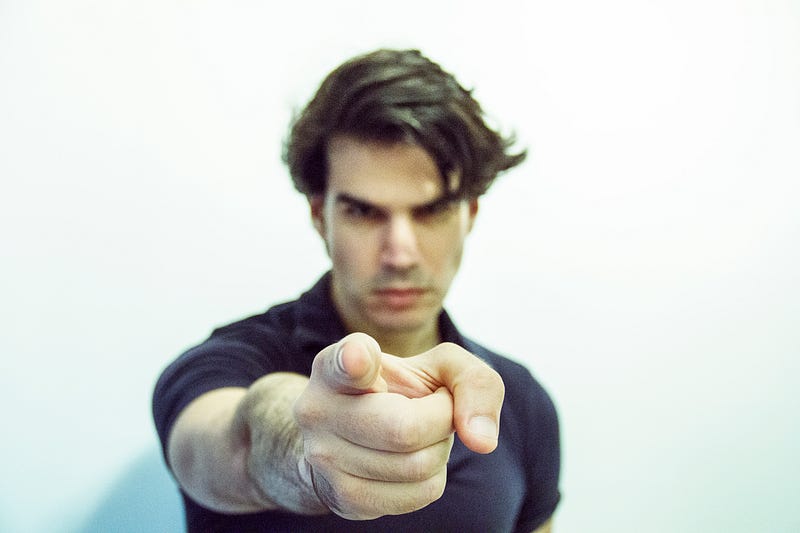
Do I want ____ to control my emotions and stress level?
When we get anxious, we are allowing an external stressor — a person, thing or situation — to control our level of physiological, cognitive and emotional stress arousal.
According to Dr. Elizabeth Stanley in “Widen the Window,” her terrific book about overcoming trauma and stress, our brain “will perceive greater threat — and thus greater stress arousal — if it perceives stressors as novel, unpredictable and threating to our ego, our sense of self or the survival of our mind-body system.”
In many cases, that annoying stressor can be an unpredictable person or their less-than-helpful behavior. Manipulative people, in particular, can try to get their way by provoking reactions from or rattling others. It gives them a perverse sense of power and “having the upper hand.” Often bullies and manipulators will push buttons, pressure and bait others into angry or flustered reactions, which they then use as leverage to get you to do something for them (while, of course, denying any bad behavior on their part).
While we don’t want to admit it, we don’t really have much control over other people’s behavior and actions. What we can control, however, it how we respond to their actions. So, the question becomes, do we want to hand over the keys to our physiological and emotional castle to someone who’s being rude or nasty with us?
My therapist made this point to me like a Judo master, using my strong emotions to expose a fundamental error. I walked into my appointment hot under the collar about yet another snide email from my boss— someone we had already determined was toxic — and he asked me simply, “What do you think your boss is thinking about right now?”
I said, “He probably left work early (which he typically did), and I’m probably the farthest thing from his mind.”
“So then,” he asked. “Why are you giving him the power to control your emotions and anxiety levels when you leave the office?”
Given my feeling that I had been willfully mistreated once again, the last thing I wanted to do was agree with my therapist’s point, but, as usual, he was right. The power my boss had wielded over my anxiety levels and emotional state was power that I had given him. Thinking about stress and anxiety from this perspective usually helps me to reclaim emotional control.
Why would I want to give more power to someone who is already pissing me off?
What’s the worst that could happen?
If I was a superhero, you could call me the Great Catastrophizer. In the blink of an eye, I can convince myself that the worst-case, most convoluted and unlikely scenario is somehow a legitimate and plausible outcome.
On top of that, I had tricked myself into believing that my worst-case thinking was justified purely because I had been right five times out of a hundred in the past. Those are some pretty bad odds. One way to overcome the cognitive distortion of catastrophizing is to actually calculate the likelihood of various outcomes.
Even ballpark odds estimations can remove the emotion and help to assess a situation more objectively and effectively.
“When we feel anxiety, there is usually no real threat,” says Dr. Breggin. “Anxiety has been restimulated from the past…The event itself is not [typically] the cause of the demoralizing emotion. Our mind has made an unconscious connection between the recent event and prehistoric stimulations of anxiety in childhood.”
Odds are that if you’re reading this, you’re probably not in a line of work associated with emergency or disaster response. So then, no one is probably going to die, right?
In the public relations business, we used to say, “it’s PR, not the ER!” Truth be told, some clients had a habit of running around like their hair was on fire, the sky was falling or someone was about to lose a limb — so it was important to step back and regain perspective.
“After anxiety has been identified, rejected and replaced with self-determination and confidence, the more recent event can be dealt with effectively,” writes Dr. Breggin.
In many cases, especially in America today, our job is what is causing us the most stress. The worst-case scenario in that case is typically losing a job. If your self-esteem is wrapped up in your profession, as mine was for a long time, it can make the loss of a job seem like a massive failure and the end of the world.
Don’t worry. It’s not. And let’s be honest, if you were stressing about your job so much already, maybe you actually didn’t really like it as much as you thought. It might be painful for a little while, but you’ll land on your feet. When you look back in two years, you’ll either have forgotten about the job or it will look like a fly on the ass of an elephant.
Besides the stressors mentioned above, there are many other real stressors that can be a challenge to manage. Exhibit A: The coronavirus pandemic. Exhibit B: The resulting loss of friends and family members, job insecurity and 24-hour media sensationalism. I have some tips on managing through coronavirus anxiety in the story below.
Can Coronavirus Cure What Ails America?
Remember that it never hurts to consult with a therapist, especially if you have severe anxiety. Long-term, sustained high levels of stress can do a number on your overall health, ranging from immune system deficiencies to chronic inflammation, sleep disorders, high blood pressure and cardiovascular disease (source: “Widen the Window”).
Some of our parents may have been raised to believe that seeking mental help is weakness. It’s not. It takes real strength and courage to ask for help, be vulnerable with your feelings and put in the hard work to shift away from negative thought patterns.
For more personal mental health stories, follow me @RussellWeigandt
###


