
Are You an Overly Authentic Person?
The Authenticity — Transparency Matrix Helps You Find Out

We place tremendous value on authenticity — who doesn’t want an authentic leader they can look up to, or an authentic human being as their best friend or life partner?
The leader who is not afraid to show his vulnerability yet conveys strength to overcome challenges makes a great role model. The friend who doesn’t hold back on telling you off for an unwise decision is worth holding on to.
Such individuals bring depth and real connection to the relationship table and make our personal and professional lives meaningful. Authenticity is extolled as a virtue, so is it really possible to be overly authentic?
Being overly authentic entails a need, almost a compulsion, to:
- Be honest about almost everything — thoughts, actions, feelings, desires, and goals
- Be on the outside, exactly who you are on the inside
- Habitually justify your actions, thoughts, and behaviors
- Accept a large part of blame and shame, even when you know you are only partially responsible
- Reject the idea of being judicious about or holding back information
Overly authentic people are actually being transparent, which means, they are conflating authenticity with transparency.
Authenticity has to do with one’s internal compass and self-awareness while transparency is a behavior. Being authentic means knowing and acknowledging who you are and acting in ways that are consistent with that true self. Being transparent means giving the world a wide open window into your life, thoughts, feelings, and actions.
While an authentic person may choose to be completely transparent at times, for specific reasons, it is a conscious decision made with the understanding that authenticity and transparency are different.
Fundamental to authenticity is self-awareness; you cannot outwardly express who you are without really knowing who you are.
Fundamental to transparency is the willingness to share details about yourself; these may or may not be true, depending on your degree of authenticity or self-awareness.
To avoid painting everyone with just two broad strokes, let’s use this Authenticity — Transparency Matrix.
On the Y-axis of this matrix is your measure of authenticity and on the X-axis is your measure of transparency. Depending on the degree of each, broadly four combinations are possible — Open Book, Discerning, Imposter, and Self-Unaware.
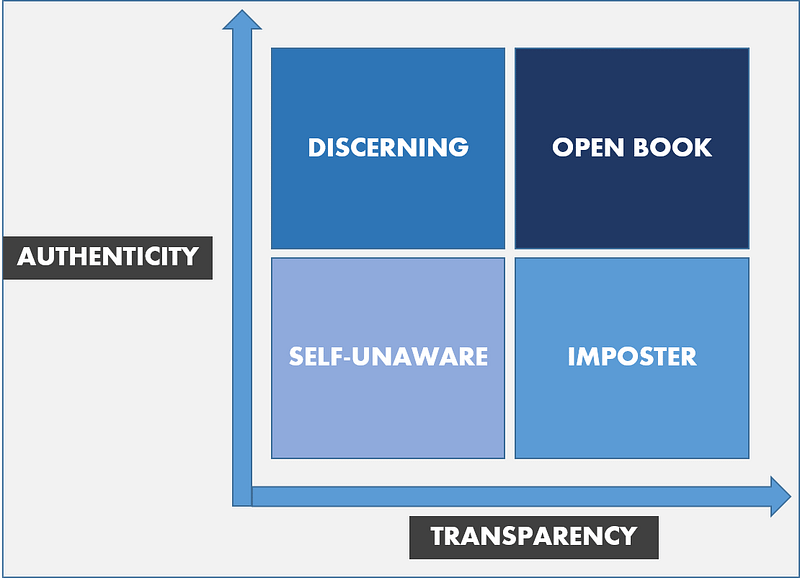
Open Book: If you are highly authentic, know who you are, your values, beliefs, and drivers and have no problems openly demonstrating behaviors that will show the world exactly who you are — you are an open book.
Everyone is aware of what you stand for and which hill you will to die on. You probably wear your emotions on the sleeve.
Consider what impact this has on your work and personal relationships and how this is positively or negatively impacting your life and the people around you. Brutal honesty or take-it-or-leave-it could be your hallmark.
Discerning: If you are highly authentic, moderately transparent and make good use of judgement about when to let the outer world get a glimpse into your inner world, you are discerning.
You are not being dishonest with yourself or others; rather, you recognize that not everything you think, feel, and do, needs to be shared with the world or on social media.
You are true to yourself and to the world; people around you know your values and who you are as a person but they probably don’t know your inner drivers, motivations, or the backstories that have shaped you (unless you chose to consciously share them). Good judgement or worldly wisdom could be your hallmark.
Imposter: The need for high degree of transparency combined with low authenticity indicates low self-awareness but a high need to display your actions, thoughts, and feelings to the world.
In doing so, you may fall into to trap of creating a pseudo reality to show people what you think they want to see and who they want to see you as. It is possible that people continue to believe your pseudo reality until something gives it away.
Many people go through their entire lives being imposters; some even choose to continue doing so consciously to keep up the façade. Although low on self-awareness, such individuals are quite in sync with the world; therefore, street smartness and adaptability could be their hallmark.
Self Unaware: With low degree of authenticity and low transparency, one might be tightly wound up, perhaps afraid of the world and/or scared about what will be discovered if one tries to look within.
Getting on with day-to-day life may be challenging. The lack of self-awareness, lack of understanding the driving forces behind one’s own actions could be causing confusion.
If you constantly find yourself asking, ‘what the heck is happening?’ and ‘why is this happening to me?’ or ‘what did I do, why is everyone being so weird?’; then it’s time for some deep reflection.
To be clear, these are questions everyone asks themselves once in a while, but if you are constantly struggling to answer these questions, lack of self awareness is probably the reason. The “Alice in Wonderland” feeling or constant fear might be your hallmark.
Which of the above quadrants do you fall into? Is that where you want to be? Is that where you are “optimally” authentic? Do you want to do anything differently, if so, why?
What is the driver behind wanting that change? It is the why that will also lead you to the how.