The scoop on the (pony) poop
Are You Absolutely Sure You Should Buy a British Pony For Your Child?
Better think twice — some are evil; most are neurotic; all have nasty habits
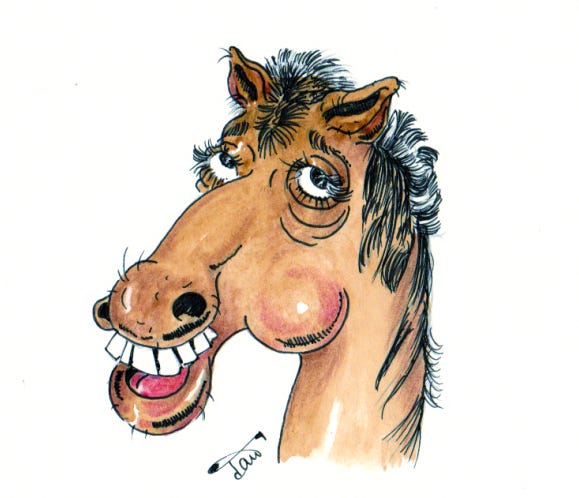
Before you take the plunge, please read this definitive (and tongue-in-cheek) guide to the characteristics and temperament of British native ponies.
When you go to meet your prospective new family member — and let’s face it, you are considering bringing a new personality, if not into your home exactly, but right into the paddock next door — you will have an idea which sort of predilection your chosen breed may be subject to.
Note: I have used ‘he’ throughout because geldings and stallions tend to strongly exhibit these characteristics; mares to a lesser extent. An exception, however, is in the case of the Welsh Mountain pony, where the indicated negative traits are more prevalent in mares and fillies.
A huge thank you to my talented sister-in-law, Jan, for the great cartoon horseys!
Let’s begin in the south of England
The New Forest Pony
The Labrador of the horse world
The New Forest pony is one of our larger breeds and considered ideal for the older child or teenager. With a reputation for being docile and willing as well as being an excellent jumper, he’s a very popular pony.
However, all is not sweetness and light. The semi-wild New Forest pony is capable of causing acute distress as he deftly relieves the unwary of their picnic. You will find traditional breed guides will trumpet the friendliness of this breed but be aware this is just a front. The New Forest pony uses pseudo-affection in order to obtain as much picnic food as possible.
The New Forest is also be difficult to catch due to his penchant for hiding in deep undergrowth. The experienced owner soon learns to recognise the steady, focused gleaming eye as the he plans his next move in order to scarf the pony cubes in your pocket. In one moment, the pony is lurking in the bushes, then you blink and he has stolen the food right out of your pocket and is already in the next meadow enjoying the spoils.
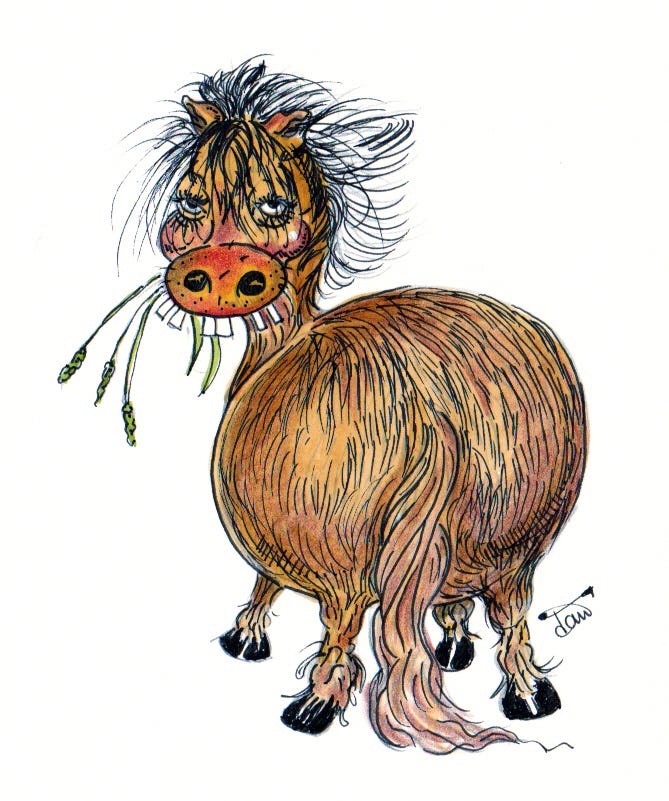
- Preferred Habitat: Behind a bush.
- Dietary Preferences: Ham sandwiches with butter (please don’t try and fool him with margarine), hard-boiled free-range eggs, chocolate digestives, HobNobs
- Susceptible to: Indigestion, obesity, being shunned at public events.
The Shetland
Not cute, not at all
Children love our small native breed, the Shetland. For some reason they see the wee, hairy beastie as cute, cuddly, and desirable. The Shetland pony is as strong as an ox with an equally strong will. They are stubborn, mulish, and hardy in extreme weathers. They also live to a ripe old age. As you can tell by the way the old ‘uns smell.
As a pack pony these characteristics are welcome, yet Shetlands are NOT suitable to spend time in the company of innocent children. These ponies have the unfortunate tendency to swear. Constantly muttering under his forelock, the Shetland curses in his deep island accent, which, fortunately, most civilised people are unable to understand. Beware, though, your children will soon become accustomed and when you hear them repeating, “Ach, awa’ wi ye, ye wee b******”, you will know exactly where it came from. Your only course of action is to sell the pony on as quickly as possible before the whole family becomes contaminated by the tiny demon’s influence.
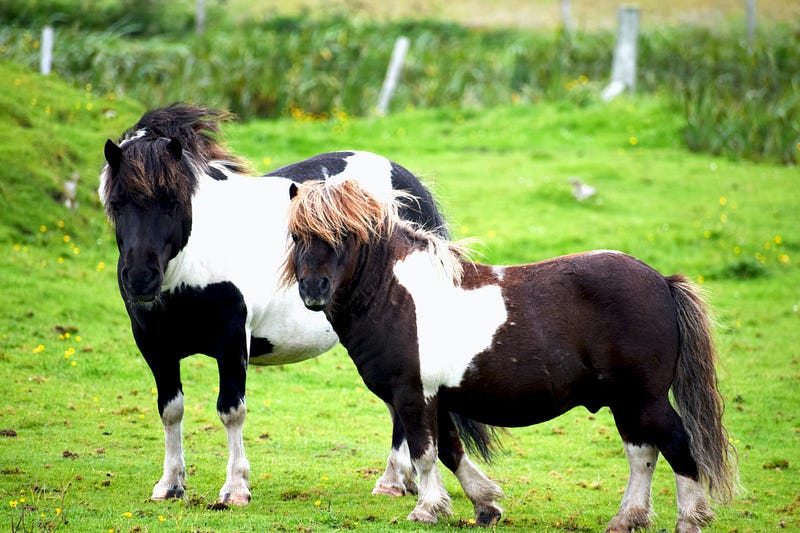
- Preferred Habitat: As far away from people as possible
- Dietary Preferences: Porridge (salted, not sweetened), good single malt
- Susceptible to: Anger, depression, speaking Gaelic, coprolalia.
The Fell Pony
Wanabee writer
The Fell pony hails from the Lake District in North West England. Sturdy and reliable, his reputation as a work and riding horse is unsurpassed. Sure-footed and even-tempered, he is a national favourite. Even the Queen has taken to riding a Fell pony in her later years.
It’s well to note that not all members of the breed share the above traits. Occasionally Fell ponies have been discovered wandering lonely as a cloud and reciting poetry to daffodils. It’s difficult to get these ponies to do any real work at all. They like to spend their days chatting in village shops and writing letters to the local paper before setting out on a leisurely hike up Scaffell Pike. Some even have aspirations to get into the tourist trade and open B&Bs.
Ponies bred near the Sellafield nuclear facility have a tendency to glow in the dark.
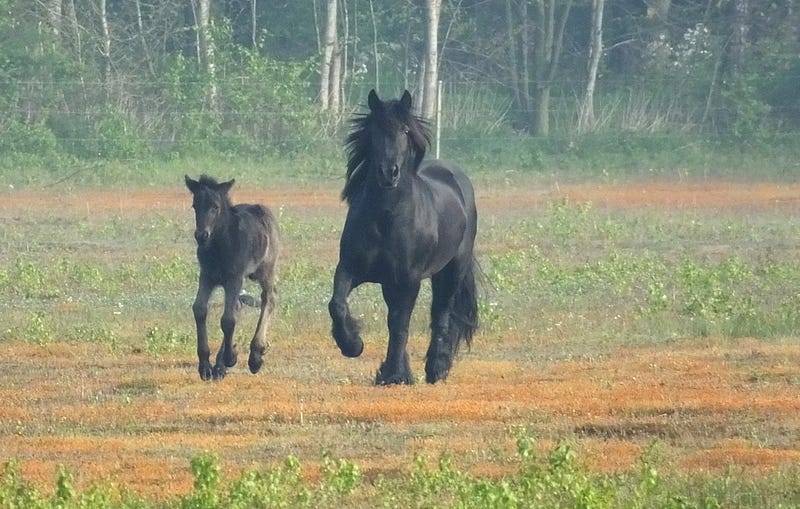
- Preferred Habitat: Tea shops or mountain paths
- Dietary Preferences: Scones with strawberry jam and cream. Strong tea from a flask
- Susceptible to: Literary pretensions, sensitivity to criticism, appearing on tourist information leaflets.
The Dales Pony
Solidarity among brothers
From the other side of the Pennines comes the Dales pony. Longer in the leg than the Fell, this breed does well in competitive sports such as long distance riding. The modern Dales pony owes his good gait to a Welsh Cob bloodline.
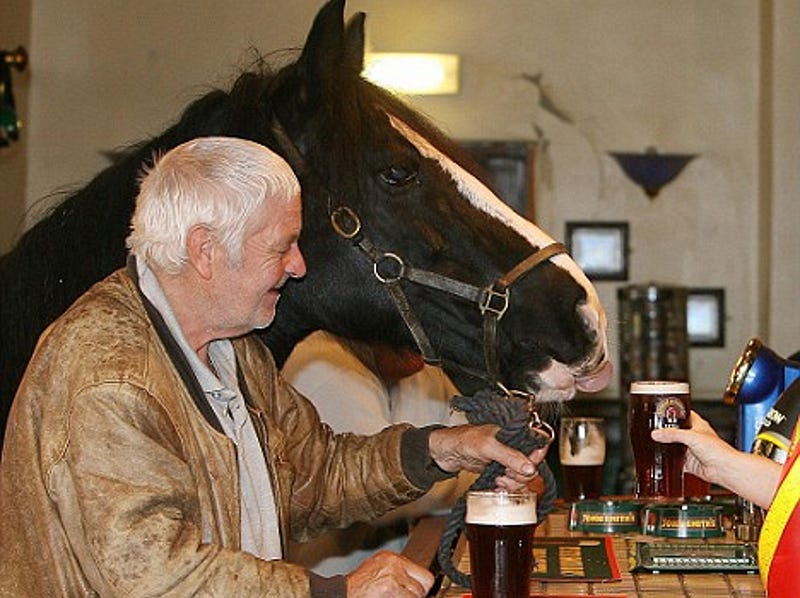
Negative characteristics of the breed are to be avoided. Ponies wearing flat caps and/or smoking pipes are dour, uncommunicative, and generally anti-social until they are in the pub with their mates. They tend to stick to same-sex groups, being somewhat traditional in their belief that females belong indoors. They also have an unwavering loyalty to their chosen trade union. In their favour, is the recent manifesto announcing the Dales’ complete dissociation from Jeremy Corbyn.
- Preferred Habitat: Working men’s clubs and allotments
- Dietary Preferences: Mashed carrots and turnips, Wensleydale cheese, Yorkshire pudding. John Smiths beer
- Susceptible to: Misogyny, moaning, socialism.
Author’s Note
There have been mutterings on a certain forum which shall be nameless, that the horse pictured above is not actually of the Dales breed. Well, hello, this is a humorous article! Poetic license and all that.
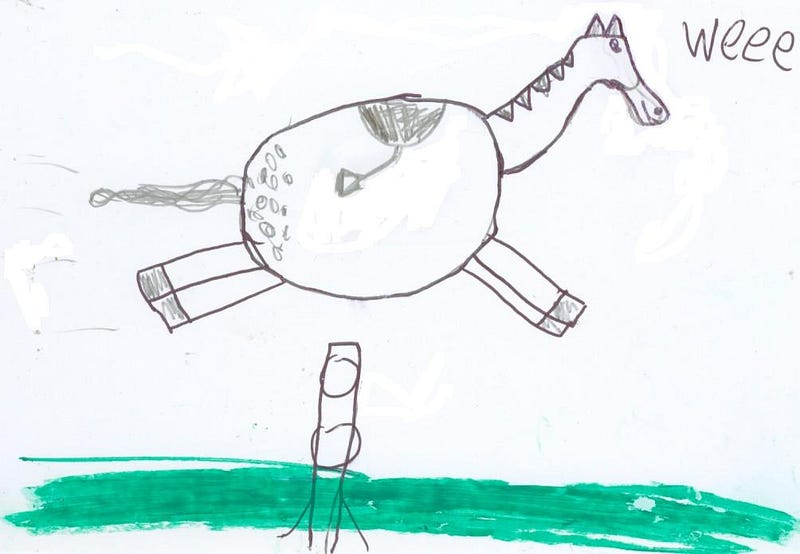
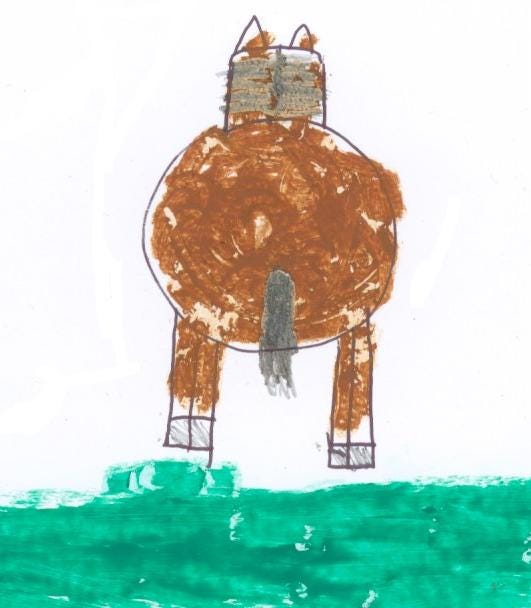
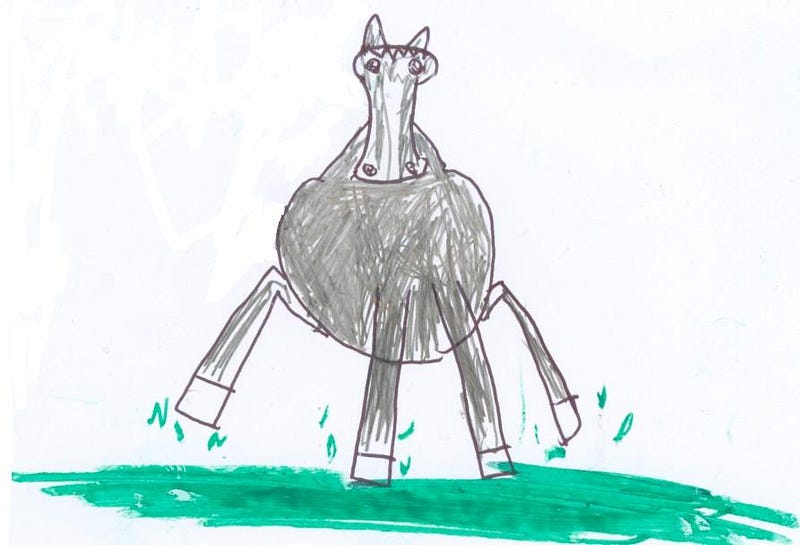
My son, Alex, has taken the ‘pity they didn’t use the right pic’ remarks to heart and has painstakingly produced some very accurate Dales pony portraits.
Hope you like them, Dales fans!
The Connemara
Has a drink problem
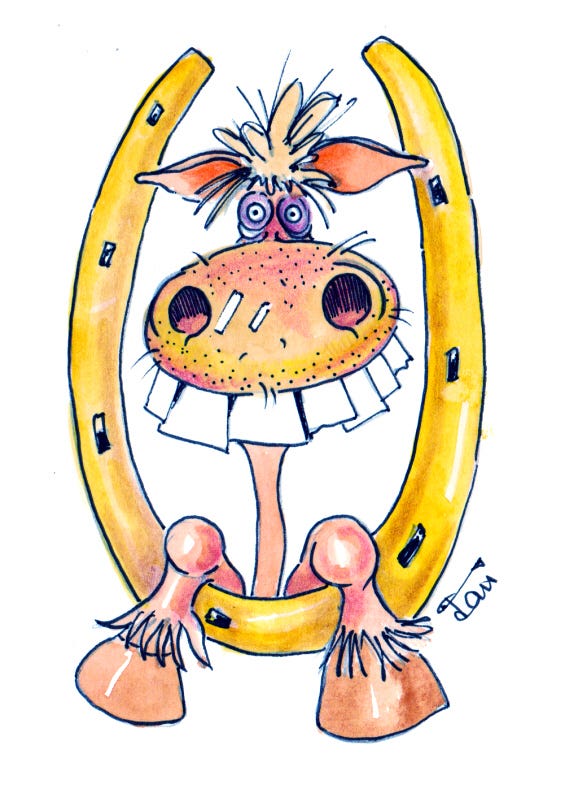
Often cited as the perfect pony for the beginner, the Connemara has a sweet expression and a reputation for being safe and reliable. With its gentle gait and easy-going personality, this breed is said to give confidence to nervous young riders.
Unfortunately these pleasant-seeming characteristics are mainly due to the fact that the Connemara is almost always drunk. Capable of sweet-talking his way into any bar, this is where he will spend most of the day. He regales both locals and visitors with tales, which are patently made up. And by the end of the night you’ll find him slumped in a stupor. Somehow he makes his unsteady way back to the bog and there lies unconscious until the need to quench his thirst drives him back to the nearest bar again.
- Preferred Habitat: Murphy’s Bar on the High Street in Galway
- Dietary Preferences: Draught Guinness
- Susceptible to: Gout, alcoholism, pickpockets.
The Dartmoor Pony
Smooth criminal
The Dartmoor pony is a great all-rounder and makes an excellent first pony.
Never growing above 12.2 hh, this pony is good-looking, hardy, and courageous. Sure-footed and calm in traffic, this breed will give any parent confidence their darling is safe. Indeed it is well-documented that many babies are put into the tender care of the family Dartmoor in lieu of a nanny.
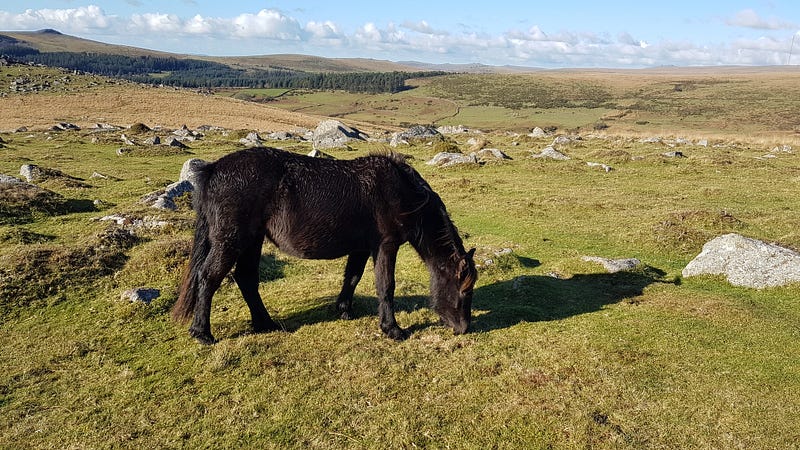
Of course, most Dartmoor ponies are paragons of virtue but occasionally a rogue pony will appear. This is due to the influence of Dartmoor prison at Princetown. Several Dartmoor ponies have been discovered helping prisoners escape and some have even taught themselves to drive. They steal vehicles from lone women driving over the moors late at night. Often these sorry individuals will turn to a life of crime. One famous example is a rock-thief and has never been caught (see photograph below showing the infamous criminal with his collection of stolen rocks).
- Preferred Habitat: On the open moor, usually disguised as a cow or sheep
- Dietary Preferences: Devonshire clotted cream, pasties, freshly-baked jam tarts stolen from an unguarded windowsill
- Susceptible to: Breaking the law, wearing prison overalls, a liking for fast cars.
The Exmoor Pony
Ducking and diving in the heather
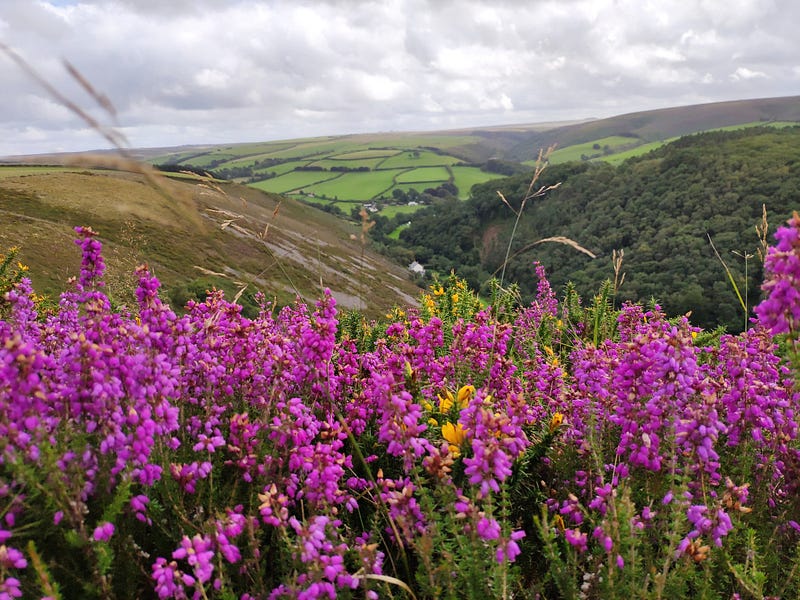
Another wonderful child’s pony, the Exmoor is extremely attractive with his mealy muzzle and dark colouring. This is the purest of our native breeds, having little contact with the outside world. Indeed, it is this elusiveness which makes the Exmoor an almost mythical creature.
And, this, I’m afraid is the main problem with the Exmoor. He lives in a constant state of terror, frightened of his own shadow. This unfortunate characteristic stems from the Royal Airforce using Exmoor for practice bombing during WW2. As a consequence, this poor animal is shy in the extreme. He prefers to live a solitary existence, leading the life of a hermit.
Dating is a nightmare, hence the low numbers. Occasionally, one has dared to make himself known as an eco-warrior. These souls are always vegan and spend their whole lives wearing flip-flops and dreadlocks. The mares of this breed are obsessed with Lorna Doone and will, occasionally, venture into the counseling professions.
- Preferred Habitat: Dark caves, up trees, in hiding
- Dietary Preferences: Lentils, home-grown organic vegetables, tofu
- Susceptible to: Loneliness, post-traumatic-stress-disorder.
The Highland Pony
Absolutely disgusting
The Highland is descended from wild pony breeds prevalent in the ice-age. Indeed he shares many physical characteristics with corresponding Scandinavian breeds, being stocky of build, hardy and usually light in colour. He often displays the primitive dorsal stripe along his back and some foals have ‘zebra’ legs.
He is very strong in the neck and can take some holding, so make sure your child undergoes some form of weightlifting training in order to attain the strength required to control this breed.
Like several of our other native breeds, the Highland can sometimes develop a weight problem. He happily enjoys a deep-fried Mars bar and, like his fellow Scot, the Shetland, a finger or two of finest single malt whisky.
All in all, with consistent schooling, the Highland pony is a pretty nice representative of our native breeds. However (and you knew there was going to be a ‘however’, didn’t you?), one of the nasty traits of this breed is its disgusting habit of spitting.
I’m sorry to say that Highland ponies have been witnessed spitting in the street, especially around pub closing time. After a few pints of beer he is likely to lose his sense of decency: shouting and singing incomprehensibly, demanding kebab and chips, attempting to muscle his way into nightclubs, and leering at females of any species. And spitting.
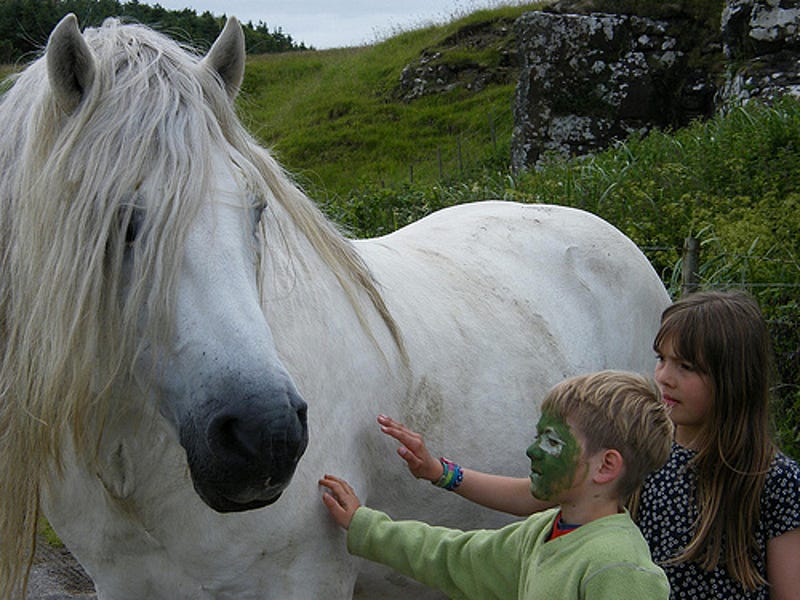
If you do happen to buy such an animal, you will have to keep it away from public view and probably away from your children too — just look at what happened to the poor young chap in the photo after his pony, true to form, spat right in his face. {Shudder}… not nice.
- Preferred Habitat: Watching TV, nightclubs, driving round town in a souped-up hatchback pounding out drum n’ base
- Dietary Preferences: Deep fried anything, donner kebabs, Carlsberg lager
- Susceptible to: Miserly tendencies, considering himself irresistible to the opposite sex, heart attacks.
The Welsh Cob
Likes to be the centre of attention
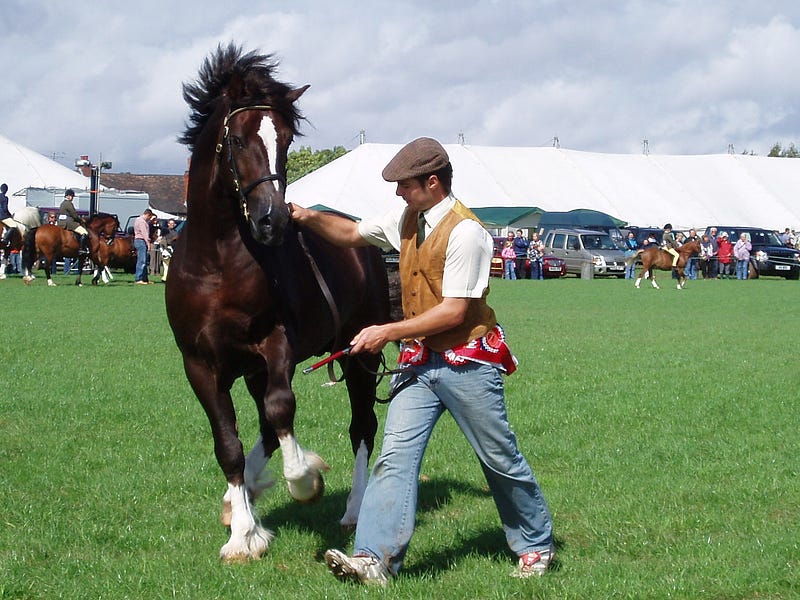
The Welsh Cob is Britain’s largest native breed and what a fine handsome fellow he is. Strong and showy, under saddle or in harness, he is everyone’s favourite, as his gleaming coat and flowing tail catches the late afternoon sun at the famous Royal Welsh Show. Although he is horse-sized, he still has that characteristic pony look — indeed, he is the perfect model for a child’s rocking-horse.
I’m glad to say the Welsh Cob does not have too many negative characteristics, and he is one of Wales’ best ambassadors. However, his one fault is that he does take his starring role just a little bit too seriously. Yes, I’m afraid the Welsh Cob is drawn towards that fickle mistress — show business. He is often driven (literally) into public performances which can include opera, film and TV acting, as well as stand-up comedy.
It is true he has a fine baritone singing voice and several of his breed have successfully integrated into the Treorchy Male Voice Choir. Unfortunately, it is a little embarrassing for us Welsh, to have to endure one reading the evening news on the BBC. We are enamoured, though, of the role of the Welsh Cob in the acclaimed sitcom, Gavin & Stacy and appreciate him as the host of ‘Would I Lie To You?’
I completely understand the temptation of purchasing one of these magnificent beasts, but be aware you may have to spend all your spare time driving up and down the M4, towing a horsebox, in order for him to fulfill his dreams of stardom.
- Preferred Habitat: On stage
- Dietary Preferences: Leeks, sushi, G&Ts
- Susceptible to: Breaking into song, liking the sound of his own voice, flattery.
Welsh Mountain Pony
Better than all the rest (she thinks)
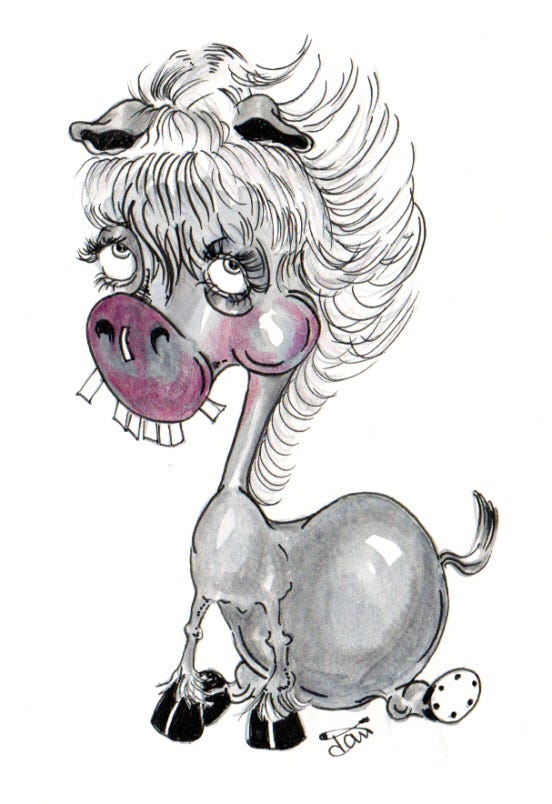
What can I say about this almost perfect pony? She has the looks, stamina, hardiness, and the willingness to qualify for the best child’s pony award. The Welsh Mountain has been improved by a smidgeon of Arabian blood over the years, resulting in a pony so beautiful she can reduce a grown man to tears. She also has the most wonderful soprano voice, capable of wowing the audience at the annual Welsh National Eisteddfod.
The only drawback to this delightful creature is her somewhat superior attitude. The Welsh Mountain is prone to sticking her nose in the air and pointedly ignoring anyone, human or equine, who she thinks is socially beneath her. This results in jeering and ridicule from her less blessed fellow natives.
On the other hand, the Welsh Mountain pony is so perfect, so angelic, so beautifully behaved that, upon occasion, she grows a single horn, sprouts wings and floats up to heaven, pooping rainbows as she goes, leaving an inconsolable child kicking and screaming on the ground.
- Preferred Habitat: Society weddings, French chateaus, high class cocktail parties
- Dietary Preferences: Champagne and candyfloss
- Susceptible to: Delusions of grandeur, over-fondness for My Little Pony.
I hope this guide is useful to you and helps prevent you making a costly and/or embarrassing mistake when selecting your child’s first pony.
Please post any bad experiences you have had with a British native pony breed — parents need to know.
First published on Squidoo by the author a long, long time ago.