
Who’s Phishing For You?
Are You A Shark Or Shark Bait?
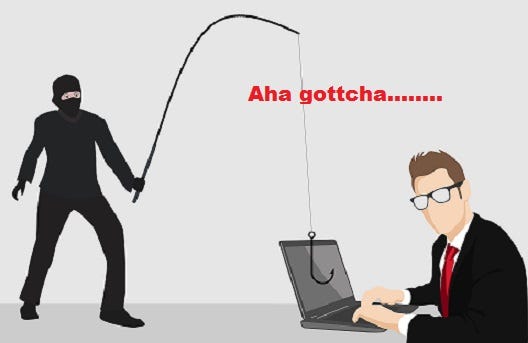
What is “Phishing?”
Phishing is a type of cyber crime.
Cyber-criminals phish for potential victims by email, phone, or text posing as legitimate institutions to entice individuals into providing personal information such as; banking and credit card details, medical data, and passwords ……. etc.
These cyber-criminals then use the scammed confidential info to access your personal accounts stealing your identity, applying for credit, filing your income taxes, stealing your money and maybe your home.
I have been aware of phone and email phishing for decades; it wasn’t until the last year that I began getting phishing texts and SMSs.
My first phishing SMS was crazy, “click here to lose 60 lbs in 60 days.”
I thought, holy crap, if I dropped 60 lbs, I’d be dead. LOL.
My next thought was scam, and I instantly deleted it.
I considered texting back “stop” and then remembered to do nothing.
I had learned from research if you do not know the source — do not respond — delete.
If you do respond, the cyber-shark then knows they have live bait and save your data.
Spam texts and emails vary in content, and some of the following essential guidelines can help protect you and your personal information.
If the text or email is from someone you do not know, delete it or ignore it.
Is the message relevant, or is it unsolicited and entirely random?
If the message states that you have won a contest, a prize, or money — it is likely a scam — delete it.
Do not click on links inside an email or text unless you know who sent the link and where it’s going.
Scammers want to create a sense of urgency and will demand immediate action. Legitimate solicitations have less urgency.
The Shark’s goal is to get you to click on a link and provide personal information without thoroughly thinking it through.
Awkward language skills like poor grammar and misspelled words often identify a phishing scam.
Real text messages from legitimate businesses will use proper grammar, punctuation, and spelling.
Phishing messages usually give minimal information and urge you to take action now.
If the message asks you to “click here” to confirm a package delivery or to obtain a refund, it is probably a scam.
An increasingly popular scam is the one that says “There’s a delivery problem with your recent purchase.” Do not take the bait!
If you do get such a message and you do have a pending delivery — contact the vendor or the shipper to verify there is a problem.
If you do not have any pending orders — delete the message immediately.
If you get an email from an unknown source and you want to check if it’s legit — enter the link into your browser manually and follow-up only after you have determined the sender’s legitimacy.
If you get an unsolicited phone call - ask the caller for a number so you can call them back - they will most likely hang up.
Do not answer your phone if you do not recognize the number. If it is a legitimate caller, they will leave a message.
Do not rush into action with an unknown source — do your due diligence —first confirm the legitimacy of the source of the email, text, or phone call.
As they say, “If it sounds too good to be true, it probably is.”
If you get a request to provide sensitive information, be sure that the Uniform Resource Locator (URL) of the web address begins with “https,” not just “http.”
The “s” is significant, it means the site address is “secure.”
It’s not a guarantee that the site is authentic; however, most legitimate sites use “https” because of the extra level of security.
Scammers love unsecured “http” sites since access is easier.
Be cautious if you sense something funky about an email or text; pull a name or phrase from the message and type it into a search engine and see if any phishing warnings come up.
You can also mouse over the link to see if it is authentic.
If you or someone you know is a victim of cyber-crime contact the FBI immediately at
The FBI wants to help you and they want to get the criminals.
Follow these steps to protect yourself and share this vital information with your loved ones.
© Copyright Stella Martann, 2022
Thank you for your time, and I hope you enjoyed reading my article. If you would like unlimited access to all Medium content — please support the other writers and me and become a member — it’s only $5 a month or $50 a year. Please click this link to become a member of my Medium family. When you use my link to join, I will receive a portion of your monthly or yearly fee.
Gratefully Yours, Stella
I also hope you’ll signup to get an email whenever I post a new story. Just click this link to be notified of my latest stories.
I am a digital nomad; please follow my travels throughout the Pacific Coast of America from the Southern to the Northern borders — Here’s the link to my YouTube channel. Make it a GREAT DAY!