
Are You a How-to-preneur or an Idea-preneur?

A lot of writers and entrepreneurs struggle with getting traction because they don’t know branding. They hear everyone on Money Twitter talking about their “personal brand,” but they don’t know how this translates to their situation.
I’m here to make it simple for you.
When you distill it down to its most basic fundamentals, there are really only two types of brand strategies for entrepreneurs: How-to-preneurship and Idea-preneurship.
Each has its pros and cons, but the main difference between the two is the time required to see results.
How-to-preneur
These are the entrepreneurs who focus on solving a specific set of problems for a specific group of people. They’re all about execution, based on proven strategies. So they’re very clear about what it is they do in their bio and their messaging.
One glance at their profile and you’ll immediately know what they do, how they do it and why they’re an expert on doing it. Their pinned post on X and their pinned stories on Medium will reflect their credentials, whether that’s in the form of client case studies or testimonials.
Everything about their online presence is designed to provide clarity on what they do and credibility for their expertise. How-To entrepreneurs are results-oriented, everything is geared toward taking action towards a specific goal.
Evan Kelly is a great example of this.
Evan is a course creator who focuses on teaching students how to launch their own online course using email newsletters and shortform content, based on the atomic essay strategy developed by Dickie Bush and Nicholas Cole, the guys behind Ship 30 For 30.
If you take a look at Evan’s profile, you’ll know exactly what he does and how he does it within seconds. He’s made it clear he has skin in the game by using his pinned story to tell you who he is, what he’s doing and what you can expect from him.
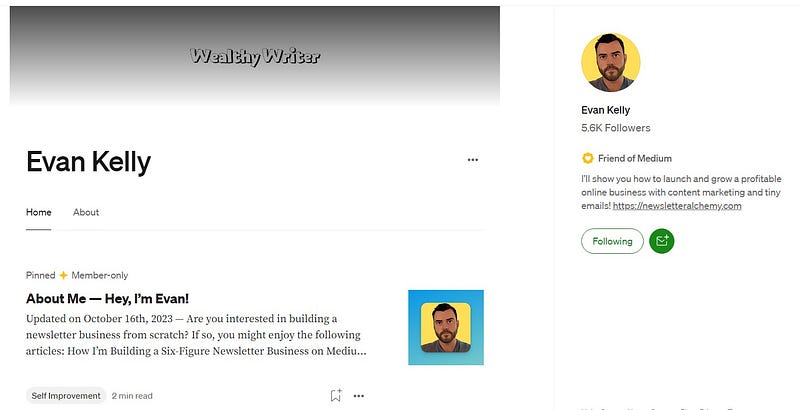
His content, his profile and his newsletter leave no room for doubt on what problems he solves. You’ll never have to guess which niche he serves, and every email you get from him will be hyper-focused on helping that group of people achieve their goals.
This strategy is great for beginners, because the monetization is simple and the time-to-execute is fast:
- Pick a niche
- Find a common problem
- Solve it
- Package up your solution as a product/service
- Profit
This is the most straight-forward, low-overhead way to get momentum quickly and start scaling a side hustle into a full-time business.
The only downside is that there’s a lot of competition, because the barrier-to-entry is low. In fact, the only real barrier you need to get over is the willpower to stick to it long enough to get results.
Anyone else who can solve that problem is a potential threat to your bottom line, because you’re fighting over a category, instead of creating one. You’ll have to put in extra effort to set yourself apart, or choose a niche that has low competition and broad appeal.
There’s no such thing as a niche of one.
Idea-preneur
These are your self-help gurus, philosophers and innovators. Think Dan Koe, Tim Denning and Ryan Holiday. The problems they solve are attached to purpose, meaning and fulfillment. While the How-To crowd is trying to help you master a skill, the idea guys are trying to help you master your mind and your life.
There’s a lot more demand for this, but the competition is fierce and it takes a whole lot more convincing to get people to see value in what you provide.
They’re raising awareness on topics society neglects or chooses to ignore. So there’s almost a level of de-programming that needs to be done just to get your point across to the audience.
This strategy tends to be much more lucrative, but takes far longer to monetize. If you go this route, you’re in it for the long haul.
Which means you better have something else set up to pay the bills in the meantime. Do not try to become an Idea-preneur without a separate income source you can rely on.
Most of the guys that have managed to make a name for themselves in this space started out as How-to-preneurs. They eventually evolved their message and their brand into the realm of big ideas once they’d established themselves.
I take a sort of hybrid approach. Some of my writing is focused on big ideas, fiction and philosophy. Some of it is actionable content to help you escape the 9 to 5 corporate jobscape.
As a newbie, it should be abundantly clear which path you need to begin with. Start getting your hands dirty and solving problems. You can become a millionaire monk once you’ve made your name mean something to strangers.
P.S. I subscribe to Evan’s newsletter because he has great ideas and actionable advice. This isn’t a promotion though, this was my idea, not his. I just think his content is genuinely useful, and every interaction I’ve had with him has provided unique insight.