
3 Highly Addictive Chemicals Big Ag Uses To Control You
The Heroine-Like Substances Added To Foods To Get You Hooked
If every logical argument pointed to the fact that we should give up meat and dairy products for our own health, for animal welfare and for the survival of life as we know it on Planet Earth, would you still eat these foods?
If you’re like most people, the idea of giving up meat, cheese and dairy might well fill you with a kind of dread. Why are these foods so addictive?
It might surprise you to learn that your addiction is real and might have more in common with a smack addict than you think.
Earlier today I published an article about how to reverse type 2 diabetes through diet. In that article, I summarised the results of a century of scientific and clinical research which provides irrefutable evidence that type 2 diabetes is caused primarily by the consumption of animal fat and that by adopting a low-fat, wholefood, plant-based diet, sufferers can expect to reverse the disease without reliance on drugs or insulin injections.
Type 2 diabetes is a huge problem all around the world. It is in the top 10 causes of death and affects close to half a billion people globally. What bothers me is why, with the vast amount of data available from scientific studies into this area, more people don’t make the simple dietary changes required for them to get well.
It’s not just diabetes, of course. Almost all the leading causes of death, including cancer, stroke, heart disease, Alzheimer’s and diabetes are all more likely to strike those who eat meat and/or dairy than those who are vegan or plant-based.
The World Health Organisation has declared processed meat to be a Class 1 carcinogen, equivalent to cigarettes and tobacco, while unprocessed red meat, such as beef, lamb and pork, has been classified as a Group 2A carcinogen which means it probably causes cancer.
Meanwhile, the dangers of high-cholesterol foods and saturated fats are so widely known that I consider them self-evident.
A balanced plant-based diet has been shown again and again and again to be beneficial to our health in so many ways that it would be impossible to list them all in a short blog post like this.
So, in terms of the benefits to health alone, there are a multitude of reasons to avoid consuming meat, eggs and dairy.
But health benefits aren’t the only reason to eschew animal products, of course. Considering that most ordinary people claim to love animals, or at least to be against hurting them, you might imagine that folks would be more eager to avoid contributing their hard-earned cash to this cruel industry, responsible for immeasurable suffering, misery and death of billions of animals every year.
Then, on top of everything else, there’s the unavoidable issue of climate change, one of the biggest contributors to which is animal agriculture. Faced with the sheer scale of industrial pollution and global warming, it is easy to feel powerless and overwhelmed, but one of the most powerful and effective things we can do as individuals is to change to a plant-based diet.
So what keeps people hooked?
Well, the mechanics of meat addiction and those of cheese addiction are very different. Let’s look at meat first…
From the moment we are weaned, the vast majority of modern humans are fed a meat-rich diet three times a day. This goes on year after year as we are growing up. No other primate does this.
According to Dr. Michael Klaper M.D., this lifelong glut of meat, for which we are not physiologically designed, causes our body’s own production of muscle nutrients, such as carnitine and creatine, to drop and we become dependant on meat for these nutrients.
We’re literally raising generation after generation of zombie children.

When people cut out meat from their diet, says Dr. Klaper, “most people can gear up their genes and enzymes to start synthesizing their own carnitine and creatine but some folks might be a bit slower, might take six months or a year before they’re really manufacturing that and they get meat cravings and when they eat meat…they feel great”.
When it comes to cheese, it’s not so much that we come to rely on it as a source of nutrients, as some people do with meat, but that some of the constituents of this sticky, gooey, fatty mess are in themselves highly addictive.

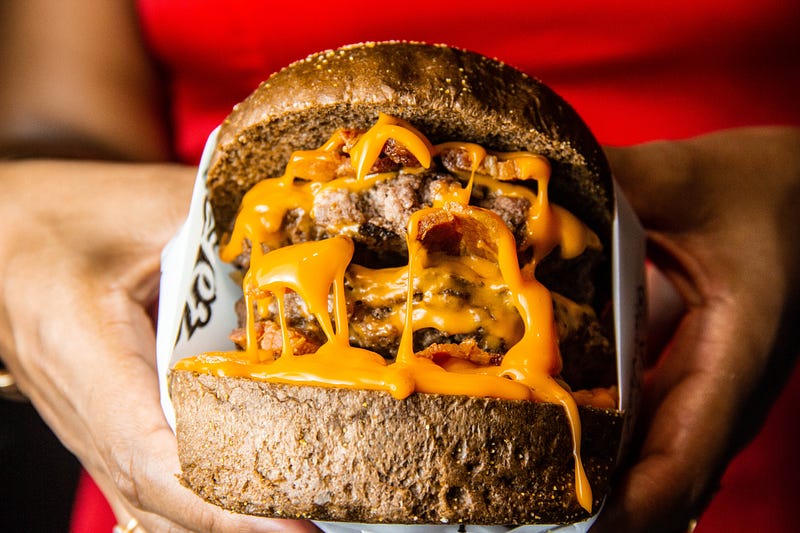
In particular, cheese contains a substance called casein which breaks apart during digestion to release a whole host of opiates called casomorphins. These casomorphins trigger the brain’s opioid receptors in the same way as hard drugs such as heroin.
It’s no coincidence that cheese is referred to as ‘dairy crack’.
The industry, of course, is fully aware of this addictive quality of cheese and cynically exploits this in order to make vast amounts of profit at the expense of public health, animals’ lives and the environment.
Ultimately, the only way to fight this coercive control, regain sovereignty over your own health and cease being part of the global abuse inherent in the meat and dairy industry is to kick the habit, get free of the addictions and go vegan/plant based.
As someone who’s been vegan now for over 35 years I can tell you this — you won’t regret it!