Are You a Biblio Junkie Who Needs Book Rehab?
You might need to get that paperback monkey off your back

Book reading and hoarding are addictions. You know who you are, you utter biblio addicts. I’m not talking about the people who bring that book on vacation they’ve been meaning to read. I mean the ones that would pack a suitcase full of books and then forget their toothbrush. The ones whose bookcases (plural) are sagging under the weight of their bad bookstore decisions.
I’m talking about book addicts, fiending for their next series. Bookdicts? Baddicts?
Literary junkies who are on a consistent and desperate quest for their next typeface fix. Those who just can’t get that paperback monkey off their back.
For those of you anxiously looking around the room right now, trying to avoid the stacks of books in every direction — yes, I’m talking to you, you bookaholics.
Whether you know that you need help, are questioning your literary sanity, or suspect you might have a word junkie in your life, it’s not too late.
How to Recognize a Baddict
Book nerds who’ve gone fully down the bookworm hole leave telltale signs. Signs that you can identify, to get them into treatment. Treatment is available and can crack the habit of even the twitchiest librocubicularist (someone who often reads in bed).
Here are some telltale signs to catch a book junkie:
- Their ears perk up at the sound of the spine of a book being freshly cracked. They might even froth at the gash a little.
- They have a Kindle as a backup for their Onyx Boox. And a Nook or Kobo as a tertiary backup. If they have them in a safe, you’re in dangerous junkie territory.
- Their only social network is TikTok — and that’s only because of BookTok.
- They started getting extra randy after you started using Demeter’s library book body wash.
- They miss their bus and train stops because they’re reading regularly.
- They get sullen and withdrawn (and possibly shaky) after finishing their latest book. This is a book hangover, and they’re getting the literary withdrawals.
- Their Pinterest boards are basically a visual library.
- They put their Kindle in a Ziploc so they can read if it rains.
- If you secretly move a few books from their shelf, their ‘spidey senses’ start tingling. Those were sorted by ISBN number, you cruel bastard.
- They’ve made you roleplay their latest book characters in the bedroom.
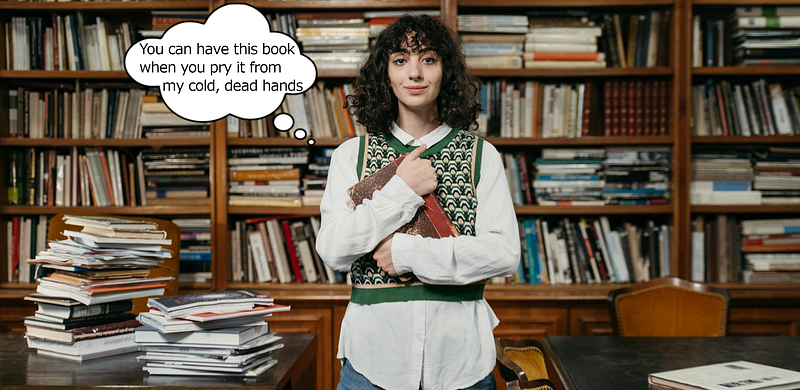
- They’ve been in an accident(s) from reading while walking because, despite their best wishes, the world doesn’t move out of their way like in Beauty and the Beast.
- They buy the paperback or hardcover but then read it on their Kindle.
- Their bathroom is painted in cerise because that’s ‘travel and adventure’ in Penguin’s classic Pantone palette.
- You’ve seen them twitch — or weep — having to walk by a closed bookstore.
- They claim they love elucubration (reading by candlelight), but we all know that they spent too much money on books and couldn’t pay their light bill.
- They ‘chase the dragon’ by completing the entire series even though the first (and second) books weren’t that riveting.
- You’ve seen them play Jenga with hardcovers.
- They have their library card barcode tattooed on their wrist.
If you answered yes to a suspicious amount of the points above, they may be deeper into bookddiction than we thought. There are those at a DEFCON 1 level of book gluttony. This includes those so deep into bibliosmia that due to their book sniffing, they’ve huffed enough book glue to kill brain cells.
Those with book-glue-huffing brain damage may regularly experience a feeling of déjà-lu. A déjà-vu-esque feeling derived from the French verb “lire”, to read. It’s the sinking feeling that you’re reading something you’ve read before.
Others may develop the condition abibliophobia — an irrational fear of running out of books to read.
Then there are those who have reached rock book bottom. Those whose voracious reading habits outstripped their financial ability to buy new books, forcing them into the dark world of biblioklepting, or book thievery. You may find that after turning to the seedy criminal underworld to support their habits, they may need to be cut off from their dealer — their ‘bouquiniste’, a dealer of second-hand books.
Some signs may be difficult to see, as extreme bibliotaphs — people who hide their hoarded books — will physically hide their habit from their loved ones.
Bibliotherapy
If you recognize the above traits in your loved one, they might be a book junkie. Don’t fret; we can crack them and get them back into your life as a willing participant. If you answered yes to more than 50% of the above, they may need book rehabilitation or what we in the book-breaking biz call bibliohab.
Bibliohab is an extensive rapid detox for book baddies that takes place over the course of four weeks. During that time they will be forced to talk to people, take up crocheting, and watch endless hours of Netflix and stupid internet videos. With the help of negative-reinforcement electrodes, their screentime will replace their desire to read with inane activities.
If you’re worried about the price tag of bibliohab, it does carry a cost. While it can be pricey, we know that you’re already used to large sums of money missing every month due to the exorbitant costs of book hoarding. Not only are there the costs of the new books, but the storage unit to store the piles of ‘I-might-want-to-read-this-again-one-day’ books.
In the long run, bookhab will restore financial sanity to your book-burdened budget.
Once they’ve gotten the paperback monkey off their backs, they can be reintroduced to society. They will likely struggle with this addiction for the rest of their lives, though, triggered by things like rainy days, bookstores, and anything made of paper. We do recommend they attend ongoing BAA (Book-Aholics Anonymous) meetings.
It’s never too late to get your loved ones to drop their book dealer and get help. Call 1–800-BOOK-AHOL today to schedule your free bookhabilitation consultation.
*Psst, bookophiles. Are the normies gone now? Stop panicking; this was all a ruse. Book rehab takes place in the world’s largest library — it’s glorious. It is just an extensive reading vacation. And the weekly meetings are book clubs.
You’re welcome.