
Are We Wrong About Stretching?
And do bicep curls really exist?

In a tacit attempt to undo the modern man’s posterior pelvis, there is a lot of brogaing, bendying and magic assing. In the religion of tight, asanas have become gods.
Somehow, we got it into our heads that if we pull at what is tight, we will soften it. If only we keep tugging the rubber band, it will become more elastic.
But have you noticed how rubber bands dry out with time? It really is quite the dissappointment to find an old rubber band, feel the impulse to play with it — shoot it off — only to have it crack or crumble between the fingers.
Tendons, dear friends, are not entirely different from rubber bands. They run on blood and water and too much tugging and yanking creates lesions which prevent the fluids from moistening them.
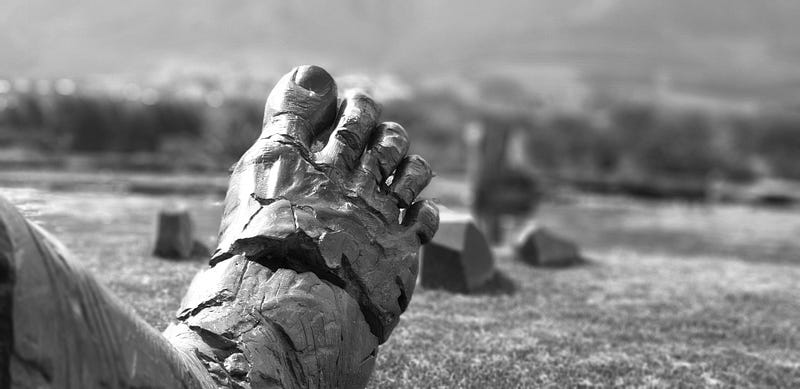
We can start with yoga asanas. To most western people, yoga asanas mean stretching, i.e. elongating or extending to full reach. This is a misunderstanding. The meaning of asana is far from “stretching”; the Yoga Sutras of Patanjali define “asana” as “a steady, comfortable position”. Another interpretation of the word “āsanam” is “the act of sitting” or simply “sitting”.
People are rarely comfortable during asanas. They think they will be comfortable once they are “done” stretching, once they are all elongated and expanded, like tiny little gods. On the other end of things, fascia genius Naudi Aguilar is scoffing, as he piles the yoga casualties of client after client, who ask him to set their bodies right.
Yoga is blamed.
Yoga is not at fault.
Neither is Mr. Aguilar.
This is because asanas are not about stretching. Good teachers keep stressing this: let go of your intent to perform, let the asana do the work. This means, stop tugging, western people, relax. Only patience and understanding will work for you.
Asanas are, rather, about getting in touch with specific geometries that the body is able to assume, with the goal of developing prana, or piezo-electrical efficiency, in the target areas.
Building energy flow and stretching are quite different things, aren’t they.
Let us get back to Naudi Aguilar. Mr. Aguilar has dilligently built on the legacy of fascia workers like Ida Rolf and Thom Myers. He has mapped and taught broadly the workings of the fascia — how to undo knots, how to re-establish proper movement and, more importantly, how this will result in the mitigation of serious health issues.
My first sting with myfascial release felt like being on shrooms. The flow and floatiness resulting from undoing fascia knots seemed to have begotten an ease that my hitherto blocked body and mind could only associate with otherwordliness.
It isn’t otherwordliness. It is a legacy, and a right.
Forget that Mr. Aguilar has brought people from pain with the crack of his fingers — he has succesfully alleviated Parkinson symptoms and difficult digestive problems time and again.
Because so much in health is about having the proper geometry.
While I disagree with Mr. Aguilar that yoga asanas are bad — what he refers to as yoga is simply a bastardization of the teachings, wherein the gun was pointed at the self all too evidently — I agree with his grand challenge ofthe physioterapeutic narrative.
Mr. Aguilar claims, in short, that if we move like we should, there is no need for stretching.
I, for one, am having a blast with his functional patterns training. It targets movements which develop tensegrity, i.e. a movement from center, like a centrifuge, in the fashion of a whip being cracked. How good this feels! And how much easier it is to train long compared to when one is strength training the accepted way.
Even after doing taiji for years am I discovering how the western mind is trying to finagle something which cannot be finagled, namely isolated muscle movements. There is no bicep curl, people, because there is no bicep.
Movement happens from the fiery mobilization of fascia, which is the whole body, not from tensing one specific muscle. The latter will only stiffen and immobilize us with age.
Let’s rethink movement and stretching once and for all. And let us understand how our Newtonian reductionist thinking has crept all the way into our kinesis, and dissected the body like a sexy evil med student would.
The cliché we are one cannot be stressed enough, and it is as true of the body as much as it is in aikyam.
Selah.