
Are We Really Born To Run?
The popular book says so, but maybe we’ve evolved yet again.
There hasn’t been a single book that has inspired me more on my running journey than Christopher McDougall’s Born To Run. Combining anthropological science, historical recaps of incredible running feats, the biomechanics of how we run, all against a secret race pitting America’s top ultramarathon runners against the ancient Tarahumara Indian ultrarunners in Mexico, this book seems to have it all for those interested in going the distance.
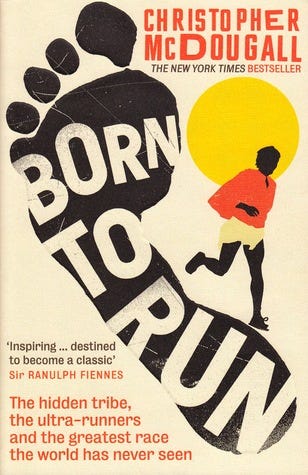
It works because it’s an inspirational book that leaves you in the firm belief that you can run long distances, because that’s what our bodies are built for.
“If you don’t think you were born to run, you’re not only denying history. You’re denying who you are.” — Christopher McDougall
To reach the conclusion that humans were built to run long distances, McDougall canvasses some impressive science with three key evolutionary points as to why our bodies are built to run far.
Compared to most four-legged animals, humans wouldn’t win in a straight line sprint across an arid plain. Many four-legged mammals can reach much higher running speeds than us bipedal humans because they can use their trunk muscles to propel them into a speedy gallop.
Despite being terrible sprinters, humans can endure long distances which other animals cannot.
Below are three key physiological reasons that McDougall says makes us born to run.

Humans sweat
With 2 — 4 million sweat glands dotted all over our body, we have the superpower of being able to run and cool ourselves at the same time. This allows us to regulate our temperature and not overheat as easily as say an elephant. (We also have access to isotonics which the average gazelle can’t flip the pop-top of very well.)
While some other animals also sweat, their bodies aren’t as efficient at this practice as us clammy humans. Most four-legged animals resort to breathing and panting to release excess heat from their body which isn’t nearly as efficient at protecting them from heat stroke as our stinky swagger is.
Humans are bipedal
Another advantage is two-legs-good, four-legs-bad. While running on two legs makes us slower, it opens up our chest, allowing our lungs to expand. This in turn enables us to increase our air capacity so that we can breathe at whatever rate we need to.
The chest cavities of four-legged animals have compress and expand in-synch with their running cycle. They can only take one breath per one or two steps, so must coordinate their running gait and breathing rate.
Because our bodies are structured so we stand upright, humans don’t have this respiration-gait restriction, and we can vary our breathing patterns as we need.
Humans have an Achilles
Finally, our super special Achilles tendon is not something you will find on a wombat. Our Achilles connects the calf muscles to the heel bone. It stores energy as it is stretched, propelling us forward when we constrict it in a step and allowing us to use less energy per step compared to other animals.
Some say the Achilles is actually the key evolution to humans developing into distance runners. Gorillas are terrible bipedal runners and have a calf muscle that connects directly to the heel bone.
This one ultimately is hard to prove though as scientists have been told they aren’t allowed to surgically remove someone’s Achilles to do a before-and-after test.
These biological reasons canvassed in Born to Run are all extremely compelling, and I’m not here to refute the fact that humans evolved in this way and have become better distance runners as a result of these physical traits.
Except for the fact that we are still evolving and so are our lifestyles.
The body described above is one that has been designed to outrun a goat so that past African huntsmen can spear it and kill it for food for the whole village. People would literally run animals to their death in order to survive.
Today, we move an ankle slightly as we accelerate and brake through a KFC drive through. Unless we make the conscious decision to run for exercise, chances are we won’t be running long distances as a part of our daily routine.
McDougall did touch on this idea on one of his trips to Mexico where he saw members of the Tarahumara tribe in a much larger state than their historical ancestors thanks to the fast food chains that had swept through the main streets of their towns.

So is it enough that we were “born to run” if we as a society don’t typically run anymore? Has our innate physiology really remained that stable as we’ve evolved a love for onion rings and deep fried cheese?
McDougall said, “If you don’t think you were born to run, you’re not only denying history. You’re denying who you are.”
I love his book, but I think that sentiment is misguided. Yes we have bodies that once adapted to run long distances, but we don’t practically need to do that so much anymore. We’ve also adapted to working with computers. Our brains have created inventions that allow us to occupy new environments without needing to evolve biological adaptations in order for us to stay alive.
We change all the time, and we don’t need to run 100km distances because our ancestors did. And I’m saying this as someone who has run 100km distances.
Basically, it’s great if you want to, but don’t feel bad if you don’t.
I still love running. I love my 5km — 10km runs that I can pepper during the week and still have time to be a mum, be a wife, go to work, cook beautiful meals, write cool stories and spend time with all my farm animals. These are other things I love doing in my life.
Because while I may have been born to run, I was also born to do a lot of other things as well.
If you enjoy reading stories like these and want to support me as a writer, consider signing up to become a Medium member. It’s $5 a month, giving you unlimited access to stories on Medium. If you sign up using my link, I’ll earn a small commission which I will most likely use on a blueberry scroll while I think of you.