
LEARNING FROM OTHER CULTURES
Are We Human Beings or Human Doings?
The answer is not only cultural, but eye-opening, as well
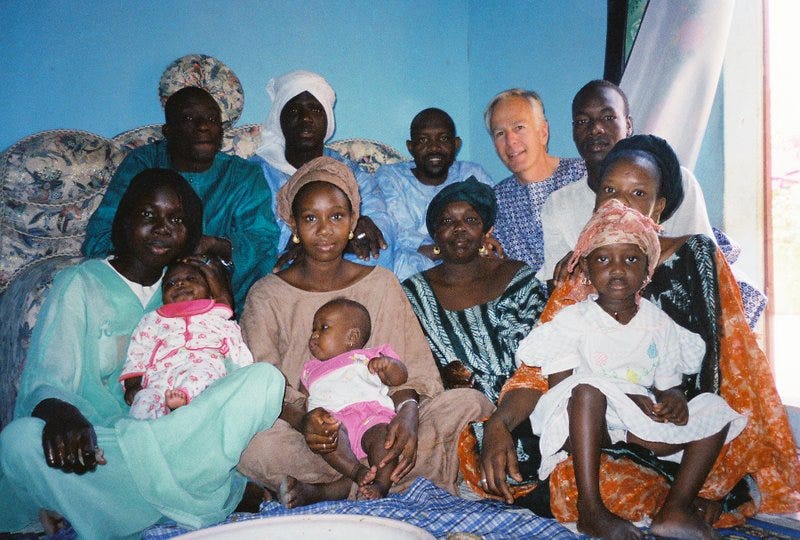
“Come and spend the day with us,” was a common invitation I received when I served as a Peace Corps Volunteer in the Islamic Republic of Mauritania.
What are we going to do? was the question that passed through my mind, but I never uttered.
I didn’t ask because, in time, I came to learn the answer:
We’re not going to do anything. We are just going to be together. That, in and of itself, was sufficient to justify the time we would spend together.
After all, there were no museums to visit, no walks to take, no tourist sites to see, no restaurants or cafes, no parks. There was nothing to see but each other and nothing to do other than simply being together.
On a typical afternoon like this, we would always eat a communal meal. Often, there was a television playing Senegalese soap operas and music videos.
Despite the fact that there were usually babies and children napping nearby, nobody ever cautioned those present to keep the noise down because it may wake up the baby. As a result of having grown up in noisy households such as these, anybody who was sleepy could curl up on part of the sofa and drift off, undisturbed by the music and chatter that surrounded them.
It was clear that the focus of everyone’s time together was centered on being, not on doing.
While spending two years in a society where the values were quite different than they were at home in the USA, I could see that it was incumbent upon me to pay attention, to learn, and, ultimately, to come away from my experiences as a more informed person.
Shining a spotlight on my own culture
Being able to spend time like this was a revelation. Ostensibly, I was supposed to be learning about another culture. But, in fact, when I realized that I could shift my focus a little bit, I recognized it as an opportunity to place the lens over my own, giving me a closer look at the one I had always taken for granted.
When I talk with my fellow Returned Peace Corps Volunteers about our time in Mauritania, which we completed eighteen years ago, we come to a common conclusion: though at the time we experienced those afternoons as being uneventful, we are now nostalgic for our Mauritanian families, appreciative of the lessons we learned about the simplicity of time spent “doing nothing,” and together.
By contrast, our hurried lives at home are in a totally different mode: the do, do, do, the go, go, go that requires us to keep a focus on our work, our careers. The pressure is both self-imposed and societal, as we climb the invisible ladders of improvement, rather than keeping our gaze closer to the ground, on our nearest and dearest people who nourish our bodies and souls.
The cultural perspective that I gained by travel
In my extensive travels on every inhabited continent, I have come to understand that there is a continuum of cultures that range, on one end, from being communal to, on the other end, individualistic.
My experience in Mauritania was very clearly on the communal end of the continuum: a stark contrast for me, having been born in and spending my life in the USA, a country on the individualistic end.
As I see it, the people on the communal end are most inclined towards being satisfied by being. Their happiness and satisfaction are created by spending time with their loved ones. By and large, they populate the continents of Asia, Africa, and South America.
On the opposite end of the spectrum are the extreme individualists who derive their satisfaction by doing: the inhabitants of the USA.
Somewhere in the middle are many of the societies of Europe, Canada, Australia, and New Zealand.
If you have traveled in any of these “middle ground” countries, you have seen it in action: people giving no second thought to closing their shop at least one day a week, as well as for vacations, holidays, and special occasions, so they can spend time with the people they treasure.
There is no search for an assistant manager to keep the place open on these days. They understand that there will be days with no earnings. They accept this as part of the equation of doing business. It’s a necessary factor in the seesaw work/life balance that eludes many of us in the USA.
Have you managed to find the balance that best nourishes you?
If you have spend time in any of these “middle ground” countries, you have most likely learned that you need to plan in advance because the shops are going to be closed on Sundays and holidays.
If you have spent time in Asia, Africa, and South America, it is highly likely that you have befriended local people who have invited you to join them in celebrating time together when they are not working.
Have you learned from other cultures that you can find a new way to balance your time?
Have you put any effort into making a shift from doing to being?