
Are We Going The Way Of Ancient Rome? The Dangerous Trends That Are Shaking Up The World Today
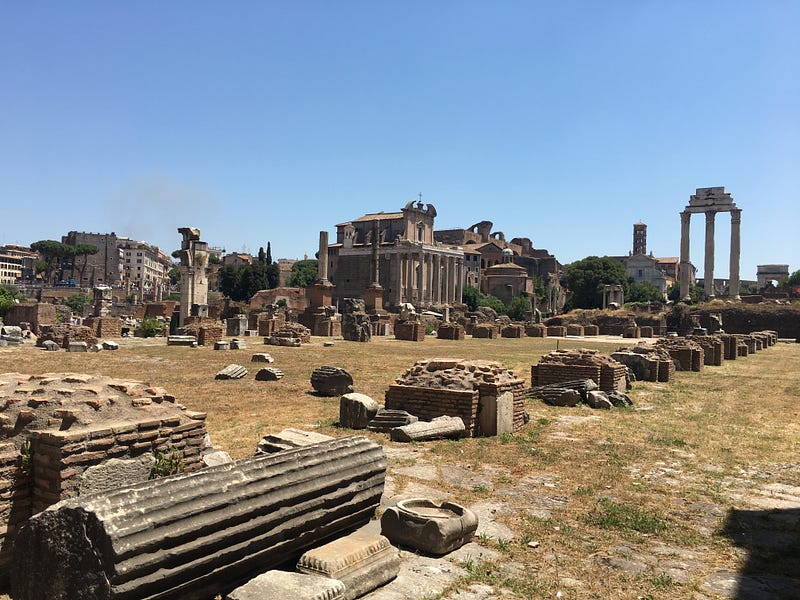
Edward Gibbon started his description of the decline and fall of the Roman Empire at a period of history when it was at its peak. During the reign of the so-called Five Good Emperors, the Empire had attained its greatest geographical extent. Its population lived in relative peace and prosperity. Yet, it is also here that the first cracks that would eventually bring down the greatest state of the ancient Mediterranean world began to appear.
The people of that era did not know that the Empire would eventually fall, and even in the times of chaos that would later come, the fall of such a superpower appeared unthinkable. The end did arrive and the Empire crumbled, ushering in an era of darkness from which it took a long time for civilization to wake up.

In hindsight, this collapse appears inevitable. The structure on which the state was based was clearly eroding slowly but surely, until one day it was no more. History can often serve as a mirror on which to reflect our own times and that’s why it is useful to take lessons from the things that happened in the past. What is alarming is that the same types of cracks that slowly brought down Rome have started seeping into our own modern structures.
As the Cold War was coming to an end, Francis Fukuyama triumphantly declared “The End of History”. From that point onward things were going to move in only direction: the direction of progress, peace, and unlimited hamburgers. However, just as the wise fortune tellers were popping open bottles of champagne to celebrate this momentous occasion, new menacing creatures were starting to crawl out of their dark caves, foreboding a new era of unimaginable terrors.
The current age brings with it numerous seemingly new challenges. Decisions need to be taken in order to set a course through these troubled waters. It might seem frightening, but for the student of history, some of these challenges are far from new. They have been here before. What was old is new again, and what is new will become old. It is up to us to construct the correct path, so that in the future our epoch does not become a warning sign, talked about by our descendants as a lesson in what not to do.
While the time of the Roman Empire can teach us many valuable lessons, I would argue that it is a preceding era in Rome’s history that can serve as a better analogy for our modern era, and offer us many illuminating parallels to what is happening today. It is in fact the fall of the Roman Republic, that is in many ways very similar to the situation in the present day.
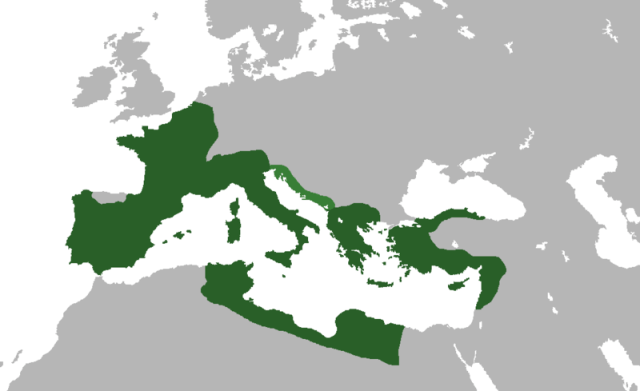
This is because our own modern institutions are modeled on those of the ancient Roman Republic. The so-called Founding Fathers of the United States studied that era in great detail and set up the newly independent republic to resemble Ancient Rome. While the United States has the closest parallels, other countries (Europe, but also elsewhere), also owe much to their Roman heritage. That is why if you want to better understand the processes at play today and where they can lead us, you should look at what happened in Rome after the Punic Wars.
Yes, you can argue that the analogy is not perfect. After all, our modern era differs greatly from that of Ancient Rome in multiple ways. However, human nature has not changed since that time. If you dropped a baby born in that era into the 21st century and have it grow up in one of the countries of today, they would not differ from anyone else. The point of a historical analogy is not to model perfectly, but instead to teach us lessons and show us potential dangers.
Polybius was an ancient Greek historian who spent much of his later life in Rome and wrote an extensive history of that city. He is also credited with developing a cyclical theory of political evolution called anacyclosis. According to the theory, states undergo cycles of development going from monarchy, to tyranny, then to aristocracy, which gives way to an oligarchy, which is then replaced by a democracy, which then degenerates into an ochlocracy (or mob-rule). Once this is completed, the cycle resets itself and goes back to a monarchy.
This is a powerful model that gives us predictive capabilities. Polybius wrote his “Histories” at the height of the Roman Republic, when its greatest rival had been vanquished, and riches beyond imagination began pouring into the city of Rome. Yet of one thing he was certain: Rome too would one day fall. Amid the triumph, he was starting to see the first signs of the problems that would lead to the eventual collapse of the Roman Republic.
Have we hit up Ochlocracy?
As the clock ticked down the last moments of 2018, and fireworks around the world welcomed in the new year, the headlines in the leading global newspapers were dominated by ominous signs of looming chaos. Trump shuts down the federal government over financing for his pet project, Brexit descends into utter retardedness (even after we thought we had already hit rock bottom in 2016 with the referendum), Putin rattles his sabers against Ukraine, and the first order of business for newly elected Brazilian President Jair Bolsonaro is the signing away of the rainforest.
What should arguably be humanity’s greatest era is quickly descending into a mix of chaotic protest movements rampaging through national monuments, brain-dead individuals plowing their cars into masses of people, all set to the background tune of the raping of the environment. The solution to petty grievances has often been either shooting yourself in the foot or setting your hair on fire. The camps on both sides are fortifying their positions and building up barricades, leaving normal people stuck in the middle to be hit with the crossfire. Say goodbye to nuance. It is my way or the highway.
According to Polybius, democracy degenerates when citizens become greedy, entitled and corrupt, which then makes them fall prey to various demagogues who try to entice them with seemingly sweet, but ultimately bitter promises. What we are seeing is the rise of bread and games for the unthinking masses, combined with fiery rhetoric promising to solve all their real and imaginary problems.
The solutions that are rising up in popularity are nothing more than a mixture of pipe dreams and delusions. Any normal person should be able to see that they are far from reality, but mind-boggingly some people will still get fooled by the simple, but dangerous messages.
While the solutions offered up by populists are just hot air, they arise because there indeed are real problems:
1) Rising inequality between the rich and poor, with the rich getting richer and the poor getting poorer (or at least perceiving themselves getting poorer). 2) Unstable economy driven by greed and corruption. 3) Rising debt levels among the population and countries. 4) Decadence, rise of reality TV and druggie culture, coupled with a loss of real values. 5) Massive migration flows from poorer countries. 6) Wars abroad, and terrorism at home. 7) A degradation of the environment, climate change, and loss of biodiversity.
Yet the years leading up to 2019 have been the best years in humanity’s history. After the end of World War 2, we saw a rise in prosperity for most of the world’s population. At least in the developed world (but also in many parts of the developing world), people had more money, better education, better healthcare, and more leisure time than all the generations preceding them.
Advances in technology have also allowed us to travel to the other side of the world in hours, and share information within seconds. Almost anyone now has access to vast stores of knowledge just with the click of a button. This would be something hard to imagine for the people of any era that came before us.
How come our political institutions are getting messed up then? What are the driving factors of all these worrying trends? To answer these questions, we don’t need any sophisticated analytical tools. We can just look into the past. Ancient history can serve as an analogy to show what can happen when a certain combination of factors start unraveling the deepest fibers of society.
How the Roman Republic won its greatest battle and seeded its own destruction
The defeat of Carthage once and for all in 146 BC had established Rome as the sole superpower in the Mediterranean world. It was now controlling vast swaths of land, and with them enormous resources. The conquest of new territories and the opening up of the trade routes brought in great riches. Rome went from a city-state to a world power almost overnight.
This had a tremendous impact on the social fabric of the Republic. The elites grew enormously wealthy, while a new class of impoverished arose. Traditionally, the city was built around a class of small farmers, who owned their own land and produced crops on it. They were the backbone of society, growing the food, not prosperous by any means, but generally satisfied with their lot in life.
The Roman army was composed of citizen soldiers who would be called up to battle in times of need. As the wars that the Republic fought in started to take place further and further away from, many of these small-time farmers ended up spending many years on campaigns. With no one to work their land back home, their plots would deteriorate. When they came back after the wars, their farms would be in ruins and they would end up racking up debts. Unable to pay those debts, these farmers would then be forced to sell their land and move to the city as landless poor. And who would buy up these plots of land? It would be the aristocratic elites now with deep pockets full of gold from the wars.
What made the problem even worse was that after losing their farms, they were unable to find work. The wars had also brought in many slaves, who ended up doing most of the jobs. The newly landless Romans were not competitive on the job market against these slaves. After all, you can’t really compete with free.
Discontent among this newly impoverished class grew. Social strife was nothing new in the Republic. Since its founding, there had often been periods of social conflict, as the plebeians tried to gain more rights from the patricians. By the time of the Third Punic War, this process had largely been completed, and the plebeians had acquired almost equal rights to the patricians. A new aristocracy composed of the patricians and some newly rich plebeians arose.
However, this new strife was different from the previous struggle between the classes. While in the old conflicts, the main protagonists were the plebeians who were rising up from the bottom with visions of improving their prospects, the new struggle included large sections of people who had been better off before, but lost out.
Of course this was not the only struggle. For centuries now, Rome had been controlling the Italian peninsula through a system of alliances with neighboring cities. These cities provided a large proportion of the Roman armies, but only received a meager portion of the spoils of war. The people of these cities were clamoring for more rights and most of all, to be granted Roman citizenship. They argued that they earned it through their loyal support of Rome. However many current Roman citizens were against this, fearing that they might lose influence.
The tensions between the different classes and groups were growing. The battlelines were hardening. The poor wanted to move up in life, while the rich wanted to keep their privileges.
Then in 134 BC came Tiberius Gracchus. This was a man who came from a wealthy and well-connected family, however his main political aim was to reform the system and alleviate the struggles of the poor. How much of his acts were due to genuine caring for the down and out of society, and how much of them were due to his own personal ambitions is up for debate. Probably it was a mix of both.
In that year, he was elected one of the plebeian tribunes. This was the position meant to defend the rights of the plebs and thus had wide-ranging powers, including the power of the veto. He had to share these powers with several other guys who were also elected as tribunes for that year.
His main political agenda was to get a land reform passed. The proposal on the table was a quite simple one. A large part of the lands in the Roman Republic were so-called public lands, lands that in theory were owned by the state. In practice, most of these lands were farmed, usually by rich Roman landowners.
The proposal was to limit the amount of public land that could be farmed by a single person to a certain amount, and then redistribute the rest to the landless poor. Yet this was met with strong opposition from many wealthy senators. One reason for this was that they were set to lose lands that they started considering as theirs. Another, and probably more important reason was, that whoever would preside over the land redistribution would become very popular with the people. This would get them many clients, which was incredibly important in the patronage system of Rome.
The Senate blocked this reform. Tiberius was furious and was resolved that the reform was going to be passed in any way possible. Traditionally, the Senate had to register its opinion before the vote would pass onto the people in the Assembly. However, Tiberius decided to bypass the Senate altogether and move directly onto a vote in the Assembly. The senators were furious, and devised a devious plan to block the reform.
The plebeian tribune had the powerful right of being able to block any legislation with a veto. Tiberius was not the only tribune. There were several others. The senators went to one of them, Marcus Octavius, and convinced him to use his veto power to stop the entire process.
Tiberius tried everything in order to unblock the proceeding, including talking to the senators and coming up with some sort of a deal, but it was of no use. He then decided to do a much more radical action. If a tribune is blocking the will of the people, then he should be deposed, he argued. This was something that was never done before, but for Tiberius passing his law was incredibly important. The Assembly voted to depose Marcus Octavius. With him out of the way, the land reform law passed.
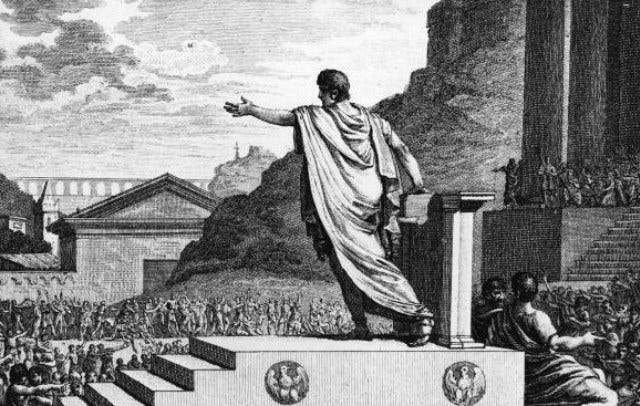
The Senate continued to try to derail the implementation of the legislation, but Tiberius always came up with a way to bypass them, often not in a very legal way. The final nail in the coffin was when he decided to run for re-election as tribune. This was never done, and gave the senators proof that he wanted to make himself king.
Kings were detested in Rome due to historical reasons. For some senators it became logical that if Tiberius wanted to make himself king, he should be killed in order to prevent him from doing so. A group of senators gathered up, armed themselves with all kinds of things, got up on stage while Tiberius was speaking and beat him to death, along with many of his supporters. They then dumped the bodies into the Tiber River.
For the senators, this was supposed to be the end of this. They got rid of a potential tyrant and brought back things to normal. Instead, what happened is that this was the start of a shitstorm that a hundred years later ended with the fall of the Republic and the rise of the Empire.
Personal ambition above all else
On the way to its fall, the Republic became enveloped in further chaos, each round being more and more bloody than the previous one. Slimy characters popped up all over the place, ones who had their own ambitions as the driving force. The slippery slope went through the rivalry of Marius and Sulla, then men like Cinna, Clodius, Crassus, Pompey and Caesar, ending with Octavian becoming Augustus, the first emperor of Rome.
The Republic became divided between two opposing camps, the Optimates, the conservative faction that supported the aristocracy, and the Populares, the popular faction which was on the side of the plebs. These were not parties in the modern sense, but instead loose groupings of people who advocated a certain set of policies.
A rich real estate magnate known for his sex scandals, large ego and entanglements in Syria, Marcus Licinius Crassus is a good example of the type of men that sprung onto the stage in the dying decades of the Republic. Crassus was a man whose primary goal was to look out for Number One. He flip flopped on issues when it suited him, was driven to acquire as much money as was possible and even started building a wall to try to hem in the slaves that revolted under Spartacus.
He is known for building the first fire department in Rome, however the way he used it was not always very ethical. One thing that he did was to have his firefighters come to any area with a fire and before actually starting to take out the fire, they would ask the owners of all the nearby buildings whether they wanted to sell for cheap. If they did, then the firefighters would proceed onto extinguishing the fire. If they didn’t, then they would do nothing and let the buildings burn to the ground.
Crassus was a man without scruples, always out to make a buck or two. Whenever there was an opportunity, he took it. The times of Sulla were dark and dreary. In a fit of murderous rage, Sulla wanted to get rid of his enemies once and for all. Thus began the Proscriptions. Sulla drew up a list of his enemies and offered a large reward to anyone who killed someone on the list.
The list kept getting larger by the day. People close to Sulla kept adding more and more people on it, not just the enemies of Sulla, but other people that they disliked, as well as people who might not have anything to do with politics, but maybe had some nice house or farm. Thousands of people were killed in this way. Crassus took advantage, and ended up buying up many of the properties of these recently executed people for very cheap.
The politicians of that era became extremely opportunistic. Most people stopped being driven by what is good for the state, but instead cared only about what is good for themselves. A typical politician would oppose a law, not based on whether or not he agreed on the policy, but instead based on whether it would help his political opponents or not. Self-interest took precedence over the common good.
The wealthy senators were looking to their own interests and were not willing to compromise. Eventually the events forced them to cede in to many of the demands, but only after violent struggles. On the other side, many of the populist leaders were not above rabble rousing, irresponsibly promising all kinds of things, and the people fell for it. Ochlocracy engulfed the Roman Republic.
Anger is the new driving force
What makes a people sing kumbaya and throw up at the thought of a king one day, and then worship at the feet of the infallible god-emperor just a hundred years later?
Well, the answer lies in what we discovered during the Economic Meltdown of 2008. Humans are very irrational creatures. Even if you don’t give them a gun, they will still find a way to shoot themselves in the foot. Now imagine what happens when you supply them with tons of explosives!
What the model of Econ Man gets right is that humans do have looking out for their self-interest as their main driving force. What that model gets wrong is that they don’t always go about it in a very rational way. They have a tendency to fall for cognitive biases, which can lead them astray.
People perceive the world in a certain way, whether due to nature or nurture. They have certain personality traits, certain principles, and certain ways of thinking. These then lead them to interpret the world in a distinct manner. Cognitive biases can serve to fortify these world-views and drive their actions.
A senator from the patrician class in the 2nd century BC has all his life been taught that things are the way they are for good reasons, and that it is up to him to defend that order of things. The senators feared the loss of their power, their prestige and their possessions. Humans have a tendency to value the things that they own and fear loss above all else. The bias at play here is the endowment effect, where you ascribe more value to things, because you own them.
Evolution has given all living beings certain inner drives. Humans have a status drive, a tendency to try to rise up in status or at least to seek to protect their status quo. When you control things, you have a higher chance of surviving than if you don’t. Some people are naturally more ambitious than others, but a certain level of ambition is always there, since it is one of the basic driving forces of life, passed down from our more primitive ancestors.
Culture also has a big effect on the way you think and act. Due to historical lessons, the Romans were taught to fear people who wanted to become kings. The Republic was set up in 509 BC, when the Romans overthrew their last king, who had been abusing his power. Since that time, king was a dirty word.
Imagine yourself as a senator and you hear that Tiberius Gracchus is doing whatever he wants, ignoring the traditional way of doing things, and amassing crowds of rowdy supporters who are enthralled with him. His prestige among the plebeians is growing by the day, giving him more and more power. You are scared of his ambition, fearing the worst. He probably wants to be king, you think to yourself.
Now confirmation bias starts working its effect. You hear a newsflash on Gracchus, then you hear another one, a slave delivers you the latest gossip on the street. All these things confirm your initial assessment. He does want to be a king. And since you are taught that a king equals the devil, then you need to do something to stop him. With Gracchus attracting large crowds and his speech becoming more fiery, some of the senators came to believe that he wanted to be king. This thought grew stronger with every turn of event, and clouded their judgment. A few of them decided to take the matter into their own hands and ended up killing Tiberius Gracchus.
To picture how a few small events can grow into large misunderstandings and then escalate, imagine yourself on the other side, as a simple urban poor, who has recently been displaced from your farm and have had trouble finding work in the Big City. You hear Tiberius telling you that you might get your farm back. You grow ecstatic. Fuck yeah, that’s my guy!
Then you find out that he was killed. Naturally, you will become angry. You start doing things to voice your anger, joining up numerous other people who have similar feelings as you. You break some things, injure some people, and insult many others. Now the senators and their supporters get angry. This is the point when sparks can start flying.
Plutarch in one of his works painted a powerful imagine of what is behind the state of affairs in this world. He described a scene, with large crowds of people gathering in the middle of the city. At first thought, it seems like a normal every day scene from the market, people going to buy fresh produce for the day.
Here comes the kicker though. Things are not as they appear. All those people are there to sue the shit out of each other. How come? If you use first principles thinking and go back to where it all started, you will find that emotions were the initial culprit of all this. In each of those cases that will be put on trial that day, a single emotion was at the start of all that was was to come after.
Humans are emotional beings. One common, but at most times very dangerous emotion, is anger. Anger leads to moral indignation, which leads to hate, and as every Star Wars fan knows hate leads to the Dark Side.
Anger is the gateway drug to more permanent states of moral indignation or even outrage. This can in some cases be constructive, but if not managed properly, often it can degenerate into something destructive. Moral outrage is just a step away from violence.
Different cognitive biases are once again at play here. The fundamental attribution error occurs quite frequently among people, as they usually explain other people’s behavior by attributing permanent characteristics to them, instead of taking into account the external factors that could have led them to behave the way they behaved. For example, they might see a person respond in an angry manner, and conclude that the person in front of them is an angry person in general, while in fact it was some very rare external stimuli that made him react in an angry way (and in general they are in fact a cheerful and calm person).
When applied on a more general group level, this can lead to stereotyping. Humans are social animals and like to divide themselves into groups. This can lead to dangerous “us” versus “them” divisions. It is quite easy to move from conclusions made on the individual level through the fundamental attribution error, and then come up with generalities on a group level.
This is how this type of rationalization often works: This man did that (you don’t take into account the circumstances), therefore he is bad. He belongs to this group. The men in this group have the same characteristics as this man, so therefore they are all bad. Once you have drawn up this type of stereotype, it makes it much easier to hate. And in advanced states of moral outrage or hate, it is pretty easy for you to justify violence against that particular group.
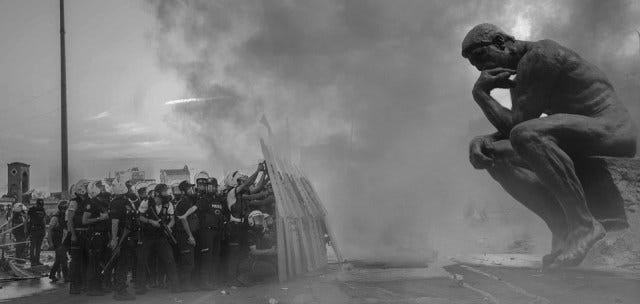
Emotions played a huge role in how people acted in ancient times and they play a huge role in how people act today. The ancient Greeks and Romans divided the soul into three parts: the rational part, and two emotional parts, the spirited part, and the appetitive part. In many ways, this division resembled Daniel Kahneman’s System 1 and System 2 division of thinking, where the first is the fast, emotional thinking, while the second one is the slow, rational thinking. The ancients thought that emotional thinking often leads humans astray. You can argue that the Roman Republic was undone by emotions: anger, ambition, and desire.
The chaos in the Republic degenerated in a spectacular matter, from a few quarrels to violence, from a few traditional norms being broken by the Gracchi and the Senate, to individual political assassinations, to gangs of thugs roughing up the opposition, all the way to Sulla marching on Rome itself, and Pompey later arrogantly stating for magistrates not to quote him laws, since he had a sword. Within a few decades, a once orderly Republic was engulfed in political terror where thousands of political enemies of the powerful were killed through political orders, and then sank into a series of full-on civil wars.
At the end of this tunnel comes a savior who will end this chaos and bloodshed, and bring order to the galaxy. As the turmoil of ochlocracy engulfs the Republic, ordinary people start clamoring for a sense of peace. When one man promises to end this chaotic state of affairs and restore order, the people rally behind him, resulting in one-man rule. Due to the halo effect, people think he can do no wrong. They are willing to trade their freedom for stability. The Empire is born.
Are we experiencing a deja vu?
Economic conditions where certain groups of people perceive themselves as being worse off? Check!
Ambitious politicians using confrontational politics to promote their own narrow personal interests? Check!
Groups of people expressing moral outrage and dividing everyone into “us” versus “them”? Check!
The three main driving forces that led to the fall of the Roman Republic are present and accounted for in the current state of affairs. Incidentally, these three forces are usually also present at other times when society is heading towards catastrophe.
Remember World War 2? You had the collapse of the economic system (which was even worse in Germany and combined with the feelings of loss of national power among the Germans). You had ambitious politicians using confrontational politics to promote their own interests. This created conditions ripe for dividing people into groups, labeling scapegoats, and then expressing moral outrage. Violence was not too far off.
We are not there yet, but the dynamics seem to be heading in a negative direction. The problem with the poor in the Roman Republic after the end of the Punic Wars was not that they were poor, but in that they were relatively worse off than before.
Perception plays a huge role in the way a person reacts to their condition. For example a person in a lower caste in India might be generally satisfied with their life and have the perception that all is just, even though they live in horrible conditions, while a person living in America, who is in all ways richer than that poor Indian might be hugely dissatisfied.
Relativity is what shapes this perception. One type of relativity is when you compare your own situation to other groups. This can play a role. If your welfare level stays the same, and the welfare level of the richer group that you are comparing yourself to also stays the same, then the situation usually doesn’t really rile you up that much. However, when you see your situation as staying the same, while the group you are comparing yourself to is getting richer, that might cause some unease and indignation for you.
The other type of relativity is when your own situation changes, for the worse. You can see that either your own situation or the situation of your parents was better before, and the prospects of you getting back to that level are pretty much non-existent. This is what causes the most amount of anxiety for you. When you add to this a comparison with another group that is getting richer in these times, you have the perfect set-up for moral outrage.
This is what the small-time Roman farmers were experiencing. Their situation was getting relatively worse. They lost their farms, had higher levels of debt, while at the same time had trouble finding other jobs. On the other hand, the level of riches that some sections of Roman society were experiencing was previously unheard of. The situation was ripe for anger and moral outrage.
In Rome, the rise of populism and the support for populist demagogues was a revenge of the people that don’t matter. Soldiers came back after serving their country in wars for many years, but then they were left in ruins. They often ended up losing their farms and couldn’t find work elsewhere. When someone came and offered sympathy to them, they were ready to listen.
The current rise in populism has been often attributed to a revenge of the people that don’t matter. These are regions and groups that have been relatively better off in the past, but have lost much of their prosperity in the last years, which has generated the feelings of no one caring about their plight.
Just like in Ancient Rome, this type of situation is ripe to be exploited by ambitious individuals who are in it just to satisfy their own ego. Fostering divisions and destructive politics (instead of constructive) are their modus operandi.
You have different types of politicians who contribute to the toxic atmosphere:
1) The purely narcissistic types who only think about their own interests and have identified the country as being synonymous with themselves Trump, or Putin 2) You have ones who have a grand vision, but their destructive politics bring about chaos, like Gingrich and Jeremy Corbyn 3) Political trolls like Farage 4) Hybrids like Boris Johnson
Donald Trump is the latest example of populism in the US, but the way for him was paved by a previous generation of political trolls.


The US has its history of nasty partisanship and political violence, however the bulk of that happened in the 19th century. There was some of that in the 20th century as well, but after the nasty interval of McCarthyism, the Congress worked within the paradigm of bipartisan consensus building. Democrats and Republicans had their ideological differences, but in general they were on friendly terms with each other and worked in the spirit of compromise.
Then came the era of Ronald Reagan and Newt Gingrich. Ronald Reagan got elected President on a campaign of outrage, but once in office he kept his trolling to the international stage, while trying to work with the Democrats in Congress in a bipartisan way. He did shut down the government several times, but every time this happened, both the Democrats and Republicans gave a few concessions to end the stalemate.
Newt was the guy who wanted to blow the entire system up in order to feed his own vanity and sense of grandeur. In the 1980’s, he was only a recently elected congressman, but that did not stop him from causing mischief. His battle plan was to be as nasty as possible, to destroy the consensus building tradition and instead bring about a Republican dominance. He resorted to the practice of name calling, not just the Democrats, but also his own less confrontational Republican Party colleagues. He went about destroying all the different norms and traditions that the lawmakers from the two parties had implicitly agreed upon after the end of the war.
These trolling tactics worked magnificently. They did bring about a Republican victory in Congress, but polarized the country and commenced an era of bickering. Instead of discussing problems that were plaguing the country, millions of dollars were spent investigating where Bill Clinton put his penis.
If you hear Newt Gingrich speak, he talks about his mission to save Western civilization and other such stuff. Many of the Roman senators were also thinking that they were preserving their own civilization. Instead, they were instrumental in destroying it.
With Newt’s trolling, the Democrats started responding in the same way. They brought in Jim Wright as speaker of the House of Representatives. Wright was a guy who enjoyed sticking it to the Republicans and especially relished when he could push something through despite Reagan’s vetoes. He would often clash with Newt Gingrich, whom he called “sociopathic” and beholden to his ambitions. However, he himself was also not a paragon of virtue.
This was the start of the chaos that engulfs the political arena in America today. While guys like Gingrich or Wright, besides their own personal ambitions, might have also had some high-minded principles that they were trying to promote, the newer generation of loud-mouths such as Donald Trump are in it just for themselves. Donald Trump doesn’t really care about anyone or anything besides Donald Trump.
You saw a similar evolution in Ancient Rome. The early consensus breakers such as the Gracchi brothers or the senators were also defending some sort of a policy, whether reformist in the case of the Gracchi or conservative in the case of the senators. However, they ended up giving way to a newer generation of politicians, like our old friend Crassus. Crassus was in it just for Crassus.
It is not just low morals that are gaining ground, but also corruption. In the Roman Republic, as the chaos grew, it became more and more expensive to get elected. Candidates had to spend a lot of money to bribe the electorate, not just with empty promises, but also with games, and even money. Towards the later stages, some guys were buying elections outright. The role of money in the entire crisis is important to note. The Roman elite became very corrupted in their hunt for money and power.
When Jugurtha, the King of Numidia, a kingdom in northern Africa, came to Rome, he brought with him bags full of money and bribed many politicians to get his way. Many of the top political officials ended up colluding with foreign powers. In the hyper-competitive environment of the late Republican Rome, a chicken and the egg problem of money and political power arose. More money meant more political power, and more political power meant more money.
Today, you see similar trends. The cost of campaigning is skyrocketing, with the candidates having to spend more and more money. Often, it is the candidate with the more flashy and expensive campaign that wins. The cost to win a seat in the US House of Representatives increased by 344% from 1986 to 2012, while the cost to win a seat in the US Senate increased by 62% during the same years.
The country has been sliding downhill towards confrontation just as the cost to run an election is increasing exponentially. The system keeps on getting more corrupted. Game theory is a good way to explain why and how this works. Imagine that everyone in the system is moral and does things by the book. Then one day, a guy comes and starts going around the system, buying votes. This guy wins and the honest guys lose. Well, the next time, the guys who were honest before learn their lesson and start corrupting the system.
That’s how a race to the bottom starts. One guy shouts, so the other guy starts shouting louder. One guy starts calling people names, the other guy starts getting even more rude. The problem is that if you want to stay relevant, you need to keep on doing it. It’s just like the classic game theory example with the two robbers who were caught and the police is now trying to get them to confess. If one of the guys rats out the other, and the other guy stays silent, the rat goes home free, while the other guy rots in jail for 5 years. If they both rat each other out, then they both serve 3. If they both stay silent, they will serve 1 year in prison.
The best possible outcome for both of them combined is for them to stay silent. However, staying silent is a huge risk. What if the other guy talks? Betraying the other guy however has huge potential benefits for the cheater, especially if the other guy has honor. In such a system, it is quite logical that both guys will cheat, and if they don’t cheat, they will cheat the next time. In the current political climate, if one side tries to be constructive and the other side keeps on being destructive, then the destructive side will win. That’s why both sides will continue on being more and more destructive. In the current system, the honest, constructive guy has no chance.
It is not just in the US, but in Europe and around the world, similar conditions are being replicated. What you are seeing now is many people from the more traditional parties starting to use populist rhetoric in order to try to outflank the extremists. One example is the Conservative Party in the UK. To beat the loud-mouthed alcohol lovers of UKIP, they started sounding more and more radical, until they created the current mess of Brexit.
There are some interesting trends that parallel the rise of divisive politics and trolling in the US Congress. Analyses show that the rate of cooperation has been in decline in the US since the 1960s. This has also mirrored general trends in the decline in trust for state institutions. At the same time, you have a trend in the rise of economic inequality. According to Emmanuel Saez and Thomas Piketty, income inequality declined rapidly in the US during most of the 20th century, until 1970, when it started to increase sharply, reaching levels not seen since the 1920s.
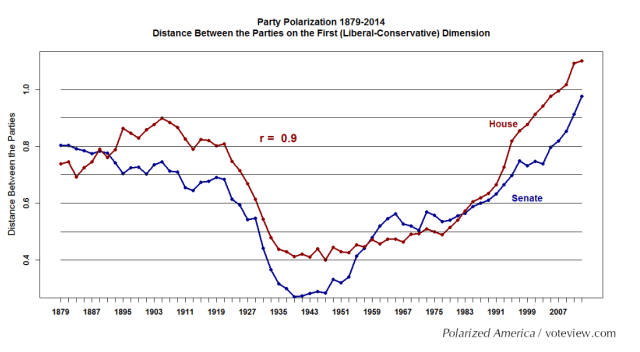
According to a polarization index of political scientists Keith Poole and Howard Rosenthal, the polarization in the US at this point today is the highest in history! Peter Turchin developed a theory, which he calls the Double Helix Theory, where he surmises that whenever you have high inequality, you also have lower levels of well-being. He shows that the levels of relative well-being have been in sharp decline since the 1960s in 3 out of 4 categories: employment, wage relative to GDP, and family (only health increased). The last time you saw such sharp declines in the US was in the period leading up to the Civil War!
Peter Turchin also developed a trans-disciplinary study of history focusing on the major trends, which he termed cliodynamics. He looked at wide cyclical movements in history and the era of the Late Roman Republic has basically the same structural-demographic forces driving political instability as today. These being a drop in relative welfare and the elites engaging in power struggles and competition.
If you take a book on the history of the Roman Republic starting from the end of the Third Punic War until the Marius and Sulla era, and the history of the US Congress from the election of Ronald Reagan to today, and read them in parallel, you will be astounded by how many similarities there are.
A tradition of consensus destroyed by power-hungry individuals pushing their own agendas and not willing to compromise. Growing divisions between polarized sections of society, with the threat of violence looming at every corner: Welcome to deja vu!
Guilty until proven innocent
It is very hard to stop the wheels once they start churning. We have arrived at the edge of a political abyss. Not there yet, but the explosives are in place, ready for a spark to set them off. What haunts us now is the specter of the alt-right and the alt-left. Their antics are what could start the fireworks and push us over the edge.
Identity politics is inherently divisive in its essence. It is pure “us” versus “them” politics, where through confrontational rhetoric an in-group and an out-group are created. Cognitive biases have a field day with this kind of thinking.
Instead of promoting similarities, identity politics emphasizes differences. It actually creates enemies out of people who might be neutral. A person’s identity is not something static and unitary, but instead it is usually multi-layered. One person can be an American, immigrant, Muslim, a man, resident of Michigan, liberal, father, brother, son, a teacher, and all kinds of other identities. They can use these identities in different contexts. With identity politics you are focusing on just one of those identities and this one takes precedence. If that identity is portrayed in a negative light, the person might become defensive and that part of his identity might become dominant.
Once you push a person on the defensive about their identity, then they might buckle down and actually hold onto that part of their identity much more strongly. Identity is at the core of a person’s self-esteem, and the brain has built in mechanisms to fight against the loss of a sense of self-worth. This attack on a person’s identity can hasten the formation of certain political beliefs, which then become intertwined with personal identity.
It’s sort of a chicken and the egg problem. Once a political belief becomes a part of a person’s identity, then every attack on that political belief strengthens that person’s sense of self, and every attack on that person’s identity strengthens that person’s political belief. You get the backfire effect on steroids. This can explain why identity politics provoke such explosive and emotional responses. They shut down the logical part of the brain, and get people into primal survival mode.
What characterizes both the alt-right and the social justice warriors of the alt-left is their black and white view of the world and intolerant discourse. Nuances do not exist for them. You are either with us or against us, meaning that you subscribe fully to all the orthodoxy, and do not dissent. Moderates are cast out, dissident opinions are squashed, and militancy is leading to first signs of violence. Economic factors might have set off the initial discontent, but it is identity politics that are in the driving seat now.
The problem with the alt-right and the alt-left is that they take real existing problems and go full retard on them. Each side harps on their own real or imagined problems and doesn’t acknowledge the legitimacy of any of the problems that the other side is trying to address. This type of attitude then just catapults moral outrage to astronomical levels, which is further enhanced by the impenetrable bubbles each side encloses itself in order to feed their confirmation bias.
Both these radical movements are increasingly totalitarian, each professing its own orthodoxy which cannot be deviated from or even questioned. If you don’t think all Muslims are terrorists, that all Mexicans are criminals, and that Obama is an Arab born in Kenya, or if you don’t use baking soda instead of deodorant, then you are a cuck, plain and simple. If you don’t subscribe to the notion that gender is a social construct having 0% to do with nature, believe that all men are rapists, or haven’t burned any evolutionary psychology books yet, then you are an evil racist misogynist. Wait, what if you are black? Then you are an uncle Tom. What if you are a woman? Then, you are a man… wait… no, that’s good, we like trans… wait let me check with my superiors on what my official stance towards this should be.
What were are seeing is more and more radical discourse. Both sides are not speaking to each other, but past each other. The aim is not to convince the other side to see their point of view or to come to an agreement on how to solve the problems. Instead, the talk is meant to fortify the ranks, and maybe gain new recruits who have been wavering on the sidelines.
The reinforcement mechanisms the sides use have some very specific peculiarities. The alt-right likes to peddle conspiracy theories. These stories usually involve all kinds of imaginary ghosts and dragons, all coming for you and your family. Conspiracy theories are incredibly seductive to a certain type of people, especially in uncertain times when feelings of anxiety increase. It is comforting to believe that you know what is really going on and that it is not your fault.
Hilary goes to a pizza place, orders a pizza and then goes to watch people have sex with kids. She also apparently sold nuclear materials to Russia. The Podesta emails prove it! Oh yeah, and the chemicals in the water are turning the frogs gay.
This is not a joke. Some alt-right people actually believe that this is true! Of course don’t forget George Soros, everyone’s favorite boogeyman. The elites are down to no good and have a secret plan to control you.
This is just a part of the belief set of the alt-right. Someone has an agenda, whether it is the Cultural Marxists (whoever they are), the Jewish-Muslim cabal or the globalists. The more disturbing this conspiracy theory is, the more easy it is to dehumanize its protagonists.
The aim is to get people riled up, to get them angry. Anger sells, as anyone who watches TV knows. As talk show hosts found out back in the 1980s, the more anger you manage to raise in your show, the more people will watch. That’s when the money starts rolling in.
The alt-right are the inheritors of a long tradition of loud conservative pundits such as Glenn Beck, Rush Limbaugh, or Bill O’Reilly. Those guys served as the gateway drugs to the more whacky conspiracy theorists like Alex Jones, who believes the louder you scream something, the more true it has to be. Listening to Beck and Limbaugh was like getting hooked on marijuana. It gets you high, takes you away from reality and gives you that tingly feeling.
However, at one point you want more kick. So you try a line of coke, the Alex Jones variety. You know it’s bad for your health, you know you will get that weird nose twitch, but hey it lets you see all those illegal immigrants voting for Hilary, so you get addicted.
These alt-right guys have been able to capture a bubble audience, but not in controlling the general discourse. In the US, they hover around in their own safe space, with Fox News being the main TV network that caters to them, but they are increasingly buttressed by a wide constellation of online news sites like Breitbart, conspiracy peddlers like InfoWars, and radical blogs that get more and more extreme.
The alt-right are not the only guys on the far right in the US. They were paved the way by the neo-cons and then the Tea Party movement. What we are also increasingly seeing is the rise of the Christian fundamentalists. Some of these groups are sometimes overlapping, but there is also a certain friction between some of them as well.
While in the US, the alt-right and nationalists are only a niche, in Russia, the biggest country in the world, they have succeeded in capturing almost the whole market. Thanks to the work of Putin and his cronies, most independent media has disappeared, to be replaced by a series of Russian Fox News clones.
In the US, it is the social justice warriors of the alt-left that have been more successful in directing the flow of the mainstream discourse so far. They have a huge influence on what can and cannot be said in public or in private. Their rhetoric has slowly crept into the mainstream media. In many ways they have also affected the normal relations on the street as well, and self-censorship is quickly becoming the norm in today’s society.
The alt-left has weaponized a wide variety of causes, but in a way that has alienated many other segments of society. Legitimate concerns have degenerated into farces, not only undermining the credibility of the message, but also endangering the basic principles that the free world stands for, like free speech and the presumption of innocence.
The MeToo Movement started off as a reasonable reaction to some things that unfortunately some men have done. Rape has been a consistent danger to women, which should concern any man who has a female relative. Behavior like masturbating in front of someone without their consent is also a highly inappropriate behavior and Harvey Weinstein should be shamed for it.
However, this reaction has turned into a downright mean joke. It went from legitimate indignation about Harvey Weinstein’s rapy behavior to the farcical outrage over Aziz Ansari’s awkward date. It went from specific instances of bad behavior to generalizing this type of behavior on all men. The mobs immediately pronounced men as guilty just for the fact that they were born as men, and wanted to continue to be men. A new concept of “toxic masculinity” has been making the rounds, which to many men appears as gender shaming their entire gender.
Presumption of innocence went out the window. Society has internalized that if a man gets accused of sexual misconduct, then it must be true. The word “alleged” gets thrown around lightly, without respect being paid to the founding notion of any just judicial system: innocent, until proven guilty. This type of internalization has wide implications.
On the political scene, this can become a winning tactic. It is easy to get rid of an opponent simply through putting false allegations on him. Even if he gets off, the stain of the allegation will forever be on him. Malicious lawsuits became incredibly common during the period of the fall of the Roman Republic. It was a weapon often used to destroy an opponent’s reputation and credibility. Even if laws were passed to get rid of this practice, they were not very effective, and malicious accusations and lawsuits continued to hamper the functioning of normal political discourse.
This is of course not to say that there aren’t sleazy guys out there. There are plenty of those, and something should be done to stop them. However, it needs to be done in a way that doesn’t get out of control and victimizes innocent guys. Not would this only potentially hurt a lot of normal men, but it would also be a serious problem for real female victims.
Among social justice warriors, the battle against racism has also degenerated into permanent outrage, where anyone who even questions some of the tenets of orthodoxy gets burned at the stake by enraged mobs. A few years ago, a guy named Omar Mahmood, himself a minority, wrote a satire piece in his local college newspaper poking fun at the culture of permanent offense. It was quite soft, but it set off a shitstorm against him. He was verbally harassed, fired from his job at the newspaper, and his dormroom door was vandalized with eggs and gum. Apparently his article was a micro-aggression.
It gets so absurd that a man who says that he got his job based on his qualifications, and that his race shouldn’t be an issue, gets accused of white privilege. He is black. This is not a joke or a singular incident. In other parts of the country, like on the ten University of California campuses, stating that you believe that the most qualified person should get the job, is now classified as a micro-aggression.
It is legitimate to state that some blacks might have been born in poorer circumstances, and that unfortunately some people are still racist and that might affect them at some point. The environment you live in does play a role in the chances that you get. However, the alt-left has framed the issue in giant monolithic blocks, which ends up pitting different groups against each other and leaves no room for nuance. With such a variety of human backgrounds and experiences, how can you make such blanket statements? Not only does this divide people up and create polarization between groups, it is counterproductive to solving the problems that some members of the black communities might be facing.
Privilege is a relative concept. Everyone is privileged in some way and in some ways they are disadvantaged. You cannot boil down privilege to just one factor such as the color of your skin. A good looking person is also privileged, as numerous studies have shown that it is easier for them to get a job or that they are seen as more credible and smart. A tall person also has advantages, even for such things as getting elected to office. Being American has its advantages over being a citizen of many other countries in the world. Are we going to start shaming good looking people, or tall people, or even all Americans?
Your race might matter, or it might not. Your ethnic background might matter, or it might not. Your sex might matter, or it might not. The place you live in or who your parents are, might matter or they might not. The circumstances of all of these might matter, or they might not. With such a multitude of variables going into making every individual person, reducing privilege to only one factor and without context greatly misinterprets the issue.
The thing about gender shaming or getting people to accept their “white privilege” is that it usually has the opposite effect. Imagine being a poor white guy in some town in the middle of nowhere with no money and no job prospects and then getting told to accept your “white privilege”. Or an immigrant from a war-torn place like Bosnia, working all day just to make ends meet, and getting told that you are privileged. How do you think they will react?
Some of these guys might just laugh, shrug it off and continue about their lives. However, some might get angry and the first instances of conversion towards the alt-right will be set in motion. These types of tactics just serve to alienate people from each other. With alienation comes thinking in absolutes and more radical discourse. This can then turn to more radical action. Social dynamics in these instances can degenerate rather quickly. An action can provoke a reaction, which can then provoke another reaction, leading down on a path of increased polarization. This cycle becomes harder to break as political beliefs become a part of a person’s identity.
Herd behavior and mob rule are leading the way. Whoever doesn’t agree 100% with the narrative, gets chewed up and spit out raw, even if they are a progressive supporter of civil rights. At the center of one of these alt-left controversies is another Weinstein. This time named Bret (no relation to Harvey).
He is a left-wing Bernie Sanders supporter who taught biology at Evergreen College. He wrote a letter protesting the call for white students and faculty to stay away from the college for one day. Soon thereafter a huge wave of protests erupted on campus, physically intimidating him and forcing him to resign. Stating that he supported the cause, but just didn’t agree with the tactics, made him get vilified by the self-righteous mobs of activists.
What we are seeing is the formation of mob rule to intimidate opponents (or even people on their side who do challenge the orthodoxy) by the alt-left. The same is happening with the alt-right. These incidents point to the radicalization of both sides. Indignation has turned to hate. Once you start on the path of talking about who is oppressing who, you enter dangerous territory. The experiences of the former Yugoslavia or Rwanda can speak volumes about the dangers of identity politics in the modern world.
Identity politics by mentally dividing people into monolithic groups is playing a zero-sum game. In zero-sum games, there is always a winner and a loser. By framing the discussion in this way, instead of win-win scenarios, you are inciting negative reactions from the other groups. Nobody wants to be the loser, and they will fight tooth and nail not to be one. More political violence could be around the corner.
Are we on the path to political violence?
The extremes which were until now usually confined to the filter bubbles of the internet, are now being reinforced through increasing group actions in the physical world. The past few years have witnessed several events showing the growing radicalization on both sides.
The Charlottesville Rally of 2017 looked like it came straight out of 1930’s Nazi Germany. The march saw groups of polo wearing white men holding lit-up torches join up with groups of pot-bellied biker-looking dudes with swastikas, sometimes interspersed with shaggy bearded balding specimens of the superior race in full KKK gear. Some of the Trump-described “good people” even went as far as to give Nazi salutes!
The rally turned violent when the marchers clashed with counter-protesters. Over 30 people ended up injured and one person got killed when one of the marchers ran over a counter-protester with his car.
According to the FBI, the dangers of far right terrorism seems to be on the rise. This has always had a presence, from Timothy McVeigh to the bombings of abortion clinics, homemade terrorism has been a constant nuisance. In the current political climate, it is only time before it resurfaces again.
In Europe, there is a promulgation of militant extreme right wing groups. Greece has been a notorious hotbed for years, and Hungary in the past decade has seen the rise of Jobbik, with its para-military wing marching around in uniforms. Germany have seen an upswing as well, with the AfD, the far right party against immigrants, becoming increasingly popular.
Militancy is on the rise on the far left as well. While not as wide-spread as that coming from the extremists on the other side, violent protests like the one at Evergreen College are becoming more and more common. Even political figures are being harassed. The Secretary of Homeland Security, Kirstjen Nielsen, even had an angry crowd show up in front of her door.
In France, the last few months saw an explosion of civil discontent, with protests against governmental policies, egged on by a feeling of general discontent and economic malaise among some of the lower classes, degenerating into riots. The Yellow Jackets (Gilets Jaunes in French) have protested in various cities around France and also in Belgium.
While the movement deems itself apolitical, both far-right and far-left activists have joined it. It is not sure which way this movement will go, but there are signs that it might be veering towards the far right. Far-right activists, including individuals who fought for the Russian-separatist forces in the Donbass, have infiltrated the movement. And there seem to be great tensions between some of the far-right and far-left groups participating in the protests, some of these leading to violent skirmishes between them.
The question is also whether the political violence will diminish when people find out how effective it is in bringing about political change. In France, people have gotten used to striking often, maybe they will get used to political violence. Chaos could become a political strategy. After all, there is precedent, with the French Revolution or more recently the Protests of 1968.
Incidentally, the dangers of this have encouraged the formation of a movement opposed to the Yellow Jackets. This movement is calling itself the Red Scarves (Foulards Rouges), and has started organizing protests to support the government. It is composed mostly of people from the middle-class, ones who are usually pro-Macron and pro-EU. Do we have the start of a class war in France?

There had been instances of violence in Rome’s history before the last century of the Roman Republic. Even the overthrow of the Roman Kingdom was a violent act. However, they usually tended to die down soon after they started. The period after the Gracchi was different, as the violence did not diminish, but instead became a standard part of political practice.
During the time of the Gracchi, the crowds that gathered were largely spontaneous due to the popularity of the reforms that the brothers were advocating. The reaction of Nasica and his supporters, when they rushed to the Capitol where Tiberius Gracchus and his supporters were gathered was also largely spontaneous, as they had thought he was trying to make himself king. They mostly only armed themselves on the way with anything they could find, such as clubs from the legs of benches or rocks. In the subsequent melee, Tiberius and 300 of his supporters ended up getting killed.
After the events, the reaction of his brother Gaius was moderate and he did not reply with violence, but instead tried to get at the killers through the courts. Ten years later, violence again started up and Gaius was killed along with a number of his supporters. However after this, the violence died down, but the memory of the brothers lived on. Violence only started up again about 20 years later when Saturninus became tribune.
Saturninus formed alliances with two other men, Glauca, a senator and later consul, and Gaius Marius, the recurring consul and the most powerful man in Rome at that time. Together, they tried to pass through a series of laws aiming at redistributing land. These laws would not only redistribute lands to the legionnaires of Marius and other Romans, but also to numerous Italians, who would then gain Roman citizenship. While these measures were popular with ex-soldiers, the rural plebs and Italians, it was strongly opposed by a large part of the Senate and also the urban plebs, who were chiefly against giving Roman citizenship to Italian non-citizens.
There were tensions in the city, as opposing mobs were gathering and threatening each other. To get the potentially violent urban plebs on his side, Saturninus introduced a bill to give them subsidized grain. This had a huge effect on the state finances and the questor (the public official responsible for the treasury) for that year, Caepio, was strongly against it. His view was that the state could not afford it. In this tense atmosphere, one of the other tribunes put in his veto. Vetos by tribunes should usually stop the legislative proceedings, but Saturninus decided to proceed on anyways.
Once Saturninus started calling the people to vote, Caepio came in to stop the entire process through violence. Together with his supporters, he pulled down all the urns and intimidated the people who wanted to come cast their vote. The Senate then tried to get Saturninus to abandon the entire proceedings, as they said that thunder was heard. The Romans were a superstitious people, and sometimes they looked for omens to decide on what course of action to take. Since everything could be misinterpreted as a bad omen, this was often misused in the political process. Saturninus told them to STFU, otherwise that thunder will be followed by hail.
Since he saw that the only way he was going to get his bills passed was through intimidation, Saturninus asked veterans from the army of Gaius Marius, one of the first of Rome’s strongmen, to watch over the proceedings. This threat of violence helped him pass the laws. The significance of this was not really the laws that were passed, but instead the way that the entire process unrolled. Both Saturninus and his opponents were willing to use force to get their way.
From then on, things started to degenerate even more. Political violence escalated, fights between opposing bands became more frequent, and political assassinations started to appear. In 100 BC, in order to get his ally elected as consul, Saturninus ordered the murder of an opposition candidate Gaius Memmius, in plain view of everyone during the voting itself.
This was too much for the Senate, which ordered Marius to take his former ally down using any means necessary. After some initial fighting, Saturninus and his followers barricaded themselves on Capitol Hill. After a round of negotiations, they agreed to capitulate in exchange for a guarantee of safety. Marius locked them all up in one of the Senate buildings, however a crowd of senators and their followers climbed on top of the building and using tiles from the roof started to throw them down at the people below, killing Saturninus and many of his followers.
The 90’s are a decade that we don’t know much about, but it seems that petty intimidation by mobs was occurring from time to time, along with increased polarization in the legislative process. Malicious lawsuits were becoming the norm, just as the political mobs were becoming more hostile. The dominant figure of the late 90’s is a man named Drusus, who became a plebeian tribune. Initially a conservative supported by the Senate, he started championing the cause of the non-citizen Italians, who were clamoring for Roman citizenship and equal rights.
In late 91 BC, he was assassinated. This could have been one of the sparks of the so-called Social War, a rebellion of the disenfranchised Italians against Rome. Frustrated by their standing in the Republic, the Italians decided to take matter into their own hands and solve the it through war. A bloody conflict ensued, which ended when a series of decrees was passed giving the Italians Roman citizenship.
This had profound consequences for politics in Rome. Instantly, the amount of citizens doubled, which caused social tensions. Another problem was that a lot of generals were left with standing armies in the field. Many of them were clamoring for a lucrative expedition to the East in order to fight the armies of Mithridates, the king of Pontus.
Initially, Sulla was chosen to lead this war. As he was preparing to depart for Asia Minor, political violence and machinations in the Senate achieved the overturning of this decision. He was stripped of his command, which was then given to Marius. This pissed him off, and as he still had his armies in the field, he decided to march against Rome itself. This was the first time in history that a Roman general used the legions against the city of Rome itself. It marked a turning point in the history of the fall of the Republic. Now generals in control of armies used their might to control the government. The sword became mightier than the law.
The fighting between Sulla and Marius was the first real civil war of the Roman Republic. This was followed by a series of civil wars, which pitted strongmen like Pompey and Caesar, and later guys like Marc Anthony and Octavian against the assassins of Caesar, and Octavian and Marc Anthony against each other. Mortal combat weakened the political order. At the end, with the victory of Octavian, the Republic died.
Alliances would form, and then disintegrate, former friends became enemies, and former enemies became friends. In the meanwhile, political violence grew in strength as the method to control the power and get laws passed. This violence pitted against each other different groups, coming from different strata of society and with different opinions and interests.
There were cleavages between the urban plebs and the rural plebs, who had different goals and sometimes opposed each other. Writing in 56 BC, Cicero noted that the urban plebs were now more prone to support the Optimates, than it was in the time of the Gracchi and Saturninus, since their economic situation has improved and their needs are largely satisfied.
Cicero’s time saw the rise of the first organized gangs whose goal was to intimidate opponents. In the 60’s, Clodius and Milo organized armed gangs made up of slaves, freedman and gladiators. These gangs would often fight each other in the streets. Before that the mobs that engaged in political violence usually formed spontaneously or were ad hoc, however now intimidation and violence became the primary method of getting anything done and a certain level of professionalization of the mobs made it much more effective. Political violence passed from being an occasional method of getting your way, to becoming the usual method of how things were done.
This is how a Republic falls. Social cohesion and a sense of a common purpose is lost, which leads to greater and greater divisions. Petty squabbles lead to bigger conflicts, which then end up in political violence or even civil war. Mob-rule becomes the driving force of political change, and unscrupulous individuals take advantage of the situation to try to get political power for themselves at any cost.
What can be done to prevent this?
Donald Rumsfeld was inadvertently wise in folly, when he said that there are known knowns, known unknowns, and unknown unknowns. The components of any decision include the things that you know, and also the things that you know that you don’t know. However, people often forget that it is the things that you don’t know that you don’t know that often have the biggest impact on a course of events. A single unforeseen event can set in motion things that no one is prepared for.
History can give us guidelines on how humans act in different situations, but each era requires us to be flexible to the unique challenges that are inherent in it. The fall of the Roman Republic is not a perfect analogy to what is happening today, but there are enough similarities as to cause us to worry. If these tendencies are left unchecked, we could be heading towards a disaster. We have left behind the era of democracy, and entered an era of ochlocracy, where passions, ambition, and money rule supreme. When you enter upon the wrong path, it is often very hard to get off of it. You need to backpedal and find the right path.
The First Law of Motion states that an object in motion will remain in motion in a straight line, unless acted upon by an outside force. The same thing applies to human systems. The current system will continue on its path, unless a force acts upon it and changes its direction. That force can only be us, humans.
The problems before us are vast and complicated, requiring us to face against such formidable foes as human nature itself. For the Ancient Romans, general human nature was fallible, selfish, and often cruel, however these faults could be overcome through education, focus on virtue, and reason.
The way to understand these problems is to go back to first principles, form the right questions, and use the right analogies. Only by having a comprehensive and a deep, nuanced understanding of what is happening, can you formulate ways to resolve the problems.
The fundamental issue causing the current state of affairs are divisive politics. The way the game is played now is that everyone wants to win, and win big. The problem is that not only do they want to win, they also want the others to lose. The Ancient Greek commentators called this “pleonexia”, which is a term associated with greed or advantage, but can better be translated as the desire to gain at the expense of another. This they saw as the main reason of why states falter.
Politics today focus on the differences and frame the issues in such a way as to stoke emotions. If this is not changed, then we will continue heading towards disaster. We need to move beyond what divides us and instead focus on what can bring us together. In Ancient Rome, but also in modern countries, it has often been an external enemy or wars that brought people together. However, replacing an internal war with an external one is not the answer, and might even be counter-productive. In today’s world, external wars exacerbate internal problems even more.
This type of a shift does not gel well with human nature. Humans are naturally selfish and afraid of others. What can help is to use an approach advocated by Hierocles, a 2nd century AD Stoic philosopher. He noticed that humans are first and foremost concerned with themselves, then their immediate family, then their extended family, then their city, their nation, and at the end the entire world. He illustrated this by using concentric circles, with an individual being placed in the innermost circle, his family in the circle that encompasses that circle and so on.
We live in our own bubbles if you will. The key is not to keep ourselves huddled down in this bubble, but instead to enlarge the boundaries so that it encompasses everyone else. However how can you do that?
1) Acknowledge that the other side might have legitimate concerns
The first thing is to have empathy with other people and their problems. Even if you don’t agree with your opponents, you need to keep in mind that they might have legitimate concerns.
Things like racism do exist and this cannot be denied like people from the alt-right try to do. People can be quite nasty to you just based on your race, gender, place of origin, or the way you look. This can cause anxiety and feelings of powerlessness, sometimes leading to anger.
On the other hand, what drives some people to the alt-right is that their own problems are not addressed or even taken seriously. For a lot of guys, things are not going well, and I don’t mean only economically. The dating market is skewed. With the rise of lonely city life and Tinder, it is getting harder to meet women, while for a chick she can just swipe for a few minutes and already have a guy lined up for each day of the week. Guys feel disposable. Even if you are nice and a hard worker, and do manage to find a wife, you can be faced with the situation that you come home one day and find your wife in bed with another man.
There are a lot of lonely, single or divorced guys out there. Many live isolated with little interactions (or negative interactions) with the opposite sex, which can have negative impacts on their psyche. An epidemic of loneliness is in full swing among many guys in this world. If society at large doesn’t care, then alt-right ideology can be quite seductive.
We need to keep in mind that the circumstances that you are born in and the environment that you live in has a huge impact on your life. If you don’t have a bit of luck on your side, then you will have difficulties in life. Just acknowledging these things can go a long way towards reconciliation. You need to put yourself in the shoes of someone else before you judge.
The reason why demagogues are so successful is that people who feel left out think that they finally found someone who cares about them and their problems, and wants to offer solutions. It doesn’t matter that he is just using them, but even the feeling a person gets when they think someone is listening can circumvent rational thought.
2) Try to understand the arguments of both sides
There is one technique that you can use to train keeping an open mind and understand the different sides of an argument. This technique is one that the best Roman rhetoricians like Cicero used. What you need to practice, is to give declamations, but arguing from both sides (in utramque partem). You summarize the arguments from one side and argue as a proponent from that side. Then you summarize the arguments from the other side and argue as a proponent of that side.
This type of argumentation can help you to see the complexity that is inherent in proposing any course of action. What should be done in desperate times? The Roman Republic had huge problems in the distribution of income and many citizens fell into poverty. When you do not address the huge income inequalities, then you could have an angry populace on your hands. Sometimes hard working people fell on hard times, through no fault of their own. Soldiers returning from years of serving their country in wars abroad found their farms in ruin and then were not able to sustain themselves. In these types of cases, installing some sort of a safety net can greatly alleviate the pains of the members of society that find themselves in precarious positions.
From the first look it might seem evident that giving into the demands of the Roman lower classes, is the sensible thing to do. After all, the huge income inequalities and the impoverishment of a large section of the population were one of the causal factors for the descent into chaos.
However, the issues are not always so simple. The senators who opposed these types of measures, might not have been just looking out for Number One, but might have had legitimate concerns about what types of effects they might have on the economy.
When you give debt relief, you will create losses for the creditors. They might either go bankrupt themselves or try to recoup their losses elsewhere (and this might lead to further exploitation). You might also introduce moral hazard into the system. With the borrowers knowing that they won’t have to pay back the debt, they might start borrowing more than they can repay. The potential lenders fearing that they might not be able to get back their money, then stop lending, which then causes a credit crunch (and all the associated things like higher interest rates). This then has a negative impact on the economy.
The Populares also started introducing things like subsidized grain. Some even calling for it to be free. However, apart from the arguments that this can leave the population feel entitled and clamoring for even more handouts, these types of policies are incredibly costly. You need to get the money from somewhere, usually through taxes. This then exacerbates other problems like tax collectors taking too much money from people, especially in the provinces.
When Clodius passed a law in 58 BC, which stated that the monthly grain distribution in Rome would be for free, Cicero protested that this would be a huge misuse of public money, apparently costing around a fifth of the entire revenue of the state. Once such measures are introduced, it becomes very hard to take them back. In fact, that is what happened in Ancient Rome. The measures caused the population to feel entitled to them, and they rioted whenever changes to them were proposed. This fixing of the price of grain then became an official policy of the state, which could not be changed. This had many negative effects.
Another thing that comes with allocating money to carry out a certain policy, means that it cannot be used for other projects. Here the trade-off was with investing in Rome’s badly lacking infrastructure. A city of around a million people, did not have the basic amenities like aqueducts, to be able to service such a large population. This means that thousands of people lived in squalor with very limited access to things like clean water.
The measures to help the poor in Rome were incredibly costly and the money to pay for them had to come from somewhere. It came from gouging the provinces.
3) Think in systems
Whenever making any decision, you need to think of the wider implications. There are always various factors that either affect how the decision is implemented or the decision can have an impact on other matters down the line.
For example, let’s have a look at the wider impact of some of the Populare policies. One policy that was introduced was subsidized grain for the population of the city of Rome. Like any policy, you need to find the money to pay for it, and this one was incredibly costly.
Much of the financing for this policy came from taxes from the provinces. The thing about tax collection in the Late Roman Republic was that it was mostly outsourced to private contractors.
There were big conglomerates that would bid on getting these contracts. For example, in order to get the right to collect all the taxes in the Province of Asia for five years, they would bid a certain amount. The advantage of this system, is that the state has the certainty that it will collect a precise amount of money and therefore can start planning its expenditures for the future.
These big conglomerates were financed by numerous people, who would then buy shares. Around this then developed a quite advanced financial market, where people would be able to buy and sell debts and obligations and other financial instruments.
The problem is that the investors will then want to make a profit, which might then lead to exploitation of the population. The tax collecting companies sometimes abused the population by setting exorbitant tax rates and then using harsh methods to collect the money. In theory, it was the role of the Roman governors in the provinces to oversee that these companies don’t abuse the population, however a lot of these governors got bribed a lot of money to turn the blind eye.
Moral hazard was introduced into the system. In order to beat out all the other contractor conglomerates for the right to collect the taxes in a certain province, the contractors started putting up artificially high bids, wildly miscalculating the amount of money they would be able to get. In 60 BC, one of these companies won a bid to collect the taxes in the Province of Asia, but it turned out that that it would not be able to recoup their investment.
What ended up happening is that the Roman state, after much debate in the Senate, gave them a rebate. They were too big to fail and some important people had put in a lot of their money into the venture. Bailouts are not a feature of just our modern economy, but were present and accounted for in Ancient Rome as well.
Land redistribution also wasn’t a problem-free policy. While, in the initial stages, you could get unused land or limit the land that the rich landowners are using, but at some point you will run out of land to redistribute. Some of the land that was redistributed to poor Roman citizens, was in fact farmed by Italian allies, who were not very happy. Also when the land in Italy became limited, further land needed to be gained through military conquests.
By using these examples, you can see the need for a systems thinking approach. With any policy, there are many trade-offs that will need to be made, benefits, but also drawbacks. That’s why it is important to have as many of the different actors be present at the negotiating table. This way you can define the best course of action for achieving the common good.
The problem in Ancient Rome was, that many of the actions were quite short-sighted, promoted by politicians who were using them in order to advance their own careers and not thinking how what they do will impact the overall well-being of the Roman Republic.
The same problems are inherent in the political systems of today. Politicians still think short-term, because this is what is most beneficial for their careers. The long-term outlook usually gets pushed to the back-burner. Solutions that will benefit only a small number of constituents get promoted, instead of taking a wider perspective and defining the common good.
This is where the analogy of the Roman Republic is incredibly useful. On it, we can see the big picture, how certain events and decisions might have seemed insignificant at the time, but turned out to be turning points which led further down on the path to destruction. It was not one event or condition that caused things to deteriorate, but a combination of them. It is only on an example from the past that we can see the dynamics play themselves out.
Of course, there are also many differences from those times, chiefly technology and the fact that men and women have been made equal and slavery doesn’t exist. On the lower level, differences include in the way that taxes are collected, but also the fact that the system of police is much more organized than in ancient times.
However, there are some first principles that are quite similar. Human nature is pretty much the same. Cultural conditions might play a role, but deep down the basic instincts are still the same as that of our ancestors. That is why humans have the tendency to react similarly to similar types of conditions.
At the moment, the world is experiencing the same types of stressors that overwhelmed the Roman Republic. The general economic conditions parallel those of the Late Roman Republic era. The key here is not the specific, but the general. A perception of a decline in a person’s economic condition will have similar reactions overall, even if the specificities of what caused these conditions might differ in some ways.
That is because humans have a tendency to fall for the same types of cognitive biases. Behavioral economics allows us to get better perspectives on the irrational way that humans can behave in different circumstances. While we are far from developing anything like the psychohistory that Isaac Asimov described in his novels, these insights into the workings of the human brain do give us a very basic predictive capability.
Trump is not the cause, but the symptom of the problem that the world is experiencing today. To understand the potential evolution of what is happening, you need to look at the underlying conditions that generated this threat.
These conditions are then linked to other conditions, with cause and effect sometimes setting up dependent paths which are hard to get off of. Systems thinking can help in seeing the overall picture. People need to have a shared conception of what is the common good. This can only come when they realize that they are only a part of a bigger whole.
This will be incredibly hard in the decadent world of today, where people spend hours taking selfies and watching reality TV. Real values have been replaced by instant gratification, and a right here right now, fuck the consequences type of culture.
Cato, the original hardass of two millennia ago, once said in a public speech that the surest sign of deterioration in the Republic is when pretty boys fetch more than fields, and jars of caviar more than ploughmen. The influx of money after the end of the Punic Wars, brought with it a culture of decadence. The rich spent time focusing on getting more money, and living a hedonistic lifestyle. Many of the poor got hooked on this cycle as well, getting addicted to spectacles and gladiator games.
We are in a similar situation today. Decadence is all around us. Many people are just interested in money and showing off their wealth. Materialism and consumerism has reached astronomical levels. Sports stars are millionaires, while teachers and scientists have to do with meager wages. People only think of themselves, which is the reason why identity politics exudes such a strong pull. In such times, it is hard to get people to focus on what really matters. It is hard to get them to stop behaving in a selfish way and to look up and see the world. This task is very nearly impossible, but without it, we are doomed.
The way ahead is to take example of systems thinkers like Martin Luther King and Nelson Mandela. Their message was one of unity and not division. Even when they were addressing real problems, they did it in a way that unified and not divided. M. L. King had a dream of a colorblind society, where not the color of your skin mattered, but your abilities.
Nelson Mandela, through his wise actions, saved South Africa from falling into a potential civil war. His message was one of unity and hope. He started off as a militant, but through time realized that this is not the way. If you want a functioning country you need to have a common message for all its inhabitants, even for those that you used to think of as enemies.
Sitting in jail, Mandela would root against the South African rugby team, since this was a cherished symbol of the Afrikaners, who were running the country at that time. After the fall of Apartheid, some of the black activist leaders wanted to dismantle it, but Nelson Mandela saw that this would only serve to antagonize the Afrikaners. Instead, he turned this symbol of a minority, into a symbol of hope and unity for the entire country.
The Roman Republic can give us similar lessons as well. It too had periods of conflict, for example between the plebeian and patrician orders, where the plebeians were fighting for more rights. However, it managed to pull through and not fall into chaos every time.
What differed between that time and the last hundred years of the Republic? We might only guess, since very few records survived from before the Gallic sack of Rome in 390 BC, and what we can draw upon comes from later recounts of the history from Roman historians living hundreds of years after the events. However some things do shine through.
In 494 BC, not that long after the fall of the Roman Kingdom, the young Roman Republic was in a war against several Italic tribes. The government was totally controlled by the patrician order and the plebeians decided that there was no point for them to fight for this state of affairs. The issue was also tied to the high debt rates that some of the plebeians had and the reluctance of the patrician-controlled institutions to address this. So they withdrew to the Sacred Mount, outside of Rome.
What solved the problem was when the Senate sent former consul Agrippa Menenius Lanatus as an envoy to the plebs. He used an interesting analogy to illustrate the interdependence between the different groups. He said that they are just like the body, which is composed of different parts. Just as the body needs both the heart and the stomach to function well, the Republic needs all its groups as well. With one part not functioning well, the body dies, and so does the Republic.
This is a prime example of systems thinking. Both, the patricians and the plebeians realized the need to work together to solve the problems. The patricians agreed to a reform of the state, which gave the plebeians much more rights (for example through the creation of the plebeian tribunes with veto power). The plebeians then went back to work with the patricians in defeating the enemy that was waiting at their gates.
4) Check your opinions
What is also incredibly important is to keep an open mind. You always need to examine the evidence for your assumptions and not fall for cognitive biases. A lot of times the things that people take as true, have actually been invented for a specific purpose or are not the way that they are presented as. We are living in a post-truth fake news era, however fake news has been here since forever, ranging from propaganda to yellow journalism. Even Rome was full of it. In fact, Octavian, who later became Augustus, the first Emperor, was a master at it.
Group identities are often manufactured, created through founding myths. Rome as well came to accept numerous stories in order to explain how it came to be and what it stood for. It came to connect itself with the Trojan War and the strong cast of heroes that fought in it. The later Romans regarded themselves as the descendants of Aeneas, who fled the fall of Troy in order to establish himself on the Italian peninsula. However, this was an invented myth, which started to gain ground only at the time when the Romans were heightening their contacts with the Ancient Greeks. Through these contacts, they adopted much of Greek mythology and tried to connect themselves to it.
This type of identity manufacture occurs as a natural process, but it is also often pushed up from above by a certain group of people in order to aid them in impressing upon others their own view of society. This is one of the things that Augustus did when he set upon creating the Roman Empire. According to the official narrative of his regime, the fall of the Republic and the chaos that tore it down were due to a loss of piety. Famous writers like Virgil were instrumental in helping him craft this new Roman identity. Augustus succeeded in promoting greater religious practice and linked his own era to that of the mythical heroes of ages long gone. In this way, he connected himself to a long lost Golden Age and the Gods.
In modern times, this type of myth creation still occurs on all sides of the political spectrum. One example is the famous “War on Christmas”. Apparently, this long American tradition is under assault. Yet, this is far from the truth and in fact contradictory to the other founding myths of America. That is the story of the Pilgrims, who are viewed as the forefathers of the American nation. Thanksgiving is one of the most celebrated holidays, and was created in order to celebrate a day when the Natives saved the recently arrived Pilgrim immigrants from starvation.
The thing is, that the Pilgrims did not celebrate Christmas. In fact, they banned it. While this stance on Christmas softened through time, in the era of George Washington it was still just another ordinary day. Washington enacted his daring crossing of the Delaware River on Christmas Day 1776, in order to take advantage of the fact that the Hessian troops would probably be celebrating the holiday. Christmas itself did not become a federal holiday until 1870. So much for the War on Christmas myth. The only Christmas warrior was actually George Washington.
These fake myths however have a powerful sway on people and tend to linger in their psyche. They are often used to mobilize them, especially if they are pictured as being threatened. The different sides that are polarizing the political arena often use these myths as a way to stir up discontent and divisions.
Today, one of the most polarizing issues is the one on immigration. There are two sides on this, one accepting immigrants with open arms, the other instead fearing them and wanting to shut the borders. The story of Ancient Rome can be quite illuminating, as immigrants and foreigners in general, were a polarizing issue in those times as well. Late Republican Rome was full of immigrants, from Italy, but also other parts of the world. This was a source of economic growth, but also social tensions. On one hand, the immigrants created new jobs and through their production helped the economy to grow. They also brought to Rome new ideas, which then fused with old Roman ideas to create some of the most enduring philosophical works of the ancient world.
On the other hand, immigrants also brought in crime and their presence stoked social tensions with poor Romans. Immigrants were direct competitors for jobs with the lowest strata of Roman society. One way the Optimates could also sometimes garner populist support from the poor masses, was when they railed against the immigrants and expanding Roman citizenship to other Italians. This meant that immigrants were periodically expelled from Rome from time to time. Many of the urban plebs were also strongly opposed to granting Roman citizenship to Italians, as citizenship was a source of pride for poor Romans and a way to feel morally superior.
Opinion on immigrants and foreigners was also divided among the Roman elites. Some of them gladly accepted new ideas from the outside. Greek education and philosophy greatly influenced Roman life, and many of the most influential Romans adopted them in order to get ahead. On the other hand, other people like Cato, believed that these foreign influences were ruining Roman culture and weakening it.
However, in a few generations, these new ideas became an integral part of Roman culture, and the descendants of these immigrants became Roman fully in language and outlook. Within a short time of the conquest of Gaul, the Roman Senate welcomed its first Gallic senators. Their fathers or grandfathers fought against Rome, their sons and grandsons became its defenders. When emperor Claudius was defending the inclusion of Gauls in the Senate, he did it by reminding the senators that most of their ancestors also came from abroad at one point. Even the ancestors of Julius Caesar and the ruling house of Imperial Rome, the Julii, were originally immigrants from the city of Alba.
Social mobility also existed in Ancient Rome. You have to keep in mind that a large part of the Senate in later Imperial times was made up of the descendants of freedmen, that is former slaves who managed to surpass their former conditions and rise up in society. Just like today in the US, many people whose ancestors were slaves have managed to make great contributions to society and even attained some of the highest posts in it.
Unfortunately, this nuanced view is missing from the Culture Wars that are raging because of the identity politics of today. The fundamental problem is that both sides are on the complete opposites of the nature vs. nature debate. This is the defining question of our age now. The alt-right believes that the basis of humans behavior is 100% nature, while for the alt-left it is 100% nurture. Both sides ignore basic common sense and science.
There is a basic confusion between what is and what ought to be. The alt-right likes to point at evolutionary psychology and say, look this and this happens in nature, so this is the way things should be. They are committing the naturalistic fallacy, equating what exists in nature as being the way things should be. On the other side, the alt-left don’t like evolutionary psychology and try to ignore it. They believe that men and women should be equal, so that means that there are no differences found between them in nature. This is called the moralistic fallacy, mistaking what is for what ought to be. However, no wishful thinking is going to wash away the fact that there are differences between men and women. That does not mean that they shouldn’t be equal, it just means that they don’t always behave in the same way.
Opinions are often just a result of perception. How information is presented matters. Saying the cup is half full or half empty is not going to change the amount of water in the cup, but it can affect the way a person thinks about the content of the cup. Behavioral economics has shown how important framing is to human behavior. If something is framed in a negative way, it can provoke negative thoughts or anger.
The ancient Greek and Roman philosophers realized how destructive anger can be and tried to come up with techniques to keep anger away. For example, Stoics like Seneca or Marcus Aurelius practiced their entire lives to master their emotions. Ancient Skeptics like Sextus Empiricus (cool name, eh?) urged everyone to keep a healthy dose of skepticism towards things, to suspend judgment until you reflect upon the matter at hand.
5) The process matters
However, this still does not address the biggest problem: How to deal with human nature. There will always be people who will try to exploit the system for their personal gain. And there will always be people who will fall for their BS. There is no way to get around it.
For ancient Roman commentators, one of the biggest reasons why the Republic faltered was because people stopped respecting the norms. There was a system put in place that promoted consensus building and moderation. The elaborate system of checks and balances was meant to promote collaboration and prevent people from abusing their power.
The system had no mechanism to prevent people from going around it. Instead it relied on self-control, where all the officeholders would respect the traditional way of doing things. Once people stopped honoring this, there was no way to stop them. Little by little, norms were depassed, each case serving as a precedent for the next. Little by little, the exception became the rules, until at one point there were no rules, until power passed to those who had the swords.
It is important to remember that it is strong institutions that guarantee the stability of the political system. It is robust, independent institutions that are the guarantors of democracy, but also crucial for economic growth. They cannot be dependent on any one person or group in order to make them function.
Just like the old Roman Republic system, modern governmental systems are fragile. That’s why you need to guard against people who try to go around the rules to get their way. There’s a need to speak up when people don’t respect the norms. Trump tries to break the rules as often as he can. For example when he rages against the media and bans reporters from his press conferences, he sets a dangerous precedent. Society needs to take a stance that this is not OK.
What is particularly worrying about Trump is how he delegitimizes the entire electoral process. Numerous times he has stated that millions of voters voted illegally. Calling into question the entire electoral system could have grave repercussions in the future. When an election does not go a person’s way, they could refuse to accept the results. Such a state of affairs could move the country closer to chaos and violence.
If we want to live in a just and stable system, it is not just the results matter, but the process matters too. As Aristotle stated, virtue is doing the right things for the right reasons. It is not Machiavellian ends justify the means that will achieve the optimal result at the end. If you only care about the result and not how you achieved the result, then you will only be able to achieve a Pyrrhic victory. You might win the battle, but lose the war. You might get your legislation passed, but at the end lose the Republic.
Some systems are more fragile than others. For example, the European Union is built around consensus building. In order to get the right policies passed, you need all the participants to be willing to participate in a constructive way. If you get a few bad apples in there, who break the rules and work in a destructive way, the entire system can collapse. This might make some of the trolls happy, but it would be bad news for the citizens.
That’s why it is crucial to have citizens that can determine who is a systemic player and will abide by the rules and try to think of the common good, and someone who is in it just for themselves. Don’t fall for the halo effect. Of course, the reality is that no matter how hard you try to educate, most people will keep on falling for cognitive biases. This means that the most effective way to combat norm-breaking is through putting in place enduring systems that would prevent this. However, it is still important to educate the people and remind them that their actions matter.
Politicians can have different policies and ways of solving problems. That’s a good thing. However one thing that they all need to have in common is integrity. One example is John McCain, when he was running for President, one lady asked him about Obama being dangerous for the country because he’s an Arab Muslim. McCain put her in her place. He stated that while he might disagree with Obama’s policies, he believes that Obama is a good man who wants the best for the country. This is how real statesmen should behave. Honor and respect for the opposition is crucial for a democracy.
When Polybius came to Rome, he was amazed at the strength of the system of checks and balances and the integrity of its officials. While back home in Greece, public official were incredibly corrupt, Roman officials were moral and incorruptible. There is the example of Fabricius during the Pyrrhic Wars. After the defeat of the Roman forces by Pyrrhus, the King of Epirus, at the Battle of Heraclea in southern Italy, Fabricius was sent to negotiate with Pyrrhus for the exchange of prisoners.
While he was a former consul, Fabricius did not have much money. Pyrrhus upon hearing this tried to bribe him with so much money that it would make him the wealthiest person in Rome. Fabricius rebuffed him, saying that public service to Rome provides him with all the honors that he needs. Pyrrhus was apparently so impressed with the honesty and incorruptibility of Fabricius, that he released the Roman prisoners without demanding any ransom.
However, this moral fiber that ran through Roman society got weakened in the 2nd century BC. Money started flooding in and people got a taste for luxuries. Corruption and decadence set in. Ambition and power seeking became the primary driving forces of the politicians. Instead of looking out for the common good, they were more interested in just beating the next guy.
The people in power acted as if what came after them did not matter. Politicians today are behaving the same way. Trump and his arrogant politics, shutting down the government over a pet project. British politicians like Boris Johnson campaigning for Brexit just so that they could get more power for themselves. Recently, Vladimir Putin was doing a question and answer session with the people. Someone asked him about what will happen after he is gone. Putin nonchalantly answered not to worry, that he still isn’t going anywhere for a long time!
Apres moi, le deluge.
6) Don’t offer stop-gap solutions
Do not offer stop-gap solutions, but instead ones that are sustainable over the long term. Constructing a system that addresses the problems and can weather the storms, is much better than just putting band-aids on the wounds. The Ancient Romans realized the downward spiral in their political system and tried to stop it. However, the measures they tried to adopt were weak and faulty, often hampered by partisanship.
The system of checks and balances that was set up in the Roman Republic is a good example of a robust long-term solution that was meant to prevent individuals from gaining too much power. Polybius concluded that the success of Rome was due to its mixed constitution, which combined elements of a monarchy, aristocracy and democracy. The consuls were the monarchic element, the Senate was the aristocratic element, while the Popular Assemblies were the democratic element. There were checks on the powers of each of these elements. For example there were two consuls and each could veto the actions of the other, while the tribunes of the plebs also had veto power. This type of a set-up ensured that legislation was done by consensus making and reflected a wider social agreement.
The US system is also based on checks and balances, not just against ambitious individuals, but also against the excesses of the people. People like George Washington or Thomas Jefferson wanted to establish a democracy, but they knew not to give too much power into the hands of the people. That is the reason why the US became a representative democracy, and not a direct one. The people can often be swayed by passions and demagogues, and that’s why a mixed set-up of government is a more stable one. After all, the Athenians democratically voted to put Socrates to death. The people also voted for Brexit. Shooting yourself in the foot is a long-held tradition that will never disappear.
The system in place however will need to be flexible enough, and robust enough to accommodate new developments on the outside. Historian Norbert Rouland has argued that the classic patron-client patronage system broke down in late Roman Republic times. Originally, there were strong links between patrons and clients, sometimes spanning generations, which created strong networks.
However, probably due to the expansion of the Republic to new areas, the expansion of citizenship to cover allies, and the influx of immigrants, these old traditional patronage links broke. On the positive side, this increased the democracy of the system, but on the negative side it loosened cohesiveness and resulted in less ability to create consensus. This encouraged free agency on the side of both the clients and the patrons and increased competition between the elites, leading to greater individual corruption.
One reason why it became possible for loose canons such as Newt Gingrich to become so powerful in the 1980’s, was the demolishing of the old backroom dealing ways and patronage networks that existed in US politics before his time. On the negative side, these behind the scenes networks were not transparent and thus caused problems, but on the other hand, they encouraged deal-making and consensus building. The dismantling of these networks and cutting out all the different middlemen that made this possible, did diminish the petty systemic “I scratch your back, you scratch mine” type of corruption, but unfortunately a new type of individual corruption grew to replace it.
What is a feature of politics is that the systems tend to swing from one side to the other, as new flaws are discovered. These flaws are usually a result of human nature. For example, humans have a tendency to cheat when no one is looking, so a bureaucratic process is introduced in order to control it. However, over time this process becomes too stifling on innovation and is lightened. When it becomes too light, people start cheating, so a new bureaucratic process is introduced to check this. So the system swings like a pendulum, back and forth, over-correcting itself each time.
Another thing that can stress a system is when new elements are introduced. In Rome, it was expansion of the territory, as well as demographic trends. In the US and around the world, the main drivers will be demographic trends, but also new technology. Whatever solutions are put in place to create a stronger system for the future will need to be robust enough to be able handle all these elements, as well as flexible enough to adjust themselves if new elements appear.
However, even the most robust system has its hidden weaknesses, which can be exploited. The weakness of the Roman system was exposed through the events of the 1st century BC, while the weaknesses of the US system are getting exposed now.
The main weakness of even the best systems is human nature. Whether the conscious parts of it, like ambition or greed, or the subconscious parts of it, like cognitive biases, human nature is the driving force of history. However, human nature is the way it is, and no amount of wishful thinking will change it. So we need to take it as given and build systems that take into account its fallibility.
One thing that we do know is that behavior is often dependent on the conditions around you. The same person will behave differently in different situations. The environment that that person lives in can greatly affect how they act. One piece of advice given to people trying to implement good habits is to change the environment around you. For example, if trying to eat more healthy, stock your fridge with healthy foods.
Therefore, if you want people to act in a moral way, then you need to put in an environment that prevents excesses, and instead encourages virtue. Apparently even genes can be overcome to a certain extent. The new science of epigenetics shows that it is possible to affect the phenotype without changing the underlying gene structure. One reason for this is that stimuli from the outside activate certain genes and let others lay dormant.
The systems that we put in place, need to be able to diminish the centrifugal forces that are causing divisions and polarization, and instead activate those cohesive forces that will bring about stability. What will this environment look like?
A big problem is income inequality, where the poor believe that they are getting poorer. A safety net will need to be set up, in order to catch those who have fallen. For the US, that includes things like health insurance for everyone. However, as examples from Europe show, that is not always enough.
Another huge challenge that will need to be resolved has to do with the technological changes in society. It has become much easier to find information, but also to get stuck in your own filter bubble. It is now very easy to subvert the entire electoral process by pumping fake news into these closed off spaces and taking advantage of the way the brain works. This is probably one of the biggest problems leading the world to greater polarization.
The structures that are created need to be able to tear down the filter bubbles and echo chambers that have been created with the rise of social media, but also be able to allow people to vent their frustrations and help identify society’s most pertinent problems. Most importantly, they need to tackle the tribalism that online life has fostered, and instead create shared experiences that highlight commonalities.
Maybe a platform for societal debate needs to be set up. A Big Debate (Grand Debat) has been launched in France by Emmanuel Macron, to discuss the burning questions of today and try to see what the main problems are, as expressed from the point of view of the people. We can only wait and see what this format will produce (update: it seems to be working, but only up to a point, as the violence continues) and whether it will help stabilize the system.
However, the most robust structures will not be created by the government alone, but will have to engage the private sector and the individuals themselves. The solutions will need to tackle some of the technological aspects that underpin this creation of echo chambers.
Algorithms help filter the content that you see. Choice architectures sometimes nudge you subconsciously in certain directions. Part of the answer will lie in new technologies like artificial intelligence, but also in social media platforms reforming how they present information.
However, we have to keep in mind that human nature is the driving force behind all this. People often engage in motivated reasoning, where emotions, instead of logic, drive their actions and thoughts. Just exposing people to more diverse sources of information might not always decrease polarization. The backfire effect is incredibly powerful and happens when people hear facts that counter their long-held belief, but still end up strengthening their previous world-view.
Whatever more permanent structures are created, one thing is clear: These structures cannot be used to stifle free speech.
7) Free speech is fundamental
The freedom of speech is a fundamental prerequisite for freedom and democracy. The ability to express yourself freely, not only lets humans to arrive at the best ideas through the exchange of views, but it also unburdens your psyche from fear. Any democratic system needs to promote free speech and not stifle discourse. Not agreeing with what someone else is saying, but supporting their right to say it, is the bedrock of freedom.
The basic principles that the free world stands for are being undermined by the radicals on both sides. Free speech, presumption of innocence, and the freedom of thought are being challenged. Character assassination has become a method of working. This is further enhanced through modern technologies like Twitter, where the message is amplified and echo chambers are formed.
However, freedom of speech can also be misused. Some despicable people, like far-right extremists, are using the free speech defense to say some pretty evil comments. Can you limit free speech for example for spreading things like Holocaust denial or outright racist speech? Everyone should have the right any stupid thing they want, as long as it doesn’t incite violence. The limit for freedom of speech should be when you are calling for the physical liquidation of others.
The problem with policing speech is who decides what can be said and what can’t be? Everyone has their point of view and that would bias their decision making. The price for a world where no one is afraid to open their mouth is that you will sometimes be exposed to pretty retarded things.
What about things like fake news or climate change denial? This is where it gets tricky. Fake news is a real danger to the stability and credibility of democratic systems. With the advent of social networks, the danger of fake news has grown exponentially. There is much debate on what to do in order to cut down on it, but also not stifle freedom of speech in the process. One has to be careful about defining what fake news actually is, since Donald Trump and other wanna-be dictators around the world are using the term to label any news that they don’t agree with.
With the debate on global warming it is much easier. There is a wide consensus among scientists that it is happening. This is based on evidence from the hard sciences. There might be some debate on the magnitude, but the effect is real. When it comes to hard natural sciences, which work within a single paradigm, you cannot give equal treatment to all the whacky theories out there. If there is a wide consensus among the scientific community, then you need to reflect this in your coverage. You cannot give equal air time to a scientist with a PhD in geology and a proponent of the flat Earth theory. That would be just absurd.
However, things differ when it comes to the social sciences. There, researchers are working within several different paradigms, and only through debate and exposure to different viewpoints, can you get a deeper understanding of how things work. Unfortunately, there has been a tendency to censor what Steven Pinker calls “dangerous ideas”. These are not hateful ideologies, but instead inconvenient interpretations backed by evidence and defended by serious scientists. These are things like evolutionary psychology. Unfortunately, many social justice warriors are working hard to try to censor some of these “dangerous ideas”. The thing is, that if you want to make a better world, you need to understand how it really functions. You cannot shut down debate, because you don’t like what someone is saying. There are very real dangers and the consequences of this censorship are being felt.
In August 2017, Google fired James Damore, an engineer, after he wrote an internal memo questioning some of the things taught in the company’s diversity training. He stated that some of the disparities in employment between men and women can be attributed to biological differences. This of course set off a shitstorm, with some people arguing that he was right, while others arguing that he was wrong. David Brooks, journalist for the New York Times, summarized the debate as Damore championing scientific research, while his critics were championing gender equality. However, whether he was right or wrong about the science, a larger issue is at stake. He was fired for merely stating his opinion. This is a serious precedent, which could have serious implications for our rights of freedom of speech down the line. The seriousness of this cannot be understated, the loss of freedom often comes on the coattail of good intentions, and a slippery slope.
An example from the Late Roman Empire can illustrate how freedom of speech can be lost rather quickly with the advent of orthodoxy. In 313 AD, with the Edict of Milan, emperor Constantine legalized Christianity in the Roman Empire, thereby putting it on the same level as the traditional Roman religion. However, at that time, Christianity had many different interpretations, with many bishops arguing with each other over the nature of the revelation.
One of the most prominent disputes was the one between Arius, a bishop of North African origins, and Alexander, the bishop of Alexandria, and thereby the leader of one of the most powerful Christian dioceses. The dispute was quite mind-boggling if you look at it with a pair of open-minded eyes. Arius argued that Jesus was the son of God and so came later, while Alexander and his followers argued for the Holy Trinity, with God and Jesus being simultaneous. Most people were like WTF and Constantine himself was puzzled over this and in a letter tried to reconcile the two sides by writing that it is just a matter of words.
However, it did not continue to be a matter of just words. In 325, the Council of Nicea established orthodoxy, the one correct interpretation of Christianity, and this was based on the Holy Trinity concept, not the ideas of Arius. His thoughts were censored and later banned. His followers ended up getting persecuted and later killed. With censorship and orthodoxy, a former matter of words turned deadly.
Censorship and orthodoxy went hand in hand with greater intolerance and violence. One person who became a victim of this is Hypatia, probably the greatest female philosopher of Antiquity. She was a pagan who taught Neo-Platonist philosophy, but was quite tolerant and had friends among both pagans and Christians. However the atmosphere in Alexandria, and all over the Mediterranean world, was growing more and more intolerant towards those who did not profess the one true Christian faith. In 415 AD, she was attacked by a Christian mob and killed. Within the next hundred years, the last vestiges of paganism and ancient philosophy would die as well, banned by the current holders of the “truth”.
The catering to people’s feelings, and censoring works that might offend someone, could lead to a world akin to Ray Bradbury’s Fahrenheit 451. In that world, people developed short attention spans and started preferring mindless entertainment. A culture of offense developed and since almost every book had parts which could offend at least one group, the government decided to burn all books. Instead of putting out fires, firemen were tasked to start them.
In one of the most memorable scenes from Bradbury’s book, as he is leaving the house Captain Beatty, the fire chief of the main protagonist of the story — fireman Montag, casually mentions that if a fireman is caught with a book, he will be told to burn it within 24 hours. Otherwise, other firemen will come and burn his house down.
It is still not too late
If we don’t take the lessons of history to heart, our future will not be the peaceful and prosperous Federation of Planets of Star Trek, instead it will be the Galactic Empire of Star Wars. That is if our planet, and our species, survives at all.
Historian Andrew Lintott viewed the Social War as the point of no return. This is what started a chain of events from which the Republic could not recover. Luckily, we have still not hit this point of no return.
The problem is that there are now many people who are trying to blow up the system, without offering any alternatives. History teaches us that it is very easy to destroy working structures, but it is extremely hard to build them up. Once corrosion sets in, it is not easy to apply the brakes and hit the reset button.
Progress is possible. Our time is proof of that. A century ago, planes were a novelty. Now it is pretty common to hop on a plane and within a few hours be a continent away. A hundred years ago, in the United States, you still had people alive that had started off their lives as slaves. Now, there is equality: one person, one vote.
However, the story of Ancient Rome also shows us how fragile systems really are. The Roman Republic was a march of progress for 400 years since the overthrow of the Roman Kingdom. However, it took only around 100 years for that progress to be reversed and the system to collapse like a house of cards.
The Roman Empire then took over, but it too ended up crumbling. When Edward Gibbon described that era as the time in history when people were the happiest and most prosperous, he wasn’t kidding. Only in his time was the level of prosperity catching up to the level of the early Roman Empire. Once it crumbled, it took more than a millennium to get back to the same level.

Read More: If you are interested in this type of stuff and want to read an even longer article (basically a book) on the similarities between the situation at the end of the Roman Republic and today’s time, then read this article:
11 Lessons from the fall of the Roman Republic and how relevant they are for today.
In that article, I analyze the situation through the commentaries of the ancients themselves. There is a lot of wisdom in what they said and it could give us ideas on what things are creating the situation that we are in today.
Update: Donald Trump has indirectly threatened to use violence against his political opponents, either through the police or military, or through vigilante groups like Bikers for Trump. This is quite dangerous.
Update: While on the far right, the alt-righters are getting quite dangerous, another group, the Christian fundamentalists are also getting more radical. Some have even said that a new civil war might happen over abortion rights. On this issue, some of the most radical ones are not willing to compromise, as they see abortion as something forbidden by God.
Update: The internet is now the biggest factor in how many people in the developed world live their lives. That’s why its freedom needs to be protected. However, in recent years we have seen numerous moves to censor it, not only in authoritarian countries, but in supposedly democratic countries as well. Through attempts to remove net neutrality and through the promotion of draconian copyright laws, the internet is slowly changing for the worse. If nothing is done, we could face censorship.
Update: While the discussion here focuses on the collapse of the Roman Republic and what types of parallels there are with the collapses of modern democracies such as the US, there are also wider societal implications. There is an interesting study done by NASA on societal collapse and which factors can bring it about: climate change, unsustainable resource exploitation, energy and water shortages, overpopulation, agricultural misuse/over-exploitation and of course already mentioned unequal wealth distribution.
Update: Another thing to keep in mind is the role of unforeseen events in history. These can dislodge the direction of societal development unto new, unpredictable paths. Out of many examples of this, one is the explosion of a volcano in Iceland in 1783 might have sparked profound changes in the world, including indirectly the French Revolution.
Update: Here is an interesting article about how over-sensitive false accusations can lead people to the alt-right.
Update: I was also wondering about what role underemployment, especially among college grads, but also high school grads, can play in the rise of populism. Statistics have shown that the underemployment problem had been quite high recently ( article, article, article). While, to be fair, underemployment has fallen from its record highs in the past few years, but it still remains quite high.
Originally published at https://gainweightjournal.com on January 26, 2019.