avatarJanice Harayda

Free AI web copilot to create summaries, insights and extended knowledge, download it at here

5296

Abstract

ber Springsteen by a ballad like “My Hometown,” a love song like “Rosalita,” or a pop-rock dance tune like “Dancing in the Dark.”</p><figure id="6461"><img src="https://cdn-images-1.readmedium.com/v2/resize:fit:800/1*L2B1Lku3IFjk6C3Acqq69w.jpeg"><figcaption>Promotional poster for Springsteen’s 2023 tour / <a href="https://blog.ticketmaster.com/bruce-springsteen-e-street-band-2023/">Ticketmaster</a></figcaption></figure><p id="8cc7">Then I read <a href="https://www.washingtonpost.com/made-by-history/2023/01/05/springsteen-greetings-50th-anniversary/">a Washington Post story</a> by the cultural historian Jim Cullen, published to mark the 50th anniversary of the release of “Greetings from Asbury Park, N.J.” on January 5, 1973. And I saw Springsteen in a slightly different light. The article makes a good case that his legacy will lie not in his albums or hits but in his live performances.</p><p id="48cf">Cullen argues that if Springsteen came of age in the album era, he has transcended it on the live circuit. That’s enabled him, after a career of more than five decades, to hold onto a passionate fan base and keep packing stadiums when many musicians of his generation might be lucky to fill a theater in a second-tier U.S. city or even a high school auditorium.</p><p id="fe54">How did he do it?</p><p id="5526">Springsteen had polished his skills as a performer — and proved he could excite crowds — during thousands of hours of shows in venues like the Stone Pony and in college towns. One fan would tell the New York Times nearly a half century later that she first saw him in “a sleazy little blues bar” in Cambridge, Mass., in 1974.</p><p id="7c57">“It was like the roof was going to blow off the venue,” she <a href="https://www.nytimes.com/2023/04/07/arts/music/concert-ticket-prices.html">said</a>. “I have never experienced anything else like that in my life.”</p><figure id="9a02"><img src="https://cdn-images-1.readmedium.com/v2/resize:fit:800/1*LnMdlCHrlzsvA8LllbGebg.jpeg"><figcaption>The Stone Pony in 2016 / <a href="https://commons.wikimedia.org/wiki/File:Stone_Pony_Asbury_Park_NJ1.jpg">Wikimedia Commons</a> <a href="https://commons.wikimedia.org/wiki/Category:CC-BY-SA-3.0">CC</a></figcaption></figure><p id="e146">That ability to electrify audiences gave him a fallback position when “Greetings From Asbury Park, N.J.” flopped, and his second album had sales that didn’t impress executives at his label, Columbia Records.</p><p id="c194">“He continued touring — it was the main way he paid the bills, living on an allowance of $35 per week,” Cullen writes. “And the rising tide of his reputation, spurred by his live shows, was reaching influential disc jockeys like Ed Sciaky at Philadelphia’s WMMR-FM and critics like Rolling Stone reviews editor Jon Landau. The latter <a href="https://www.salon.com/2020/01/25/jon-landau-saw-the-future-of-rock-n-roll-and-helped-bring-springsteens-best-work-to-life/">called Springsteen</a> [the] ‘rock-and-roll future’ after hearing him perform and would soon become Springsteen’s manager, producer and confidant.”</p><p id="c392">But as Cullen tells it, Columbia was losing patience with his lackluster sales. It decided to advance Springsteen the money to record a hit single and see if he could meet the challenge. Within six months, he had written “Born to Run,” which would become the hit he needed and the title song for an album that sold seven million copies and is seen by some critics as one of the greatest of all time.</p><p id="5cad">Springsteen went on to have one of the most storied careers in rock ’n’ roll. But by the dawn of the 21st century, the music business was changing.</p><figure id="50f1"><img src="https://cdn-images-1.readmedium.com/v2/resize:fit:800/1*0qgRV0DEjTTV3kW52lAu2w.jpeg"><figcaption>Detail from the proclamation naming Sept. 23, 2023 Bruce Springsteen Day / <a href="https://twitter.com/GovMurphy/status/1647414785439420417">@GovMurphy</a></figcaption></figure><p id="bdd9">The arrival of the now-defunct digital-file sharing app Napster in 1999 had opened the door to the era of Spotify and Pandora, when streaming services allow people to pay to play anything they want on their devices.</p><p id="65cc">The death of the album era upended the industry. Cullen writes:</p><blockquote id="138a"><p>“Insofar as there’s money to be made in recorded music, it comes from streaming (though individual streams typically generate a fraction of a cent for artists) or from licensing songs for advertising, film and television or other platforms….Now live shows are king. Once upon a time, touring supported records; now it’s the other way around.”</p></blockquote><p id="ffe5">Springsteen’s early days on the road have left him better prepared for that reversal than musicians who became stars without those years of scraping by with far-flung bar and campus gigs.</p><p id="3128">“In an important sense, the 73-year-old Springsteen is back where he started: making his livelihood on the road,” Cullen writes. In February he launched a year-long international tour that was temporarily halted after he and his wife and bandmate, Patti Scialfa, <a href="https://datebook.sfchronicle.com/music/springsteen-tour-covid-new-jersey-e-street-band-17901807">tested positive</a> for Covid-19.</p><p id

Options

="7bff">But if Cullen is right, that won’t change how the world remembers him:</p><blockquote id="45b7"><p>“His days of million-selling albums have long since passed — his latest, ‘Only the Strong Survive,’ has moved about 40,000 copies — but he retains his place as a titan of the live circuit, generating well over a billion dollars in ticket revenue. His life on the stage has been the one constant of his career. And long after he has left it, that stage will be his legacy.”</p></blockquote><figure id="5117"><img src="https://cdn-images-1.readmedium.com/v2/resize:fit:800/1*XabulG0ViNVLoWDJMjbWzQ.jpeg"><figcaption>Patti Scialfa greets the Obamas in 2008 / <a href="https://commons.wikimedia.org/wiki/File:20081102Bruce_Springsteen_and_family_greet_Barack_Obama_and_family.JPG">Wikimedia Commons</a> <a href="https://commons.wikimedia.org/wiki/Category:CC-BY-SA-3.0">CC</a></figcaption></figure><p id="34e0">For those of us who grew up in Springsteen country, his legacy goes beyond that. A half century after the arrival of “Greetings From Asbury Park, N.J.,” he still lives 10 minutes from Freehold in Colts Neck, N.J. Or, to put it slightly differently, about 11 miles from the Monmouth Medical Center, where he was born.</p><p id="e0cd">It’s remarkable — when you think about it — that Springsteen has stayed so close to home. It’s as though Elvis had remained in Tupelo, Mississippi, instead of buying Graceland in Memphis, or John Lennon had moved back to Liverpool instead of into the Dakota on Central Park West. Did Bob Dylan take young Jakob to an ice cream stand in Hibbing, Minnesota, the way Springsteen took his children to the Jersey Freeze?</p><figure id="ffbc"><img src="https://cdn-images-1.readmedium.com/v2/resize:fit:800/1*x0qq7SuuOgTjwDMMtphPRg.jpeg"><figcaption>President Biden on awarding Springsteen the National Medal of the Arts / <a href="https://brucespringsteen.net/news/2023/bruce-springsteen-awarded-national-medal-of-arts/">Official Springsteen website</a></figcaption></figure><p id="6ef2">Springsteen has more than a token presence in the place where he grew up. He’s part of the life of the community.</p><p id="7282">I’ve met people who’ve seen him at children’s soccer games and at the beach club in Rumson. Alone or with Jon Bon Jovi, who used to live nearby, he’s taken part in countless events to benefit the working-class and other heroes honored in his songs: to help the family of a slain police officer in Long Branch, to save the Count Basie Theatre in Red Bank, and to help Hurricane Sandy victims and children with special needs in Monmouth County. He donated a firetruck, known as the “Born to Run” truck, to Freehold.</p><p id="f886">Last month President Biden gave Springsteen the National Medal of the Arts for his role in American life. And since then, the governor of New Jersey <a href="https://nj.gov/governor/news/news/562023/approved/20230415a.shtml#:~:text=Governor%20Murphy%20Declares%20September%2023rd%20as%20Bruce%20Springsteen%20Day,-04%2F15%2F2023&amp;text=WEST%20LONG%20BRANCH%20%E2%80%93%20Governor%20Phil,Springsteen%20Day%20in%20New%20Jersey.">has declared</a> Sept. 23, 2023, Springsteen’s 74th birthday, the first official Bruce Springsteen Day in the state.</p><p id="424a">For those of us who’ve lived in Springsteen country, those things, too, will be part of his legacy. Nobody should expect them to be the last of it.</p><p id="fcb8">Last year Springsteen showed up at the Freehold firehouse and spoke on the day the town announced that it would convert the outdated structure to a community center named for him.</p><p id="2b8c">He’s traveled a lot, he told the crowd. But <a href="https://www.app.com/story/entertainment/music/2022/03/08/bruce-springsteen-center-freehold-nj-museum-my-hometown/9428758002/">he said</a> there’s been one constant to his journeys: “I always come back.”</p><p id="75f8"><i>@janiceharayda is an award-winning critic and journalist in Alabama who was born and raised in New Jersey and returned for a decade in adulthood. She spent her childhood summers near the Pine Barrens hamlet called Double Trouble. Her writing has appeared in major media including the </i>New York Times<i>, the </i>Wall Street Journal<i>, the </i>Washington Post<i>, </i>Newsweek<i>, and </i>Salon<i>. She has been the book columnist for </i>Glamour<i>, the book critic for Ohio’s largest newspaper, and a vice president of the National Book Critics Circle.</i></p><p id="7267"><b><i>If you’d like to read all of my articles without hitting a paywall after three, you can do it by joining Medium with my referral link:</i></b></p><div id="fc73" class="link-block"> <a href="https://janiceharayda.medium.com/membership"> <div> <div> <h2>Join Medium with my referral link - Janice Harayda</h2> <div><h3>Read all of Jan Harayda's reviews and articles. Your membership fee directly supports Janice Harayda and other writers…</h3></div> <div><p>janiceharayda.medium.com</p></div> </div> <div> <div style="background-image: url(https://miro.readmedium.com/v2/resize:fit:320/0*USO6UEvybWiJo5Tj)"></div> </div> </div> </a> </div></article></body>

‘GLORY DAYS’ IN NEW JERSEY

Are We All Wrong About Bruce Springsteen’s Legacy?

I grew up near him and thought I knew what it would be, but a historian says a lot of us miss the point
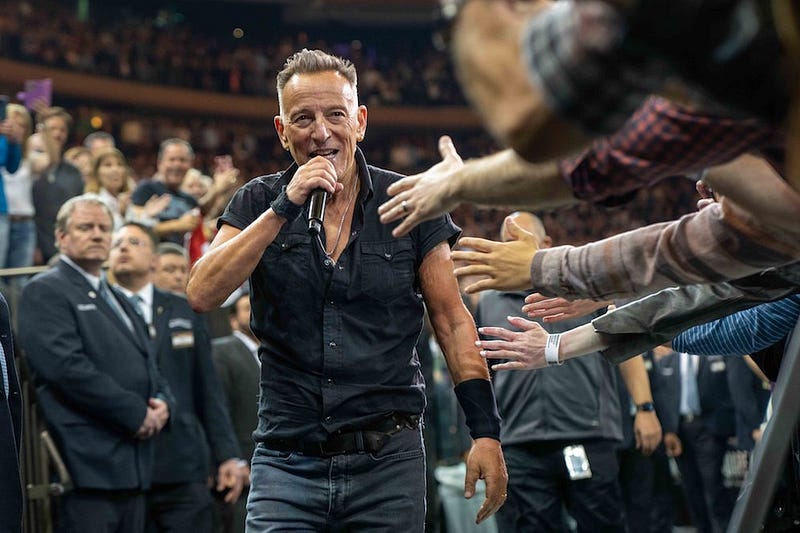
Bruce Springsteen at Madison Square Garden in 2023 / @springsteen on Twitter

Fifty years ago, Bruce Springsteen released his first album, “Greetings From Asbury Park, N.J.,” named for the beach town 20 minutes up the Garden State Parkway from my family’s summer house in the Pine Barrens.

Every June, on the way to our place, we’d pass the Jersey Freeze stand in Freehold where Springsteen took his children for ice cream. But we didn’t turn off the highway to visit the town in the title of his landmark album. Asbury Park was a sad, rundown place that had been losing visitors for years to spiffier spots like Long Beach Island.

But Springsteen and I had things in common besides our Jersey Shore roots.

One was that we’d both been seen as discipline problems at our Catholic elementary schools. As Springsteen has often recalled, a nun at St. Rose of Lima School stuffed him into a garbage can because, she said, that’s where he belonged.
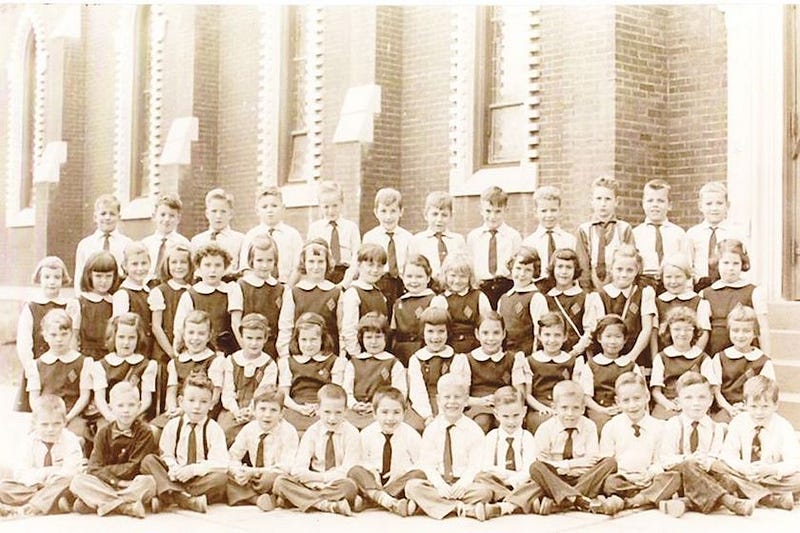
Springsteen, front row, third from left, at St. Rose of Lima / Springsteen Archives, Monmouth Univ.

I was luckier. A nun at St. Francis merely called in my mother to report that I had what people used to call “a fresh mouth.”

Perhaps fortunately for the sisters, both of us had defected to large public high schools by our freshman year.

Naturally, I felt some local pride when Springsteen became a superstar.

I cared enough to ask a taxi driver, while I was on a reporting assignment near Asbury Park, to swing by the Stone Pony, so I could see the bar where he and bandmate Clarence Clemons started out.

I listened with amusement when, at high school reunions, classmates boasted of knowing someone “who knew someone who was in a band with Clarence before E Street.”

I was irritated when my fellow journalists carelessly wrote that Springsteen grew up in “the beach town of Freehold” because, while Asbury Park is a beach town, Freehold isn’t.

And I was incredulous when Springsteen named one of his most celebrated albums “Nebraska.” Nebraska, Bruce? Really? Did the Beatles call their “Abbey Road” album “Broadway”?
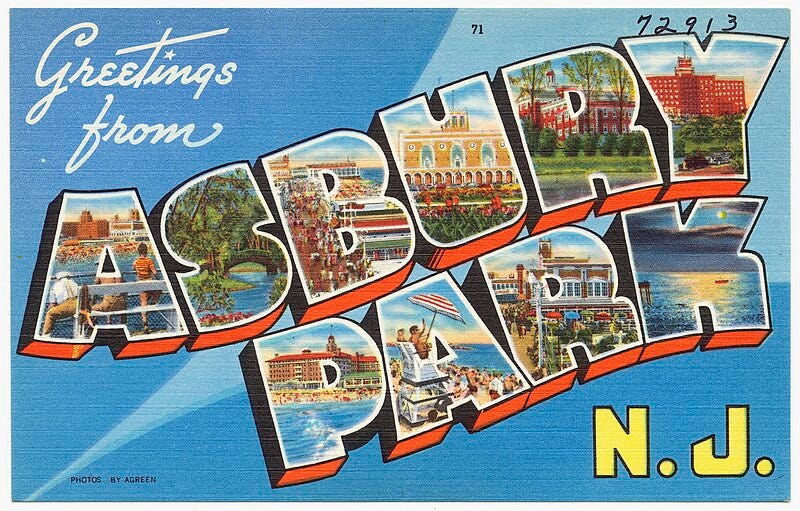
Vintage postcard that inspired the cover of Springsteen’s first album / Boston Public Library CC

But I wasn’t a Springsteen obsessive, the sort of fan who camped out for five days at places like Millennium Stadium in Wales, hoping to score a ticket or front-row seat. Nor was I the kind who paid $896, as someone once did, for a red bandana he’d worn. When a Ticketmaster imbroglio ensnared him last year, I paid scarcely more attention than I did to a similar mess involving Taylor Swift.

Springsteen’s raspy baritone sounded monochromatic to my ear, with less range and color than the voices of his contemporaries whom I preferred, such as Linda Ronstadt. His E Street Band lacked the magic of earlier groups like the Temptations and the Beatles. I didn’t find his style — unruly hair, rolled-up sleeves, and jeans so tight, they looked sprayed-on — especially sexy.

Despite the gaps in my fandom, I felt sure I knew how people would remember the musician fondly known as “the Boss”: for the albums, obviously, and the songs on them.

My tastes run to rousing stadium anthems like “Born to Run,” “Born in the U.S.A.,” and “Glory Days.” Bonus points for the local interest of the last: It’s about a star Little League pitcher and teammate of Springsteen’s in Freehold.

But it was fine with me if other fans chose to remember Springsteen by a ballad like “My Hometown,” a love song like “Rosalita,” or a pop-rock dance tune like “Dancing in the Dark.”
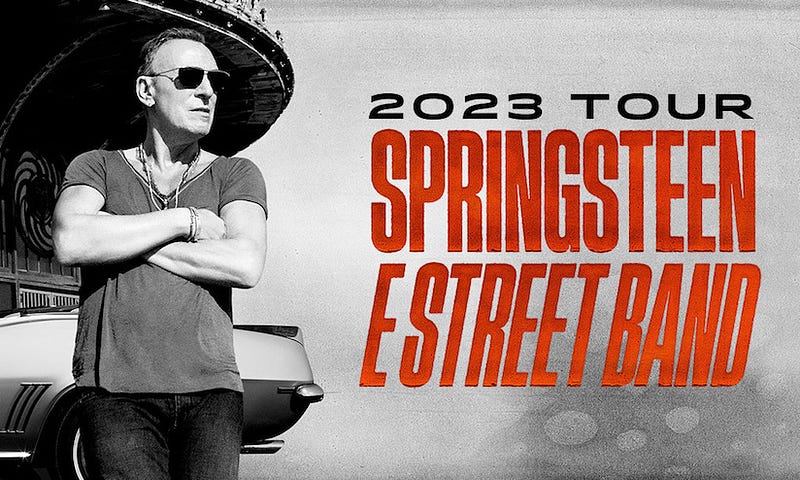
Promotional poster for Springsteen’s 2023 tour / Ticketmaster

Then I read a Washington Post story by the cultural historian Jim Cullen, published to mark the 50th anniversary of the release of “Greetings from Asbury Park, N.J.” on January 5, 1973. And I saw Springsteen in a slightly different light. The article makes a good case that his legacy will lie not in his albums or hits but in his live performances.

Cullen argues that if Springsteen came of age in the album era, he has transcended it on the live circuit. That’s enabled him, after a career of more than five decades, to hold onto a passionate fan base and keep packing stadiums when many musicians of his generation might be lucky to fill a theater in a second-tier U.S. city or even a high school auditorium.

How did he do it?

Springsteen had polished his skills as a performer — and proved he could excite crowds — during thousands of hours of shows in venues like the Stone Pony and in college towns. One fan would tell the New York Times nearly a half century later that she first saw him in “a sleazy little blues bar” in Cambridge, Mass., in 1974.

“It was like the roof was going to blow off the venue,” she said. “I have never experienced anything else like that in my life.”
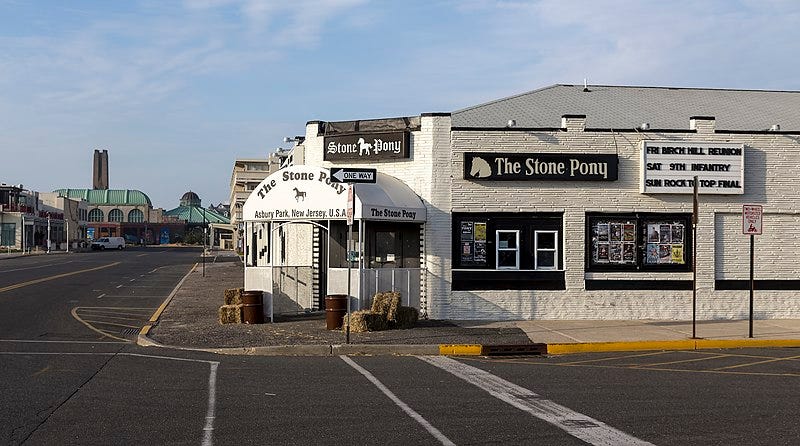
The Stone Pony in 2016 / Wikimedia Commons CC

That ability to electrify audiences gave him a fallback position when “Greetings From Asbury Park, N.J.” flopped, and his second album had sales that didn’t impress executives at his label, Columbia Records.

“He continued touring — it was the main way he paid the bills, living on an allowance of $35 per week,” Cullen writes. “And the rising tide of his reputation, spurred by his live shows, was reaching influential disc jockeys like Ed Sciaky at Philadelphia’s WMMR-FM and critics like Rolling Stone reviews editor Jon Landau. The latter called Springsteen [the] ‘rock-and-roll future’ after hearing him perform and would soon become Springsteen’s manager, producer and confidant.”

But as Cullen tells it, Columbia was losing patience with his lackluster sales. It decided to advance Springsteen the money to record a hit single and see if he could meet the challenge. Within six months, he had written “Born to Run,” which would become the hit he needed and the title song for an album that sold seven million copies and is seen by some critics as one of the greatest of all time.

Springsteen went on to have one of the most storied careers in rock ’n’ roll. But by the dawn of the 21st century, the music business was changing.
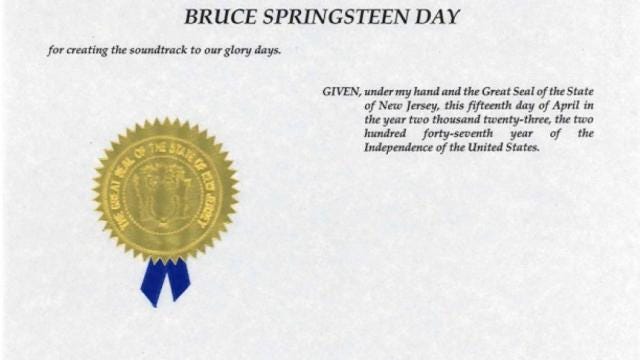
Detail from the proclamation naming Sept. 23, 2023 Bruce Springsteen Day / @GovMurphy

The arrival of the now-defunct digital-file sharing app Napster in 1999 had opened the door to the era of Spotify and Pandora, when streaming services allow people to pay to play anything they want on their devices.

The death of the album era upended the industry. Cullen writes:

“Insofar as there’s money to be made in recorded music, it comes from streaming (though individual streams typically generate a fraction of a cent for artists) or from licensing songs for advertising, film and television or other platforms….Now live shows are king. Once upon a time, touring supported records; now it’s the other way around.”

Springsteen’s early days on the road have left him better prepared for that reversal than musicians who became stars without those years of scraping by with far-flung bar and campus gigs.

“In an important sense, the 73-year-old Springsteen is back where he started: making his livelihood on the road,” Cullen writes. In February he launched a year-long international tour that was temporarily halted after he and his wife and bandmate, Patti Scialfa, tested positive for Covid-19.

But if Cullen is right, that won’t change how the world remembers him:

“His days of million-selling albums have long since passed — his latest, ‘Only the Strong Survive,’ has moved about 40,000 copies — but he retains his place as a titan of the live circuit, generating well over a billion dollars in ticket revenue. His life on the stage has been the one constant of his career. And long after he has left it, that stage will be his legacy.”
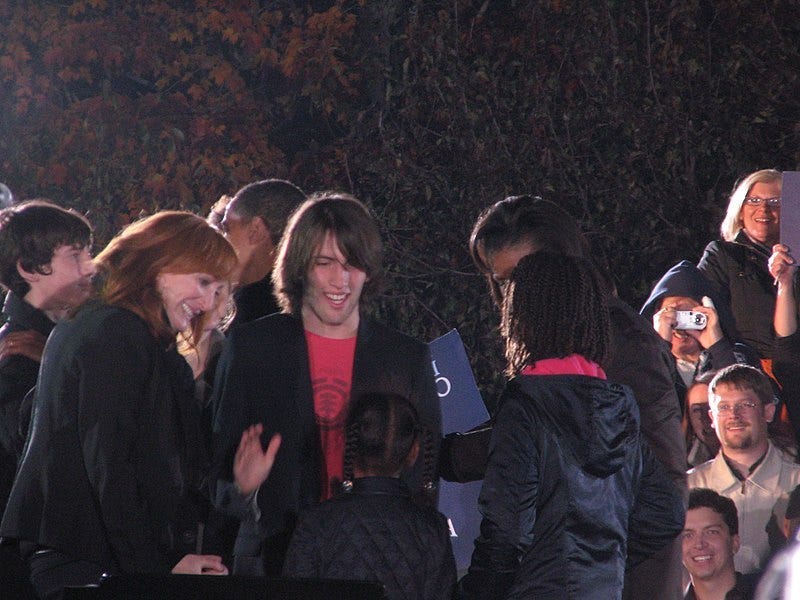
Patti Scialfa greets the Obamas in 2008 / Wikimedia Commons CC

For those of us who grew up in Springsteen country, his legacy goes beyond that. A half century after the arrival of “Greetings From Asbury Park, N.J.,” he still lives 10 minutes from Freehold in Colts Neck, N.J. Or, to put it slightly differently, about 11 miles from the Monmouth Medical Center, where he was born.

It’s remarkable — when you think about it — that Springsteen has stayed so close to home. It’s as though Elvis had remained in Tupelo, Mississippi, instead of buying Graceland in Memphis, or John Lennon had moved back to Liverpool instead of into the Dakota on Central Park West. Did Bob Dylan take young Jakob to an ice cream stand in Hibbing, Minnesota, the way Springsteen took his children to the Jersey Freeze?
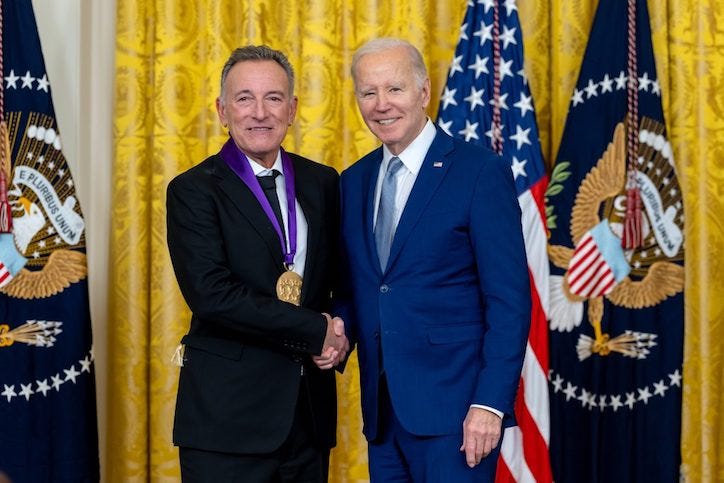
President Biden on awarding Springsteen the National Medal of the Arts / Official Springsteen website

Springsteen has more than a token presence in the place where he grew up. He’s part of the life of the community.

I’ve met people who’ve seen him at children’s soccer games and at the beach club in Rumson. Alone or with Jon Bon Jovi, who used to live nearby, he’s taken part in countless events to benefit the working-class and other heroes honored in his songs: to help the family of a slain police officer in Long Branch, to save the Count Basie Theatre in Red Bank, and to help Hurricane Sandy victims and children with special needs in Monmouth County. He donated a firetruck, known as the “Born to Run” truck, to Freehold.

Last month President Biden gave Springsteen the National Medal of the Arts for his role in American life. And since then, the governor of New Jersey has declared Sept. 23, 2023, Springsteen’s 74th birthday, the first official Bruce Springsteen Day in the state.

For those of us who’ve lived in Springsteen country, those things, too, will be part of his legacy. Nobody should expect them to be the last of it.

Last year Springsteen showed up at the Freehold firehouse and spoke on the day the town announced that it would convert the outdated structure to a community center named for him.

He’s traveled a lot, he told the crowd. But he said there’s been one constant to his journeys: “I always come back.”

@janiceharayda is an award-winning critic and journalist in Alabama who was born and raised in New Jersey and returned for a decade in adulthood. She spent her childhood summers near the Pine Barrens hamlet called Double Trouble. Her writing has appeared in major media including the New York Times, the Wall Street Journal, the Washington Post, Newsweek, and Salon. She has been the book columnist for Glamour, the book critic for Ohio’s largest newspaper, and a vice president of the National Book Critics Circle.

If you’d like to read all of my articles without hitting a paywall after three, you can do it by joining Medium with my referral link:

Music
This Happened To Me
Bruce Springsteen
Journalism
Culture
Recommended from ReadMedium