
Are We ‘Actors on a Stage’? #9
How Much of a ‘Fake Front’ Do We Project — Trying to be Accepted, and Trying to Hide Who We Really Are?
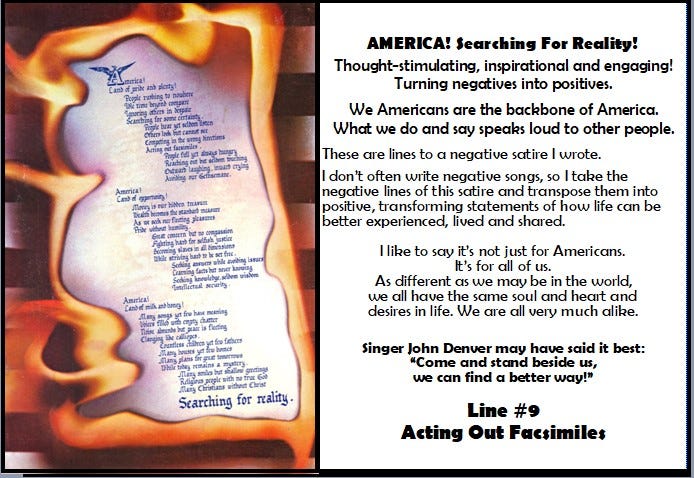
This is a satirical, negative song I wrote. The articles transpose negatives into positives. For the free E-book, and the lyrics of the song, or to hear me sing it: http://www.gospelpowerofgod.com/america-searching/
Acting Out Facsimiles
A facsimile is a ‘look alike,’ but it’s not the real thing. It’s a fake, but it looks real. In the business and legal world it’s called a copy, a reproduction, a photocopy made with a mechanical device. It’s an imitation of the original.
One way we act out facsimiles or play-like fantasies is with regard to who we are as people. We often try to copy the good traits of others, even if we don’t have them. Young people do this all the time, copying the top kids’ dress, hair, looks, and other things. But adults do it too. Not all copying or modeling is wrong. I shared how John Denver was a model for me. I never tried to copy him, but I did employ his good traits like the music he chose, and his friendly approach to folks.
We shouldn’t wear masks to hide behind, and we can’t ask God to deal us a new hand in life. We’ve got to play the hand we have, and it is seldom 4 aces.

But there are things we can do to make life work better.
The 5 ‘B’s of Living Life
Advertisers say we need all of what I call ‘the 5 B’s’ — (1) beauty, (2) bucks, (3) brains, (4) brawn, (5) booze. Booze just means the pleasures of life. I don’t mean that one literally (I just had to make the B’s line up).
But they say we need to be as beautiful, wealthy, smart, and as physically kept as possible, plus have all the toys, gadgets, cars, etc. possible. And of course, we always need a new and bigger house about every 7 years.
Roles We Play Do Change
We might have one role we play at home and a different role at the office. Of course, the mask we wear to church is different. We don’t want folks we socialize with to see the person we want to be known as with religious folk.
This can all come from not having a good self-image or significance that we talked about on page 15. Something I heard is so true: “We cannot consistently act, on the outside, different from what we think on the inside.” The keyword here is ‘consistently. We can fool some of the people all of the time, but we can’t fool those close to us much at all. We shouldn’t develop a “Dr. Jeckyl and Mr. Hyde complex.”

The “Act As If’ Principle
There is a human development theory called ‘the act as if principle.’
If we ‘act as if’ we are something we’re not, trying to grow into that role, then it’s not all wrong. It’s not just role-playing, but trying to adapt and develop to be something more than we are. It’s like a goal to make you become better.
Psychology also says it’s good to ‘act as if’ you are like the other person if you are in a certain situation with them like negotiations or sales. It’s called the commonality principle. The more the other person sees you are like them, the more they trust you and relax. If they fold their arms, or cross their legs, or lean forward, or gesture a lot, then you do the same things.
Psychology says this is not ‘cheating’ or ‘faking,’ but merely ‘creating space’ for a better relationship.
A Chat with The Gospel Life Coach
The Bible tells us to try to live better, like Jesus. “What would Jesus do?” is a common phrase today. This is not just pretending or ‘play-acting.’ I know I’m not Jesus, and I’m very far from it. But I do use Jesus as a model to try to live just a little bit better than I might otherwise live.
But our faith is meant to be in God, not in ourselves. And we’re not trying to cover something up or hide it. We’re trying to become better. This is relying on the power of the Holy Spirit inside of us.


