
Are there personality disorders that make someone more likely to develop a gambling addiction?

There have been a number of studies conducted in the past decade examining pathological gambling and personality disorders. When looking at the two together, it seems that they often go hand in hand. When the comorbidity of personality and gambling disorders has been studied through systematic reviews and meta-analysis, the prevalence rate of any personality disorder for those with gambling addictions was 43 percent while the prevalence rate of antisocial personality disorder specifically was 29 percent.
Personality Disorders Commonly Found With Gambling Addiction
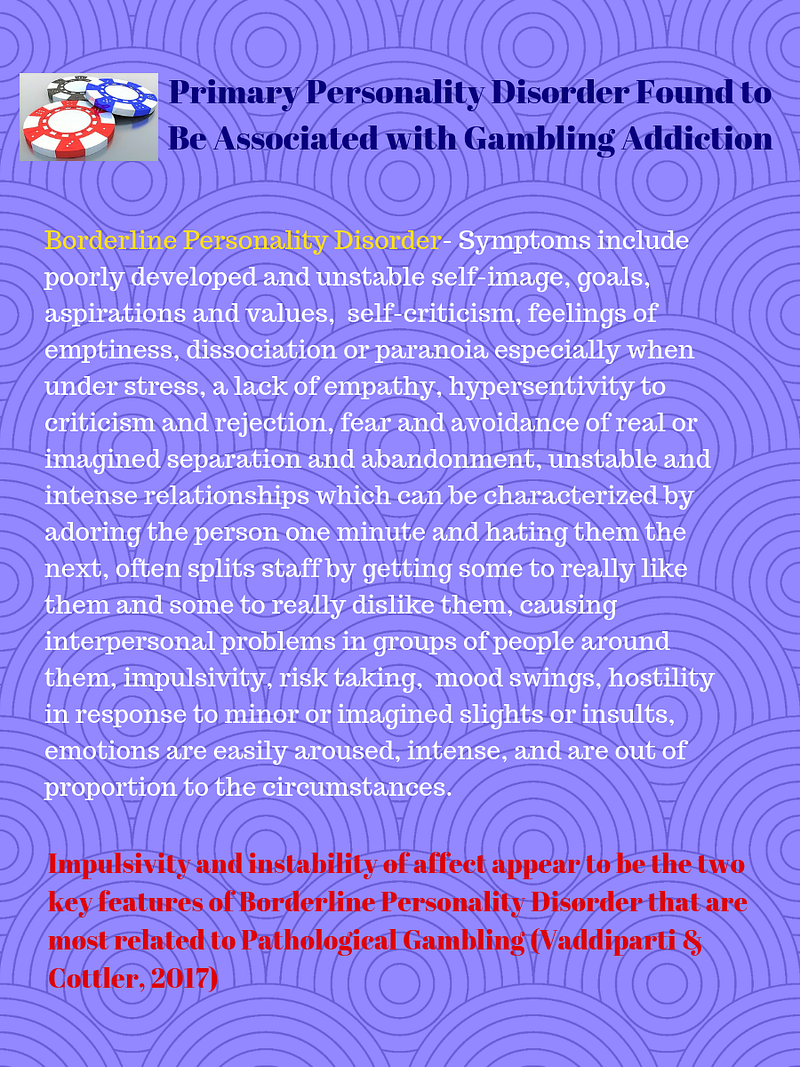
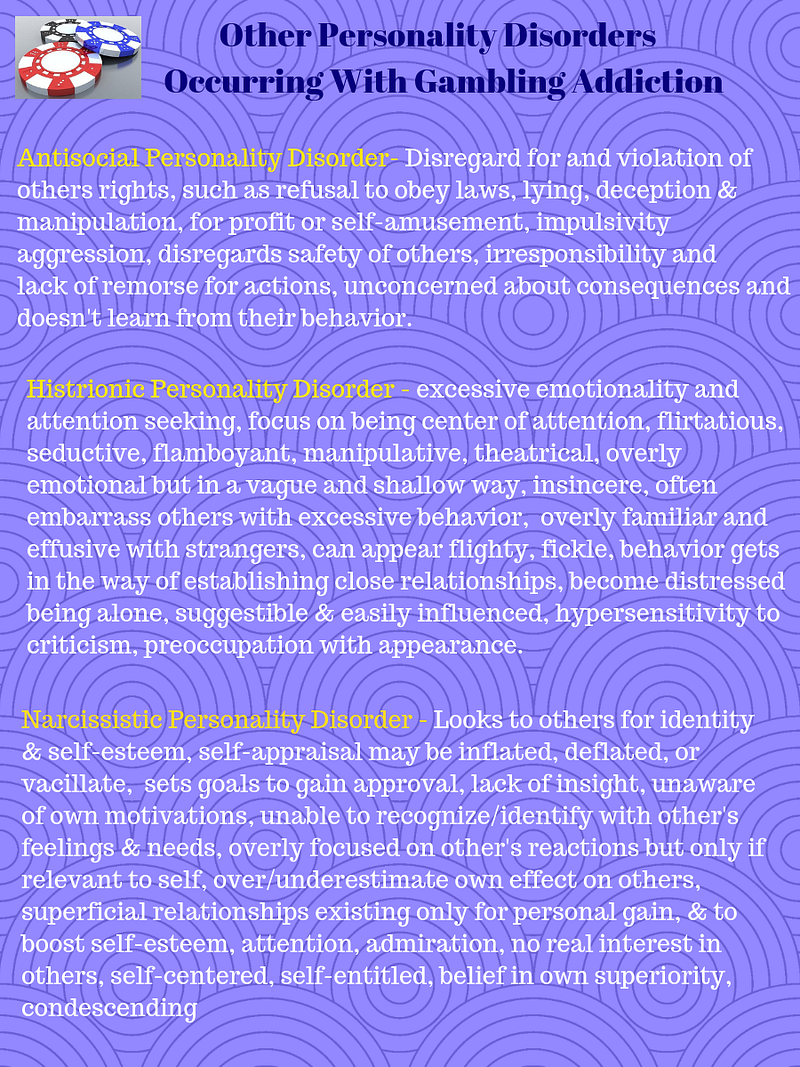
There is also quite a bit of evidence that Cluster B personality disorders (antisocial, borderline, histrionic and narcissistic personality disorders) are the most common personality disorders to be found in people with pathological gambling. Borderline personality disorder is the most prevalent, and it is believed to predate the gambling problems in most cases. Thus, it is considered to be a major risk factor for developing problem gambling. Having a Cluster B personality disorder has been associated with more severe gambling problems and an early age of onset of pathological gambling.
Personality Features Found in Gambling Addiction
One of the main personality features of pathological gambling is impulsivity. Impulsivity is a basic aspect of people’s personality, and higher levels of impulsivity can influence the development of disorders that involve problems with impulse control disorder including pathological gambling. Problems controlling impulses, being unable to delay gratification, risk-taking and sensation seeking are other personality characteristics frequently found in pathological gamblers. The other major personality trait found in pathological gamblers is antisocial behavior. Antisocial behavior is also related to impulse control problems.
Other personality factors have been found in pathological gamblers as well. When using the Five Factor Personality typology, pathological gamblers have been found to be high in neuroticism and low in agreeableness and conscientiousness.
Neurotic individuals tend to experience negative emotions, such as anxiety, depression, and annoyance, rather than being emotionally stable. They tend to be hostile and get angry easily and are self-conscious, being easily intimidated. Neurotic individuals are impulsive, acting quickly without thought, sometimes in an effort to relieve their negative emotional state and they are highly vulnerable, panicking easily with little provocation. People who are high on neuroticism have great difficulty bouncing back after experiencing a major stressor. This can be a big problem as they experience moderate and sometimes even mild levels of stress as much worse than most others.
Those who are low in neuroticism are calm, more emotionally stable, not as likely to overreact when experiencing stress and are generally happier than their counterparts. They are able to tolerate the normal hassles and disruptions in life and have the coping skills to rebound after a major problem in their lives.
Individuals who are agreeable are friendly and co-operative. They are usually well-liked by their peers and colleagues, and they are comfortable trusting others. They tend to be helpful when others are in need and are described as more altruistic than non-agreeable people. Agreeable people don’t like conflict or being involved in arguments, and they will do what they can to appease and pacify others, often being looked to as the peacekeeper of their social group.
Disagreeable people tend to be less trusting and more suspicious of others. They are less helpful to others, being more motivated to act according to their own self-interests. Because of this, they are seen as more selfish than agreeable people. These characteristics cause those who are disagreeable to have poorer and less satisfactory relationships than agreeable people. This compounds the problem as social support buffers us from stress and stress increases people’s tendency to be disagreeable.
People who are conscientious are aware of the consequences of their behavior and act in ways that are well thought out. They are careful to follow through on things that have been assigned to them or that they have volunteered for. They follow through on their commitments and are dependable. They feel a sense of responsibility towards others. They set goals and do what it takes to achieve them. Someone with a low level of conscientiousness is less motivated and less responsible in their actions. They are more relaxed in setting and meeting goals and more impulsive. They often act on a spur of the moment whim rather than making well thought out choices.
Conclusions and Implications
Personality disorders are commonly associated with Gambling Addiction. In particular, Cluster B personality disorders, have been related to problem gambling severity. Within Cluster B, those characterized as dramatic, emotional, erratic disorders, Borderline Personality Disorder has been found to have the strongest association with pathological gambling, especially impulsivity and instability of affect symptoms. Antisocial, Histrionic and Narcissistic Personality Disorders which make up the rest of the cluster have also been shown to be related to problem gambling. Additionally, certain features separate from conditions or disorders have been demonstrated to be risk or comorbid factors in regards to Gambling Addiction. These include the inability to delay gratification, risk-taking, sensation seeking, antisocial behavior and neuroticism. Research has also found that personality symptoms may moderate or mediate the relationship between other factors and pathological gambling. For example, psychological distress, and work and social adjustment were significantly associated with problem gambling severity for problem gamblers with personality disorder pathology,
The consistent findings that personality symptoms and high rates of comorbid personality disorders, particularly Cluster B disorders, suggest the importance of routine screening in gambling treatment services. More complicated psychological symptom patterns may make treatment more complex for problem gamblers with comorbid personality disorders. Future research should examine the applicability of the biopsychosocial developmental model to problem gambling in community studies. Differential treatment success rates also need to be examined as they relate to individual factors including personality profiles and characteristics. This will allow us to determine how to incorporate personality into treatment options for Gambling Addiction to achieve the most beneficial outcomes.
Other Resources That May Be of Interest
Brown, M., Oldenhof, E., Allen, J. S., & Dowling, N. A. (2016). An empirical study of personality disorders among treatment-seeking problem gamblers. Journal of gambling studies, 32(4), 1079–1100.
De Raad, B. (2000). The Big Five Personality Factors: The psycholexical approach to personality. Hogrefe & Huber Publishers.
Dowling, N. A., Cowlishaw, S., Jackson, A. C., Merkouris, S. S., Francis, K. L., & Christensen, D. R. (2015). The prevalence of comorbid personality disorders in treatment-seeking problem gamblers: A systematic review and meta-analysis. Journal of personality disorders, 29(6), 735–754.
MacLaren, V. V., Best, L. A., Dixon, M. J., & Harrigan, K. A. (2011). Problem gambling and the five factor model in university students. Personality and Individual Differences, 50(3), 335–338.
Mishra, S., Lalumière, M. L., & Williams, R. J. (2010). Gambling as a form of risk-taking: Individual differences in personality, risk-accepting attitudes, and behavioral preferences for risk. Personality and Individual Differences, 49(6), 616–621.
Odlaug, B. L., Schreiber, L. R., & Grant, J. E. (2013). Personality dimensions and disorders in pathological gambling. Current Opinion in Psychiatry, 26(1), 107–112.
Roccas, S., Sagiv, L., Schwartz, S. H., & Knafo, A. (2002). The big five personality factors and personal values. Personality and social psychology bulletin, 28(6), 789–801.
Turner, D., Sebastian, A., & Tüscher, O. (2017). Impulsivity and cluster B personality disorders. Current psychiatry reports, 19(3), 15.
Vaddiparti, K., & Cottler, L. B. (2017). Personality disorders and pathological gambling. Current opinion in psychiatry, 30(1), 45–49.