
LOOSEY GOOSEY LAWS
Are Squatters Rights More Important Than Those of Homeowners?
It’s more complicated than you may think

My younger brother Jim was a landlord for over two decades before he finally burned out.
In addition to tenants turning into squatters, he dealt with many thousands of dollars worth of destruction, improper maintenance and theft of appliances, wrought iron doors, and shutters.
In one eviction case he found his house occupied by an abandoned pit-bull and eight of her starving puppies.
Jim was more upset about the horrid condition of the dogs than he was about the broken windows and dismantled kitchen cabinets.
In his early thirties Jim had become a successful entrepreneur. He went from pushing a lawnmower to building a small landscaping company that included a tree-trimming component.
Tree work eventually became the cornerstone of his business. With the money he made from hiring top-notch “tree men” he purchased four houses in attractive mid-income neighborhoods.
All required painting, and two needed new roofs. Except for the roofing Jim and his employees did all the work.
Although he never finished college, my brother taught himself a number of valuable, lucrative skills.
He’s the only person I know — aside from my Master Gardener friends — who can identify by their scientific names almost any tree, flower, or bush.
With Jim’s landscaping, gardening and handyman skills, he was at a distinct advantage as he stepped into his new role as a landlord.
Over time Jim noticed an uptick in problematic tenants. Although he ran background checks while ferreting out information from previous homeowners, he relied on his “gut” to help signal potential trouble-makers.
His gut was beginning to betray him.
A naturally trusting and good-hearted person, (unlike his older sis) Jim was prone to believe hard luck stories and always forgave tenants who were late with their payments.
A regular church-goer who leads a men’s Christian prison ministry, Jim goes out of his way to help anyone in need. When people talk about the person who “gives the shirt off his back”— that’s who Jim is.
I hate to sound cynical but I suspect this trait is what led Jim to getting screwed — over and over again.
He’d sit on the sofa with tenants trying to help them untangle financial or other issues.
Jim once told me about the time he spent an hour explaining to a renter how and where he could get free tax filing assistance. The man was three months behind in his rent and was worried about a looming tax bill.
He hadn’t filed in years.
This individual also claimed to be a non-smoking teetotaller. Jim doesn’t drink but doesn’t object to other people indulging. He sees it as a personal choice that’s none of his business.
He prefers not to rent to smokers because of the smell that seeps into carpets, and because it’s a potential fire hazard.
The day he counseled the tardy tenant he noticed an overpowering aroma of cigarette smoke plus the blatant smell of liquor on the man’s breath — at 2:00 in the afternoon.
As Jim left he noticed the trash container pushed to the edge of the road for that day’s pick-up.
“Deb,” he said later, “that dumpster was overflowing with liquor bottles. Not cheap stuff, either.”
While I wondered how he would know the difference between cheap or good liquor Jim continued. “He could have paid three, probably four months rent with what he spent on booze.”
Two weeks later the tenant moved from the property and Jim never heard from him again. He’d broken the lease and stiffed on money owed but at least he didn’t damage anything or leave dogs behind.
It would get worse. Much worse.
Then came the time two adult couples and a teenage boy moved into a property vacated by a young family who moved at the end of their lease.
Jim hated to see the family leave but the husband’s new promotion required them to relocate to Atlanta.
He confessed he’d had a hinky feeling about the arrangement but the “alleged” previous landlord swore they’d been excellent tenants.
Within six months the tenants ceased paying rent. They also changed the locks and refused to take Jim’s calls. When he showed up at his house to speak to them — and hopefully collect payment— they wouldn’t answer the door.
Just as he was getting ready to start the eviction process one of the renters called and said they had moved. He told Jim he’d mail a check after they got settled in Illinois.
Jim knew that was unlikely to happen. He was just glad to be rid of them.
This was Jim’s only property outside the city limits. It was a large older home located on three acres in a small rural community about an hour’s drive from Memphis.
He was relieved no damage was done and was shocked to find the keys left in the mailbox.
It was that day Jim decided he would pitch in the towel on this property. He called a Realtor friend named Gary and told him he was ready to sell.
This was the during the early months of COVID. Business everywhere was slowing down or screeching to a halt. No one knew how long the epidemic would last.
Gary suggested they sit tight for a while — get through the holidays. Maybe start showing it in early spring.
Jim reluctantly agreed. He was still paying the mortgage but with ample savings and an emergency fund he decided to take Gary’s advice.
Jim’s rural house had sat vacant in the small, safe community for almost five months. He was looking forward to getting it off his books.
It was too long a drive going back and forth, and this house had the highest mortgage.
One afternoon in early March Jim received a call from Gary. He didn’t live far from the property and decided to swing by to check out the condition of the yard. He knew they’d need to get it in shape before listing it.
“Jim, I thought you said we’re gonna sell your Cummings Road property?”
“We are,” said Jim. “What makes you think I’m not?”
“Well, people are living there. There’s a truck that looks like the one belonging to those folks who skipped out last November.”
So began the nightmare saga of dealing with people who graduated from being renters, to non-paying renters, to squatters.
When Jim questioned neighbors down the street they were told the five folks who’d allegedly moved to Illinois before Thanksgiving had moved back mid-December.
Jim learned that utilities were turned back on in their names and locks had once again been changed.
This time when he came calling one of the men answered the door and asked Jim what he could do for him.
Jim told him in no uncertain terms they better vacate immediately — he was selling the house, and he needed them gone.
The man laughed and said that wasn’t going to happen. He seemed to be well versed on his “squatters rights,” and wasn’t going anywhere.
Squatters defined
The most basic definition of a squatter is a person that breaks into an empty property and begins living there without the permission of the owner or landlord.
They are also people who stay in a home that isn’t theirs but claim a right to be there.
Squatters are also tenants who ceases paying according to their lease but continue to live in the property.
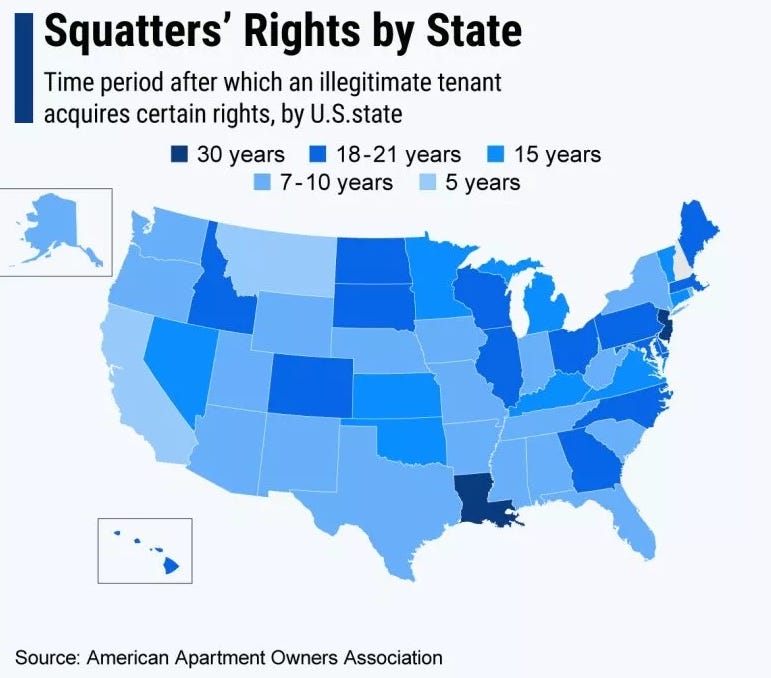
Compounding the squatting issue is the fact their “rights” vary from state to state, and in some cases it’s taken homeowners years and thousands of dollars to work their way through the system to reclaim their rightful ownership.
Adverse possession
Adverse possession legally allows people to use someone else’s property if the landlord or owner doesn’t try to evict them from their home or land. This is also called “continuous trespass.”
If a landlord hasn’t bothered with eviction long enough (depending on the state) the property title can even be converted to the squatter through an adverse possession claim.
Why adverse possession exists
While this sounds incredulous to most of us and grossly unfair to the legitimate owner who has legal possession of a property, the law was created to discourage vacant property ownership.
But when you think about it, most of us homeowners don’t want untended vacant properties in our neighborhoods, do we?
House squatting on the rise
According to an article on Realtor.com, stories of squatters taking over vacant properties and costing homeowners thousands to evict are on the rise.
Until recently, the issue has gotten little national attention.
In the article, Atlanta attorney David Metzger stated that since 2023 there’s been an explosion of squatter cases in his city. He said that while squatting used to exist mostly in low-income neighborhoods he now sees it in “bigger, fancier properties, including in new construction.”
According to the National Rental Home Council, there are at least 1,200 properties currently occupied by squatters in the Atlanta area.
It’s all over the U.S.
There are horror stories coming from all parts of the country.
In Florida, a family returned from an overseas trip to discover squatters had settled into their home during their absence.
In California, squatters moved into an unattended beach house. When the owners showed up they claimed it was theirs — it took a year to resolve.
In Maryland, a woman returned from vacation to find two squatters in her bed. While away they also sold over $50,000 of her possessions.
An Oregon woman fought almost a year to rid herself of squatters who took over her Maryland rental house — living rent-free with nothing more than his claim he had a lease.
A Texas lady recently reported that squatters had a yard sale in her house and sold her personal belongings.
A woman in Flushing, NY attempted to change the locks on a million-dollar home she inherited. The squatter inside called police and she was arrested.
What are states doing to address this thievery?
Until recently, not a lot.
Perplexing as it sounds, current law leans heavily toward the “rights” of tenants — this stemming from the fact that historically renters have had limited rights.
There are appalling stories of tenants who’ve been victimized by greedy and unethical landlords.
Renters thrown out into the streets with little recourse; unreturned deposits, and unfair fees associated with maintenance costs that are generally assumed by the landowners.
The list of abuses goes on and on.
When COVID hit in 2019 there came with it a seismic shift away from landlord favoritism.
The CARES Act banned evictions from all federally backed rental units nationwide. (In 2022 the statewide eviction bans were removed.)
Protecting vulnerable people from losing their homes during a time when COVID caused job losses and losses of income was the right thing to do.
However, during those years a dramatic uptick in squatting was occurring all over the country.
In some states the issue is being addressed. In Florida. Gov. DeSantis recently signed a bill allowing criminal penalties to be imposed on squatters.
It also gives police the right to arrest squatters on the spot and criminally charge trespassers for damage. Misdemeanor charges can be filed for falsifying a lease.

Georgia is also taking action. Its statehouse passed the Squatter Reform Act, making squatting a criminal trespass which can be handled by the police instead of a housing court. It’s expected to pass the Senate soon.
Other states crafting anti-squatting legislation include Alabama, Oklahoma, and New York.
Other recourses
Some property owners aren’t content to wade through miles of bureaucratic red tape, wasting time while squatters ruin their homes or sell their possessions.
Private services like the Squatter Squad in Southern California are popping up around the country using their own tactics to “encourage” squatters to leave.
Flash Shelton, better known as the Squatter Hunter, helps homeowners get back into their own houses by “squatting with the squatters.”
Read about how he does it on his website: https://squatterhunters.com/
Jim’s squatter situation
Jim should have started the eviction process of his tenants after the first month of non-payment. That would have put him ahead of the curve in the battle he faced later.
He would have been able to prove they were non-compliant tenants whose lease had been broken by failure to pay rent.
Because he had to start at Square One, the eviction and clearance of the unwanted, nonpaying squatters took over a year and cost him $10,000.
Fortunately there was no property damage but the squatters cost much more than the thousands in legal fees. It cost my brother time, worry and mental anguish.
Jim never received a dime from the evicted couples. He sold the property at a loss shortly thereafter.
Conclusion
Squatting is on the rise across the United States. The term “squatting” refers to someone who illegally occupies a property without payment.
It’s perpetrated by individuals who take up residence in a house without the owner’s permission and by people who sometimes “claim” to have a lease or some sort of “right” to the property.
Although it varies from state to state, squatters do have certain legal rights, including the claim of adverse possession.
Recently, states such as Florida, Georgia and others have passed — or are in the process of passing — anti-squatting legislation.
If you are a property owner make sure to educate yourself about laws regarding squatters. This is doubly important if you rent your property to any individuals or groups.
For most of us our homes are our most valuable possessions. We must do whatever we can to protect them.
Do you have a squatter story to share?
© 2024 Deborah Camp. All rights reserved.
Thank you for your time and attention.


