Are our Universities a Waste of Public Funds?
How we can Measure the Impact of our Universities
A recent report estimates that, as of 2014, MIT (Massachusetts Institute Of Technology) alumni have launched 30,200 active companies, employing roughly 4.6 million people, and generating roughly $1.9 trillion in annual revenues. Many government and University leaders across the world are in fact concerned about the impact of their Universities’ contributions to society to justify their continual public funding.
I remember the earlier 1997 MIT Impact Study by BankBoston which reported that MIT graduates had, since its founding in 1862, created 4,000 firms which, in 1994 alone, employed at least 1.1 million people and generated $232 billion of world sales. The combined revenues produced by “MIT Alumni-related” companies would make them, when taken together then, the 24th largest economy in the world.
In 2009, another report estimating that, as of 2006, MIT alumni had founded 25,800 active companies worldwide, employing 3.3 million people and generating nearly $2 trillion in annual revenues.
And as of 2014, MIT alumni have launched 30,200 active companies, employing roughly 4.6 million people, and generating roughly $1.9 trillion in annual revenues. That revenue total falls between the world’s ninth-largest GDP, Russia ($2.097 trillion), and the 10th-largest, India ($1.877 trillion), according to 2013 data on those and other countries from the International Monetary Fund.
According to MIT President L. Rafael Reif, “The report confirms what has long been clear: Our community’s passion for doing, making, designing and building is alive and growing.” He added, “As we do our part by continuing to foster our students’ natural creativity and energy, it is inspiring to see the potential our alumni hold to extend MIT’s power to do good for the world.”
The inaugural Harvard Impact Study to explore and quantify the economic and social impact of living Harvard University alumni around the world also found similar awesome Harvard alumni impact across sectors, industries, and communities globally. Harvard alumni from all disciplines of the University are making significant economic and social impact by founding organizations, employing people, serving as volunteers, and developing new ideas and products.
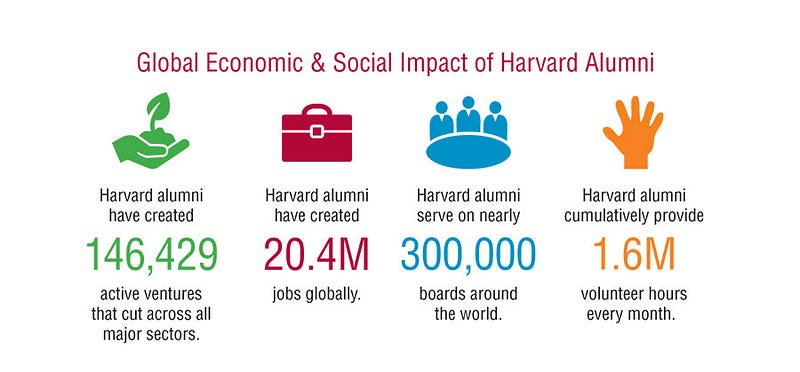
Both MIT and Harvard University alumni members share a deep commitment to improving society and giving back through entrepreneurship, innovations, board service, volunteerism and active community participation.
According to a Harvard alumni, Eri-Vincent Guichard,“Harvard gives you powerful tools for getting things done in the world,” and “Over time, you more fully appreciate the responsibility that goes with that education.” Guichard, from rural Guinea, is founder and CEO of Homestrings, an online investment platform that facilitates diaspora and impact investing in Africa. Homestrings investors choose from among funds or projects in Africa that meet economic, social, and good governance objectives.
The Harvard and MIT Reports are clear examples illustrating the contribution of Universities to their respective dynamic economy. The development of business enterprises is the definitive measure of the impact of the University and its professors through their students.
It is notable that not a single sentence in the MIT and Harvard Reports mentioned the amount of publications which their eminent Professors have respectively contributed to. Universities are measured by the social impact of their Alumni, not the personal achievements of their Professors.
In a global economy increasingly driven by knowledge and knowledge products, as well as continuous innovations, it is well that we begin to appreciate the human resource competencies embedded in the human intellectual domain. After all, the human talent is Singapore’s only natural core competitive advantage.
The initiative to reward and retain top University professors is crucial in our efforts to build Singapore into a world-class education hub.
We will need however to avoid going the same route as other Universities since our circumstances are uniquely different from other Universities in the USA and Europe.
The value of a great Professor is more than just the value of the sum total of his or her journal papers. It is also more than the measure of his or her store of expert knowledge. The “public” value of a great Professor lies in the impact that he/she makes in the “use” of his/her store of expert knowledge for the benefit of the University, his/her students, the community, industry, the nation and other countries.
It is well-known that Albert Einstein only published 3 papers. Many Singapore University professors in fact actually publish more journal papers than Nobel Prize potentials and winners!
In Singapore, the time has long since come for Universities’ Search Committees and Tenure Committees to seriously question the value of “publishing” as a motivating force in academic life. University administrators must move beyond ‘publish-or-perish’ policies and assess the full contributions of its academic staff to society.
The retention of top professors should evaluate the quality, and not merely the quantity of their publications. More importantly, teaching excellence and other contributions to knowledge should be judged against the impact of such expert knowledge on our communities, businesses, societies and nations.
The evidence of patents, commercialised knowledge products is sufficient to establish the beginning of impact. Consistent professional consulting assignments with credible national and international organizations or businesses known for their high quality professional standards is also sufficient evidence of basic impact.
A research study found that “specious and trivial” research resulted when people work with no goal other than that of attracting a better job, or getting tenure or higher rank. Such “specious and trivial” research makes little contributions to knowledge. “As a result, in the past few decades, the need to secure a job in academia has certainly accounted for a fair amount of the useless material that’s been published” (Hyde, L,1983, p. 83).
Many university professors would produce journal papers With a “publish or perish” mentality with a vengeance, simply to improve their resume in preparation for promotion or for their next job in another University.
The tremendous amount of publications by professors every year must be validated by more concrete evidence of their impact on businesses and society. There should be ample proof that the supposedly “new” knowledge contained in these journal and conference papers is in fact of some or significant public value.
While not everyone who is consulted would definitely possess expert knowledge of great value, it is however conclusive that those who claim to have specialized expert knowledge but has not been consulted professionally by those for whom such knowledge is deemed relevant, important and critical may not really have any expert or specialised knowledge of significant public value at all.
Academia, as a noble profession that prides itself for its appreciation of complexity and subtlety, and questions the face value of superficial façade, should not embrace so easily and wholeheartedly such a simplistic and reductionist technique as using a single dimension for the evaluation of its own performance and impact. No professor worthy of the title will ever accept a single quantitative measure as an indicator of his/her quality as a professor.
The multi-dimensional and multi-faceted performance of a professor can only be measured by the extent to which he/she realized the “public value” of his/her specialized expert knowledge.
The following impact dimensions, in degree of diminishing distinction, could be relevant for the evaluation of university professors:
(1) International Level Impact and Awards
(2) National Level Impact and Awards
(3) Contributions to Community and Public Service
(4) High-Level Professional Consultancy (Quality of Clients)
(5) Teaching Excellence
(6) Research Excellence (Papers, Patents, Innovations, Ventures)
(7) Contributions to the University (usually administrative duties)
The University is a powerful stimulus for economic development, leading to measurable increases both in GDP and employment. University research has the potential to produce breakthrough advances that can fundamentally alter our economic growth and quality of life. And although not all research leads to such world-changing results, it does produce a steady stream of new ideas and technologies in University students. They are, in turn, emboldened and empowered to lead in innovations and continuous improvements for enhanced productivity and superior quality of life.
University education thus has an economic impact by equipping students with the ability to generate new ideas. Companies will benefit by hiring graduates with knowledge and research skills. University graduates help firms become more efficient and productive, and help them to introduce new products and processes.
Funding with public funds for University could only be justified by its impact on a continuum of clearly defined outcomes. Currently, University research is only measured by the number of journal papers produced by funded activities conducted of its professors, research officers and project officers. Innovations, patents, venturing, licensing, high-level consulting and enterprise formation are not regarded as central in the University research impact.
Clear demonstration of the economic and public impact emanating from universities is needed to justify further public investments in university learning and research activities.
One may recall an observation of late Singapore’s Senior Minister Lee Kuan Yew some 42 years ago when he addressed a Youth Leadership Meeting:
“… It is amazing the number of highly intelligent persons in the world who make no contribution at all to the well-being of their fellow-men”.
If our University graduates were to become the movers and shakers of society as future leaders, we have to entrust them to Professors and teachers whose lives are marked by a passionate drive for social and community impact, instead of the selfish acquisition of knowledge for self-improvements. Those who are not concerned about the issues of industry, business, society and community cannot be expected to prepare or influence our children to make significant positive contributions to their society and nation for a better future.