
Are Our Burka Allies Welcomed?
Taliban tells women what to wear, so is the West
“If we want to destroy the structure of Algerian society, its capacity for resistance, we must first of all conquer the women; we must go and find them behind the veil where they hide themselves and in the houses where the men keep them out of sight.” — Frantz Fanon (1925–1961)
I agree with historian Bernard Lewis that “Like every other civilization known to human history, the Muslim world in its heyday saw itself as the center of truth and enlightenment, surrounded by infidel barbarians whom it would in due course enlighten and civilize.” (Roots of Muslim Rage)
But this fact is not only true to past religion-based civilizations. It also applies to our present time, in which secular powers use violence to impose their “truth” on the other or the “barbarian.”
The French claimed that Algeria was a country populated by fanatical barbarians. This negative vision of Algerians was to stress the need for French assistance to the new colony and justify the French occupation, which lasted for 132 years (1830–1962).
In the late nineteenth century in Australia, British settlers regarded themselves as the “fittest and highest types of mankind” and the Aborigines as the “inferior and most primitive” among the human race.
The US invasion of Afghanistan has always been linked to the Western model of women's rights. It’s as Laura Bush has put it: “The fight against terrorism is also a fight for the rights and dignity of women.” (Los Angeles Times, November 2001)
Preventing Afghan girls from going to school has been linked to Islamic Law or Sharia. The burka is as cultural to some Muslims as it’s to some Jews. Haridi Jewish women, for example, do wear the burka. Yet, the burka is depicted as an Islamic dress in the media.
Muslim women around the world and scholars of Islam have always been protesting this Western attitude. “Bring us your democracy, not your bikinis,” Zohra Yusuf Daoud, Miss Afghanistan of 1973, told a Women for Afghan Women conference in New York.
Christine McCarthy McMorris has studied this issue extensively. In her article, Bush and the Burqa, she wrote that within a few days after 9/11,
Journalist Tom Pelton, writing a detailed account of the Taliban’s reign for the Baltimore Sun September 13, included one sentence on the issue: “Women, under the rule of the Taliban organization that controls most of Afghanistan, are barred from leaving their homes without covering themselves from head to toe.”
In his September 20 address to Congress, President Bush followed suit, citing among the reasons for taking military action against the Taliban the fact that Afghan women were “not allowed to go to school.”
And on the reactions of the American press after the overthrow of the Taliban, she wrote,
For the press, the removal of the veil/burqa became an irresistible metaphor of that new freedom: “Veil Is Lifted in Mazar-e Sharif; New Freedoms Embraced as City Emerges From Taliban Rule” (Washington Post, November 12); “Women Shedding Cloak of Taliban Oppression” (Boston Globe, November 26); “Veil Lifts on Afghan Women’s Future” (Denver Post, November 27); “In Kabul, Still a Veil of Fear,” (Newsday, November 28).
As someone who lived in the Arab Gulf for 18 years, I ask: why the veil and girls education were not on the agenda of the United States when it liberated Kuwait from Saddam Hussain in 1991? Americans helped Kuwait re-establish its government but didn’t express any concerns about its constitution. According to Article 2 [State Religion] of the Kuwaiti constitution, Sharia or Islamic Law is the source of legislation.
“The religion of the State is Islam, and the Islamic Shari’a shall be a main source of legislation.”
Kuwaiti women go to school and work. They are not barred from leaving their homes. Some wear the hijab, others wear the niqab, and others don’t cover their heads. According to 2017 data from UNESCO, the literacy rate stood at 96.3% for Kuwaitis. Moreover, according to World Bank statistics from 2015, among Kuwaitis 15 and older, females have caught up to and surpassed their male peers on this metric of educational attainment, which stands, for the respective sexes, at 99.4% and 96.4%.
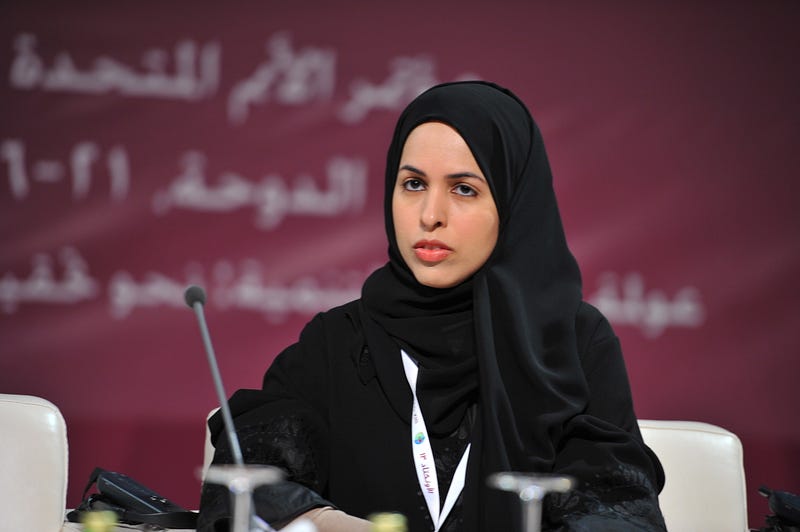
The same holds for Qatar, actively facilitating the negotiations between the Taliban and the United States. Qatar’s representative to the United Nations, Alya bint Ahmed Al Thani, is a hijabi Woman. Qatar’s constitution also states that Islamic Law is the main source of its legislation”.
With the defeat of the US and NATO and the return of the Taliban to power on August 14th, the US has evacuated approximately 58,700 people, according to the White House. Those are Afghan civilians affiliated with the US and NATO forces during its 20 years in Afghanistan. The overall number of Afghans seeking relocation to the US and other Western countries remains unclear.
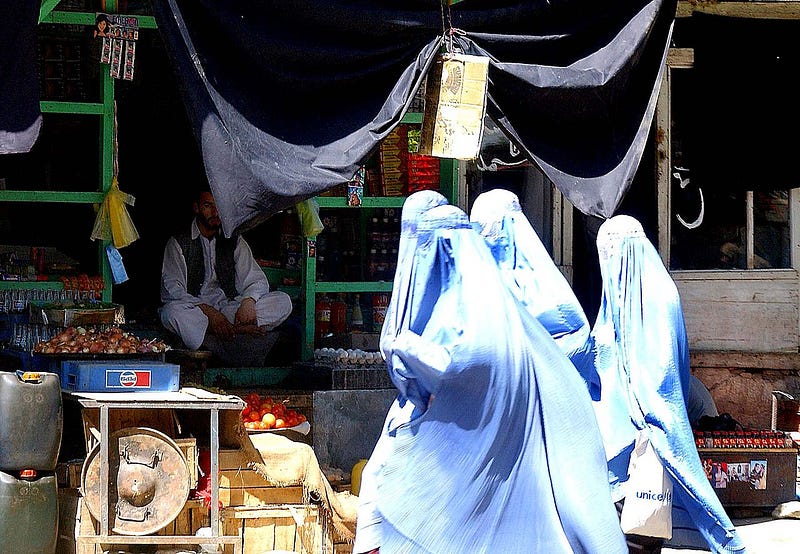
I’ve seen many photos from inside the Kabul international airport and noticed that most women are covered. One photo that captured my attention showed many Afghan women wearing the blue-colored burqa, also referred to as the ‘shuttlecock,’ waiting to board a U.S. plane.
In light of Western attitudes towards the Muslim veil, would these women be welcomed in the West? Isn’t it ironic to see that our Afghan allies, who helped us fight the Taliban, are not yet convinced that Burka or hijab means oppression?!
In most European countries, it is illegal for Muslim women to wear face-covering veils — such as burqas or niqabs — in public. Britain is the only exception, but according to a 2017 Pew Research, most Western Europeans favor restrictions on Muslim women’s religious clothing.
Even among non-Muslims with positive feelings about Muslims, large shares in most countries still favor banning face coverings. Among those who say they would be willing to accept a Muslim in their family, a median of 55% support banning facial coverings, and this includes majorities in Germany, the United Kingdom, Austria, Switzerland and the Netherlands.
In the United States, Republicans are working to ban the hijab in public, let alone the Burka. To many Americans, including Democrats, the Muslim veil symbolizes oppression and not an innocent piece of cloth.
France and Germany have banned the hijab in public. It’s expected that some other European countries would follow suit.
Furthermore, France is moving quickly to ban any Muslim woman under 18 from wearing the hijab. What’s funny and ironic is that the age of consent for sex in France — 15 years old — is lower than that for wearing the hijab!
So in closing, those Afghan women will not be happy or feel welcomed in the West unless they take off their veil and adopt the Western style of life.
An important question arises here: why do we judge our governments with one standard and the Taliban with another?
Can’t we realize that the Taliban forcing women to wear hijab is morally equivalent to France forcing Muslim women to remove it?


