
Maoris are better integrated into NZ-society than Aboriginals in Australia. Here’s why.
Indigenous people have it tough across the world. Why are Maoris fairing “less badly” than Aboriginals?
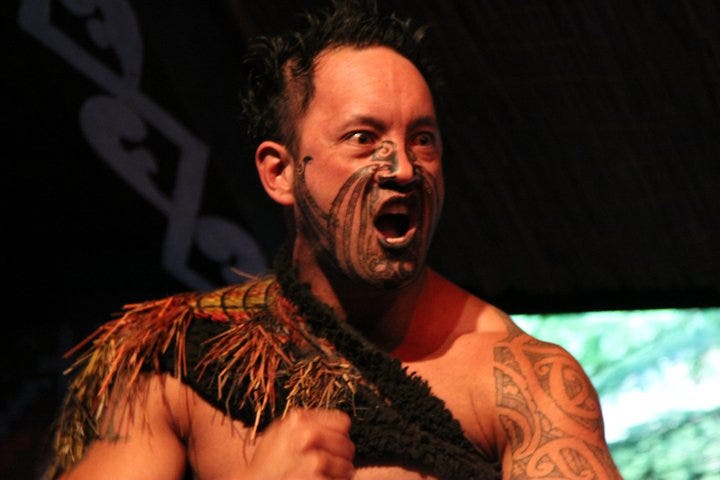
Whilst in Wellington for work some time ago, I was walking down the main street of the business district and came across a man busking on the footpath.
He didn’t receive a second glance from any other passerby. What struck me, however, was that he had a large tattoo, covering his entire face.
He was a Maori, and this was his country.
Looking around, I noticed that every government office had signage not only in English but also Maori.
In fact, over the few preceding days, I noticed a great many things: newsreaders began their shows with “Kia Ora”, instead of Good Evening, there were Maori TV channels and language lessons, the Hakka was performed by the National Rugby League team to large crowd filled stadiums, a Maori party prominently featured in national politics, Maori issues often discussed in the news, and Maori words — be they names of places, people, or things — were enunciated with care, by white and brown alike.
These are all little things on their own, but when considered together, I couldn’t help but marvel at how much a part of everyday life the indigenous people of this country were.
Is there actually any difference?
This feeling was accentuated when contrasting it with my own country.
In over 30 years of living in Sydney, how many aboriginal phrases did I know? In fact, how many aboriginal people did I know? How many did I work with?
Actually, how often did I even see them, and when I did, what percentage of the time did they appear as integrated participants of society and how often did they appear to be members of an unfortunate fringe?
Anecdotally, it seemed that one country had done a better job of social integration than others.
Could this be backed up by fact? Perhaps considering some basic human development and quality of life measures would shed some light toward this:
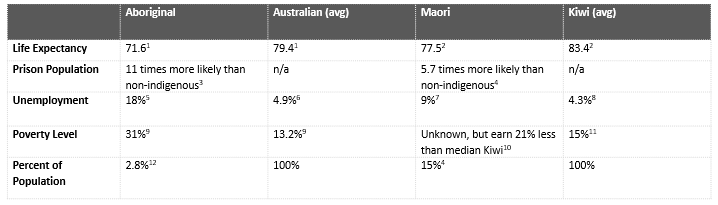
Suspicion confirmed.
Though Maoris are by no means on par with their compatriots of European descent, with stark differences worthy of intervention; the gap between Aboriginals and the rest of Australia is orders of magnitude worse by comparison.
What could be the reasons behind this great difference?
Australia and New Zealand are neighbouring countries. Both were colonised by the British, and both had a pre-existing indigenous population who suffered at the hands of the new arrivals.
How could there be such a pronounced difference in how Maoris fared in New Zealand, compared to the Aboriginals in Australia?
The answer, I believe, can be attributed to three key reasons:
#1: Smallpox
Though Maoris also suffered from introduced European diseases to which they had no immunity, it impacted the aboriginal population far more severely.
In fact, some 50–70% of the Sydney and NSW indigenous population died after succumbing to the disease within just 2 years, by 1791.
Such rapid decimation of the people, in turn, brought about a complete social collapse. Those who survived, fled inland with the disease, furthering its spread of it to other populations.
#2: Maoris were far more unified
There were 250–300 different Aboriginal nations on the continent, each with a different language, and countless more dialects. As such, it was difficult to unite them against a common threat.
The Maoris however, though in many different and often competing tribes, spoke a common tongue, and managed to largely unite behind a single Maori King, thus presenting a more united front.
#3: Establishing formal treaties
The Aboriginals, came to Australia 40,000 years ago and were nomadic hunter-gathers, who did not ostensibly (from a European perspective anyway) mark their territorial borders or develop their land through agriculture.
As such, under British Law, the land could be considered Terra Nullius, and thus available for the crown’s political occupation.
It was not until Mabo in 1992 that Terra Nullius was overturned.
In contrast to this, the Maoris only came to New Zealand from the Society Islands in the 1300s. They were a far more “advanced” society, had settled with villages, and had chiefs with whom Europeans could negotiate, trade and treaty with.
This enabled them to :
- Procure Muskets which better enabled them to fight fire with fire.
- Sign the Waitangi Treaty which entitled Maoris the same rights as British Subjects. Thus they were enfranchised along with everyone else in 1853 and had a voice in parliament with the creation of special Maori electoral seats from 1867 onwards.
- It took nearly another 100 years for Aboriginals in Australia to get the vote, and still do not have their own electoral representation. Though there were disagreements between Maori and Europeans over Waitangi Treaty, at least there was something over which to debate
#4: Timing
Events in New Zealand unfolded many decades after they did in New South Wales. By 1840, when the Waitangi Treaty was signed, the British Empire had outlawed slavery and was relatively more humanitarian in its approach
Concluding thoughts
I’m not in any way making light of, nor denying the injustices the Maori have suffered, but am merely stating that the Aboriginals have had a somewhat different experience altogether, which may explain the difference in their level of social integration.