
Are employed job seekers making it tougher for the jobless to find work?
The negative impact of misleading career advice, unrealistic expectations, and entitlement.

The state of the current job market is incredibly disheartening, especially for designers. I know this because I recently resigned from my agency job to pursue more of an in-house role. However, the journey of finding a new job is slowly eroding my once-confident predisposition.
The problem, on the surface, is an over-saturation of job seekers and limited positions — evidenced by the thousands of candidates applying for singular jobs across the board.
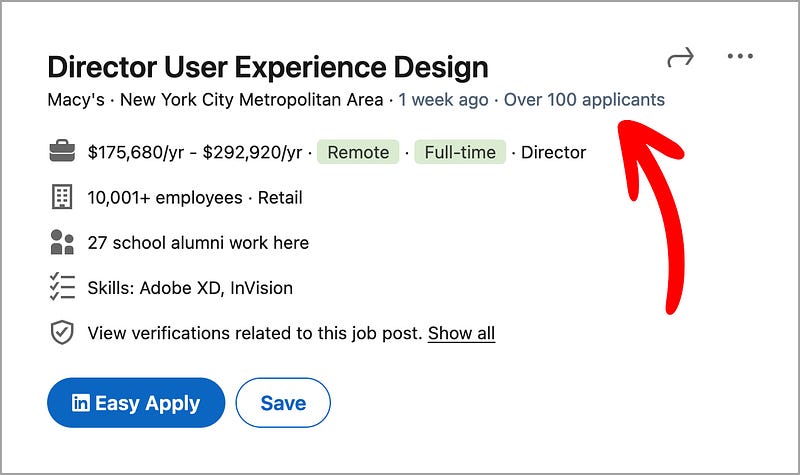
The number of job applicants is so astronomical that at the end of 2023, LinkedIn limited their application view count to display “Over 100 Applicants” instead of indicating the raw number, as they once did, which can sometimes be in the thousands.
I’m not sure of LinkedIn’s rationale, but in my opinion, this absurd update reduces transparency and is highly deceptive.
The excess of job-seeking talent is partly due to recent mass layoffs from big tech companies as well as a rise in boot camps and certification programs that falsely promise jobs.
However, this is only part of the underlying problem.
A major contributing aspect to the chaotic job market is the fact that more than 70 percent of currently employed people are considering or actively pursuing a new job. That’s a massive number of people, which indicates a systemic issue at play.
Typical desires to leave a job, such as seeking meaningful work, a better culture, a work-life balance, and an increased salary, are the likely culprits.
Unfortunately, this noble and self-prioritizing quest is significantly adding to the bloating candidate competition, making it extremely difficult for those without jobs to find work.
This surplus of employed job seekers can be attributed to many factors, as mentioned earlier. However, one scenario that may be an infectious root cause is the surge of articles, influencers, and thought leaders peddling romanticized and unrealistic job expectations.
Fantastical concepts such as empathetic corporate cultures, moral-driven work, and greater financial recognition have flooded innocent minds and those stuck at lousy jobs. And while these are admirable career qualities to aim for, the unfortunate truth is these Goldilocks jobs are few and far between.
This unrealistic perception creates a disconnect from reality for many when they land their “dream job.” In fact, in one survey, 61 percent of employees found some aspects of their new jobs to be different from what they had expected.
Pushing such idealistic conditions can create an extreme sense of entitlement. This illusionary rationale leads to a “grass is greener on the other side” mentality and a nativity regarding the fundamental DNA of businesses.
That doesn’t mean we shouldn’t seek to enlighten businesses or find better-fitting careers, especially if we feel our current jobs are not suitable for us — I’ve resigned from several companies for this very reason.
Fortunately, I gained some helpful wisdom along the way. Most notably, the awareness that the majority of jobs and companies rarely align with our individualistic values — at least not in every facet. This reality is especially true for designers, whose values typically focus less on profit-driven objectives and more on crafting meaningful design outcomes and good user experiences.
If there’s one thing I’ve learned over the years, it’s that who a company says they are is entirely different from reality.
To demonstrate this disconnect, just read a few LinkedIn posts and corporate descriptions from a companies you’re interested in, which tend to proclaim how great they are and all the good they do. Then, visit a career site such as Glassdoor or Indeed and read the reviews, which offer stark differences from current and past employees perspectives. What you’ll notice more often than is that rarely align with a company’s public persona.
Obviously, there are exceptions to this typical misalignment. I’m sure some reading this article may love your job and work for a company whose actions align well with its mission. And that’s great — you’re employed by one of a few praiseworthy companies out there.
Of course, starting your own business could circumvent this entire problem. However, this decision has its own set of overly-idealized expectations.
When I think about those contemplating leaving adequate jobs to pursue something more “meaningful”, the popular illustration of Be thankful for what you have pops into my head.
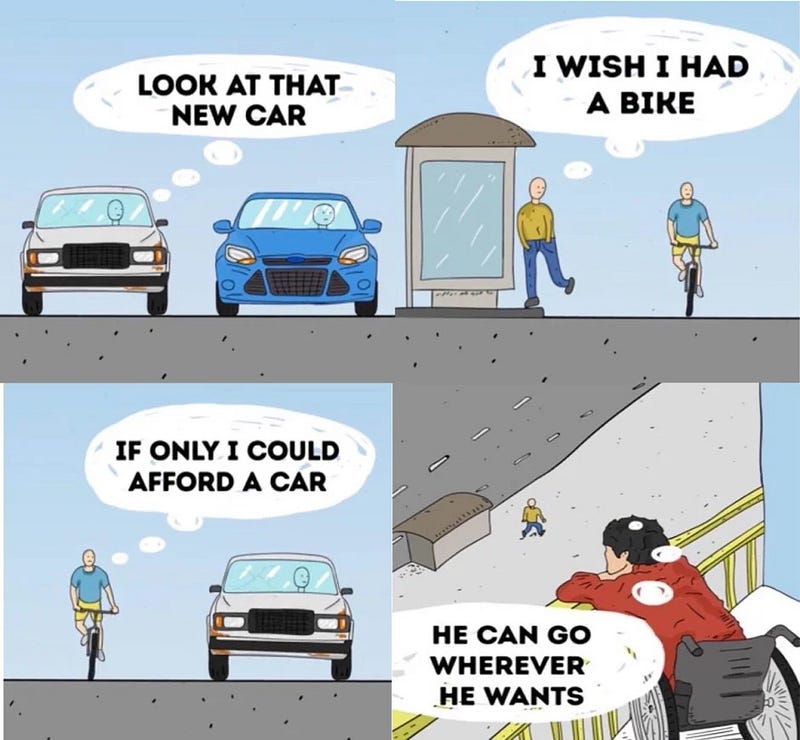
The illustration first depicts person in an old car who sees a new vehicle and thinks, “Look at that new car.” Then a person on a bicycle looks at the old car and thinks, “If only I could afford a car.” Next, a person walking sees the person on the bicycle and thinks, “I wish I had a bike.” And finally, a person looking out a window from a wheelchair sees the individual walking and thinks, “He can go anywhere he wants.”
The point of this illustration is obvious, and it can be applied to many situations, including one’s career, especially when they start questioning their happiness.
Just imagine those who make half of what you make and must support a large family or folks who recently lost jobs and have no way to pay rent.
For some, this thought exercise can profoundly impact one’s perspective and teach us to be grateful for what we have — yes, even a less-than-ideal job. Because at the end of the day, we only have control of our thoughts and actions — which can be powerful tools for managing any job perception.
As mentioned earlier, there’s absolutely nothing wrong with pursuing a better-fitting career. However, the hard truth is all companies are businesses whose primary goal is to grow and make money. Everything else comes second — and anyone who tells you differently wears rose-colored glasses.
You may not like this fact, especially if you’re some kind of a Pseudo-Marxist, but you do have to accept this economic actuality until something better comes along and transforms our system.
This reality means contending with typical unsavory business ethics, such as prioritizing quantity over quality, working long hours, or being directed by egotistical and incompetent executives. If you’re leaving a job because of these attributes, you might find out the hard way that these characteristics are baked into most companies.
One particular idiom I like to keep in mind when thinking about jobs is “Better the devil, you know.” This essentially means that you would prefer to have contact with or do business with someone you already know, even though you don’t like them, than with someone you don’t know. This is something to consider when contemplating leaving your job — because there’s a possibility you may end up in the same situation or worse.
In my estimation, most businesses are subject to the law of entropy. They start wholesome, but over time, they become complacent, solely prioritizing profit-making and gradually neglecting the importance of fostering a positive work culture.
And when the culture stars to adversely affect the bottom line, you can be sure there will be superficial team-building activities lined up— while leadership avoids the systemic issue of greed and incompetence that led to the chaos in the first place.
Now, before you cast me off as some jaded and cynical grumbler, I believed extraordinary companies with fantastic cultures and leadership do exist — I worked for one for nearly 13 years — but then we got acquired, and everything went to shit.
The best way to know if a company is worthy is by listening to folks who have worked there for an extended period. And I’m not talking about the HR employees paid to say artificially positive things online — I’m talking about people who do what you do and are in the trenches daily. That’s where you’ll find the actual company story.
We all have the right to seek a new career. However, my advice for what it’s worth is to avoid falling for propaganda from companies and online commentators who project unrealistic job expectations and inflate or sense of entitlement.
In reality, you are being compensated to provide a service that contributes to a company’s financial success. This fundamental truth applies universally. While a few exceptional companies excel in maintaining a harmonious work culture and employee satisfaction, they are rare gems amidst the masses.
So the next time you contemplate leaving your job, ask yourself, can you genuinely guarantee that going somewhere else will truly align with your values, or are you responding to romanticized propaganda and misleading career advice?
It may be worth challenging your perspective and finding value and meaning in your current job. In several years, as Artificial Intelligence consumes many of our roles, I imagine we’ll be grateful to have any job at all— food for thought.
Don’t miss out! Join my email list and receive the latest content.


