
Are emotions innate? The nature vs nurture debate
A brief overview of what we know about whether emotions are hardwired by biology or learned from culture
So far in this series, we’ve discussed emotion concepts and how they vary between cultures. We’ve focused on the distinction between WEIRD cultures with MINE emotions and non-WEIRD cultures with OURS emotions. Today, we’ll ask where these emotion concepts come from, and cover what’s known about a controversial question in emotion science: are emotions innate?
This topic is currently a battleground in the world of emotions research, with plenty of room for disagreement and many important questions still unanswered. In this article, we’ll talk about evidence that supports the idea of innate emotions, and we’ll cover evidence that suggests otherwise in the next article. I can’t give definite answers, so you’ll have to decide for yourself which alternative you find most plausible, or perhaps even some combination of the two.
Evidence in favour of innate emotions
One of the most common arguments in favour of the innate view of emotions is that it was advocated by Darwin. I’ll be honest and say that I don’t think highly of this argument, as it’s an appeal to Darwin as an authority, which isn’t very scientific. But that in itself doesn’t mean it’s wrong, and many researchers, inspired by Darwin, have developed a body of findings which indicate that emotions are innate.
For example, Paul Ekman did research in the WEIRD and non-WEIRD world and found that people could correctly match an emotion word to the corresponding facial expression. His research focused on comparisons between WEIRD countries like the US, and non-WEIRD countries such as Papua New Guinea, Malaysia and Indonesia. Findings from his research group suggested that around six emotions are universally recognised, including joy, surprise, anger, fear, disgust and sadness.
When people participating in the studies were asked to match these words to corresponding faces, they did so successfully. This success came despite the fact that emotion concepts vary between WEIRD and non-WEIRD cultures, as we’ve discussed in the last two articles. These findings suggest that, beneath all the cultural variation, there is a set of emotions that are universally recognised, and thus presumably innate. Based on these findings, these six emotion concepts have become known as universal basic emotions.
If emotions are innate, researchers conclude that they should be baked into our biology. For example, there should be parts of the brain that are dedicated to identifying and responding to inputs related to emotion, just as we have areas of our brain dedicated to detecting different colours of light and frequencies of sound.
In line with this idea, the amygdala has emerged as the leading candidate for a brain region linked with the experience of emotion, namely fear. This is due largely to research involving a woman known as SM.
She has a rare genetic condition (Urbach-Wiethe disease) that causes a range of symptoms, including lesions to parts of her brain. This will affect multiple brain areas, but for reasons that remain unknown, the condition takes a special toll on the amygdala, which can be totally destroyed.
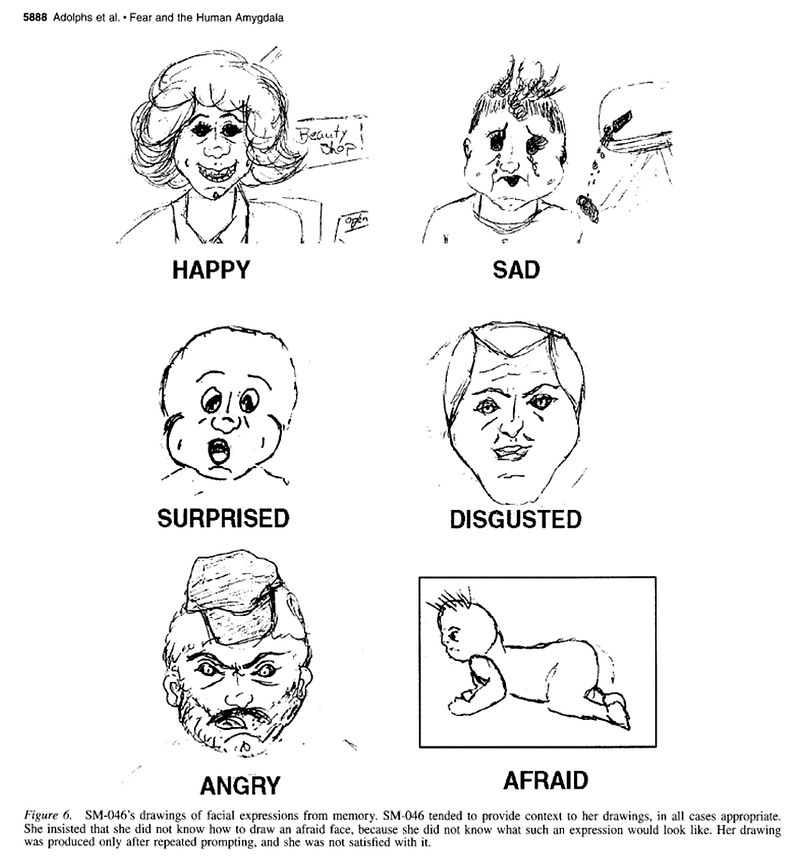
Researchers used Urbach-Wiethe disease as a way to test the role of the amygdala in emotions, studying the responses of people like SM to a version of Paul Ekman’s universal basic emotions. SM was able to recognise every emotion face except one: she couldn’t correctly identify the scared face, even though her facial perception itself was perfectly fine. Similarly, when asked to draw the emotion faces, SM could draw all of the basic emotions except fear.
These findings suggest that SM’s amygdala damage impaired her ability to perceive, and even imagine, fear in faces. SM is also completely unfazed by scary movies and spooky houses, and has no trouble handling snakes and spiders. This specific effect on fear after damage to the amygdala has been very persuasive for many researchers.
Prompted by the studies with SM, researchers have tried to find evidence that the amygdala plays a role in identifying and responding to fear-related stimuli in people with an intact amygdala. These studies involved putting people in brain scanners like MRI machines and looking for hot spots of activity while the participants were shown different images or asked to perform a task associated with fear. This is where things begin to get controversial.
Individual studies have found apparent signatures of emotional circuits that seemed to be specialised for processing inputs related to emotions, with the link between fear and the amygdala probably the most reliable. Researchers have even mapped emotions onto different body states, in line with the typical experience of WEIRD people with MINE emotions.
However, when researchers run meta-analyses to look for reliable emotion circuits across studies, only a minority of them support the idea that the human brain contains emotion circuits. This means that the findings of individual studies mostly fail to replicate each other, which questions the validity of their results and conclusions.
This remains a hotly-contested topic, and more work will be needed to settle the debate. For now, the conflicting evidence provides enough elbow room for the dispute to continue, as there’s at least some evidence of innate emotion circuits in the human brain.
If emotions are innate, then it stands to reason that non-human animals have them as well, at least in a rudimentary form. This is the argument of evolutionary continuity made by Darwin. We can’t test non-human animals by asking how they feel, so researchers look at their behaviour to make inferences about their internal state, an approach that’s highly intuitive for people in the WEIRD world.
In parallel with studies in people, researchers have shown that brain areas in fellow mammals like primates and rodents contain innate circuits that respond to different sources of potential danger, like predators and aggressive members of their own species. Consistent with the findings from SM, these circuits for coordinating defensive responses often involve the amygdala.
In another conceptual link, chronic stress has been found to increase the size and activity of the amygdala, and a hyperactive amygdala is often linked to conditions like PTSD. Given the overlap with results from SM, these brain regions and circuits, acting as receptive fields for dangerous and stressful stimuli in non-human animals, are taken to support Darwin’s argument for evolutionary continuity of emotions.
Here again, however, controversy rears its head, as people are split on how to view this evidence. For some, especially people in the WEIRD world, the idea of inferring internal emotion states from behaviour seems entirely logical. This logic is extended to mammals in general and at least some insects, such as fruit flies, which are said to be driven by internal emotion states.
These emotion states are thought to be similar, in principle, to our own. Indeed, similar enough that we can supposedly study the basic elements of emotion across species as different as humans and fruit flies, according to the advocates. For others, the idea of inferring emotional states from an animal’s defensive behaviour strikes them as unscientific and a bridge too far.
I’m not sure whether we currently know enough about the minds of non-human animals to pass judgment on this disagreement, so you’ll need to decide for yourself what you find convincing.
Next time
This is the major evidence in favour of the idea that emotions are innate. Just 20 years earlier, the view of universal basic emotions being innate and inherited from our early mammalian evolution was the orthodoxy.
This has some justification, as we can see by the striking example of SM and the role of the amygdala in supporting defensive behaviour and responding to chronic stress. However, new research over the last 20 years has challenged the idea of innate emotion circuits. These findings paint a very different picture, suggesting instead that emotions are cultural constructs that help us to navigate the culture and society in which we live.
The work of people like Lisa Feldman Barrett and Batja Mesquita is central to this movement in emotions science, and we’ll discuss their books and ideas next time when we run through evidence that emotions emerge from culture rather than being baked into biology. Until then!


