
Are Anti-Maskers The Latest Version Of Anti-Vaxxers?
And what can we do to engage them in a discussion?
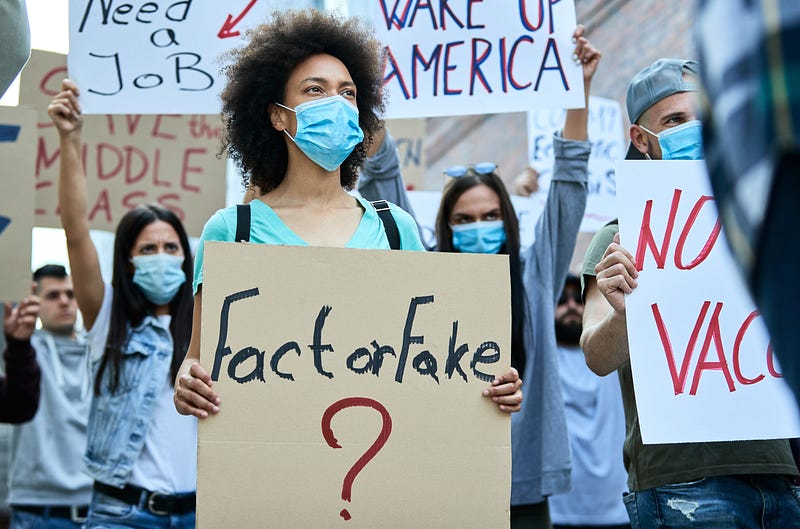
COVID-19 hits close to home.
Last week my 90-year-old great-aunt contracted COVID-19 and required hospitalization. Her son-in-law also needed to be hospitalized, and her daughter is self-isolating at home. They live in Arkansas, and we used to see them every summer when my courageous parents would load up their four children and drive from California to Oklahoma and then Arkansas. I haven’t seen them since my grandfather’s funeral in 1990.
My mother’s cousin said many Arkansas citizens believed COVID-19 would go away after the election, and few wear masks. I am sad to hear there are still people who believe the pandemic is not severe.

Trump is setting a poor example.
Since our current president does not believe in masks and has also questioned the severity of the pandemic, he has convinced many of his followers to share his beliefs. Public figures and celebrities are in a unique position to influence others. When public figures have ideas based on unsubstantiated information, this can cause public harm. One example is the Jenny McCarthy anti-vaccination campaign that began in 2007 when she became convinced vaccination caused her son’s autism.
I always thought she was the first anti-vaxxer. I was surprised to learn an anti-vaccine movement began even before the first vaccine!
“Dried smallpox scabs were blown into the nose of an individual who then contracted a mild form of the disease.” National Institutes of Health
Historical efforts to prevent smallpox.
The first attempt to reduce the risk of smallpox was variolation, a form of inoculation specific to smallpox, practiced in many parts of the world centuries before vaccination. In variolation, pus or scabs from individuals with a mild form of smallpox were introduced through the nose or by puncturing the skin. Variolation had a 1–2% fatality rate, compared to the 30% rate seen through natural infection (National Institutes of Health).
Even in the 18th century, there were anti-vaxxers:
“Pro-inoculators tended to write in the cool and factual tones encouraged by the Royal Society, with frequent appeals to reason, the modern progress of science and the courtesy subsisting among gentlemen. Anti-inoculators purposely wrote like demagogues, using heated tones and lurid scare stories to promote paranoia,” (verywellhealth.com)
Vaccine to eradication
In 1796, Edward Jenner developed the first successful smallpox vaccine. In 1980, the World Health Organization (WHO) announced smallpox had been eradicated (World Health Organization).
Why did it take nearly 200 years after the vaccine to eradicate smallpox? Enough people need to be vaccinated against smallpox to provide herd immunity. For smallpox, herd immunity required 93–95% of the community to be vaccinated. Herd immunity protects those who are immuno-compromised or unvaccinated for some other reason, such as newborns (verywellhealth.com).
The anti-vaxxer movement is a roadblock to herd immunity.
Since Edward Jenner derived the smallpox vaccine from cowpox, some people initially believed they would become part cow if they were vaccinated. Others falsely thought the vaccine had killed people. There were religious and cultural barriers. When governments began requiring compulsory vaccination, citizens felt the government was infringing on their civil liberties and shouldn’t be involved in medical decisions (National Institutes of Health).
The greater good.
Governments had to consider whether the rights of individuals supersede the rights of a community. Many governments decided the rights of many outweigh individual liberties.
Vaccination became compulsory in many countries. The worldwide effort to eradicate smallpox was similar to a military campaign. The vaccination team forcibly vaccinated a religious leader in India to remove his followers' opposition. The World Health Organization (WHO) finally achieved eradication by focusing on locating outbreaks and providing vaccinations.
Ongoing opposition to vaccines.
The fatality rate for smallpox was 30%. Eradication saved countless lives. The eradication of smallpox should prove that vaccines can contain viruses, but there is still opposition. Part of the problem is the ease of spreading incorrect information. Anyone can publish a personal story on social media, and there is usually no fact-checking of this type of account.
A 1998 study that was published and later retracted fueled many of these stories. Dr. Andrew Wakefield claimed that the MMR vaccine caused autism. After publication, scientists performed additional research and refuted the original study. Eventually, the study authors were found guilty of ethical violations, scientific misrepresentation, and deliberate fraud. The journal published a retraction in 2010, but by then, the study had already done damage. Vaccination rates dropped, and there were new outbreaks of measles (Rao & Andrade).
Many celebrities, including Jessica Biel and Jenny McCarthy, have taken up the cause of the anti-vaxxers, which has contributed to the ongoing opposition. An article on PharmacyTimes.com discusses the consequences of celebrities spreading misinformation. Social media groups also contribute to the continuing spread of information that has no scientific basis.
COVID-19 and the anti-mask movement.
Anyone studying the anti-vaccination movement could have anticipated opposition to a potential vaccine for COVID-19. The fight against wearing masks was a surprise.
When the pandemic began, the CDC and other public-health organizations downplayed masks' efficacy to preserve the supply designated for healthcare workers. This advice changed when scientists determined the virus had airborne transmission. This change in recommendations caused the public to be skeptical. A rational president might have been able to discuss this and calm the fears in the United States. If only we had a rational president.
Trump decided to downplay the virus. I don’t pretend to understand his reasons. He had multiple chances to own up to his mistake and promote the wearing of masks. Not only did he continue to ignore the recommendations, but he also made fun of people who were trying to follow them.
The president also hosted multiple indoor and outdoor events. Researchers at Stanford concluded that Trump events leading up to the election were responsible for 300,000 COVID-19 cases and more than 700 deaths (Bernheim, Buchmann, Freitas-Groff, & Otero, 2020).
Addressing the mask and vaccine doubters.
The anti-mask and anti-vaccination movements can be described as part of an anti-science movement. The COVID-19 pandemic brought together various groups of science doubters in the United States and contributed to an anti-science movement in Europe (Hotez, 2020).
Members of these movements are skeptical of science and mainstream media. This skepticism makes it challenging to present fact-based arguments refuting their beliefs. Since much of the misinformation is spread online and through social media groups, experts recommend a multi-faceted approach to combat the threats they pose.
One recommendation is “listening to and acknowledging the fears and opinions of each distinct community” and “producing a valid recommendation” (Neumann, 2020). In her undergraduate honors thesis, Neumann outlines recommendations for the various groups that oppose vaccination.
“It must be made clear that the fears surrounding the fast-tracking of the vaccine are heard and understood, and then provide information that addresses the specific fear and demonstrates that the vaccine is still safe, despite its rapid production.” Grace Neumann
Shelby and Ernst (2013) discuss the power of storytelling and how this contributed to the anti-vaccination movement. Their suggestion is to use storytelling to educate anti-vaxxers. Storytelling might involve stories of children who became ill from contracting a virus after not receiving a vaccination. They also recommend methods physicians can use to combine storytelling with factual information.
Anti-maskers and anti-vaxxers are not our enemies. They are our friends and families, our coworkers, and our neighbors. These groups have valid reasons for their beliefs. We must find common ground with them to successfully battle COVID-19.
Thankfully my Arkansas relatives have been released from the hospital. The new vaccines have the power to combat this pandemic. If we let them.
References:
Bernheim, B. D., Buchmann, N., Freitas-Groff, Z., & Otero, S. (2020). The effects of large group meetings on the spread of COVID-19: The case of trump rallies. (). Rochester, NY: Retrieved from https://papers.ssrn.com/abstract=3722299
Hotez, P. J. (2020). Anti-science extremism in America: Escalating and globalizing. Microbes and Infection, doi:https://doi.org/10.1016/j.micinf.2020.09.005
Neumann, G. M. (2020). A Public Health Recommendation Countering the Online Anti-Vaccination Movement. Retrieved November 19, 2020, from https://core.ac.uk/download/pdf/326033005.pdf
Rao, T. S., & Andrade, C. (2011). The MMR vaccine and autism: Sensation, refutation, retraction, and fraud. Indian journal of psychiatry, 53(2), 95–96. Retrieved November 20, 2020, from https://doi.org/10.4103/0019-5545.82529
Shelby, A., & Ernst, K. (2013). Story and science: how providers and parents can utilize storytelling to combat anti-vaccine misinformation. Human vaccines & immunotherapeutics, 9(8), 1795–1801. Retrieved November 20, 2020, from https://doi.org/10.4161/hv.24828


