
Archimedes’ Principle: Bath and Gold. Was the King Cheated or Not?
(…) and he rushed out from the bathtub, shouting, “Eureka!”
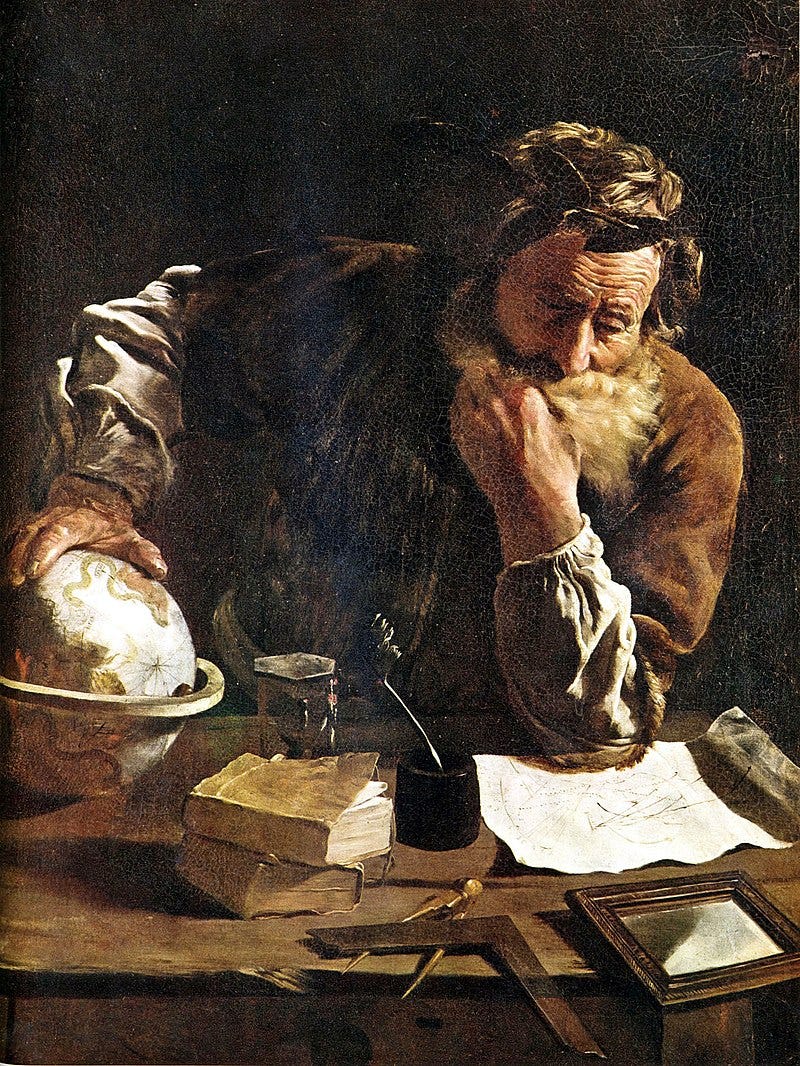
What comes off the top of one’s head about Archimedes is a bath legend during which he remarked the water level goes up as he himself goes down. The more his submerged was, the more water raised. Ecstasy has led him to spring out of the bathtub. And, forgetting to put his clothes on, to run naked through Syracuse, shouting, “Eureka!”
It is the usual story about this striking discovery. Still, it has a big gaping hole because it tells about the how without the why. The thought did not hit on Archimedes by luck. In other words, what kind of problem Archimedes was after?
Hiero II, the king of Syracuse and kinsman of Archimedes, has directed a goldsmith to create a crown with pure gold. It was a devotion for a temple as a laurel wreath after the won battle. With the gold received from the king, the goldsmith started the job. Over time, he finished the order and gave it back. Majestic and significant was this piece of art. But, a rumor has flown around, overreaching the king’s ears, “The goldsmith cheated on you, my king, by stealing a pouch of gold.” Was it calumny or not Hiero did not know. Yet, the sought after crystal-clear judgment from now was on.
The king compared the crown’s weight with the given gold. There was no difference at all. And so, the fraud was too subtle for him: apart of destroying it and comparing its volume with the earlier gold. Though the weights were the same, two options laid on table. The goldsmith was fair, and everything could go on; the crown will complete its goal as the temple gift. Or, he mixed it with silver or so. Hiero needed someone’s help what led to the obvious choice, “Archimedes come on!”
Archimedes arrived and heard from the king, “Help me decide whether it is real. Has it within something more than gold? Tell me. But I demand, do not destroy the crown!” That heard, Archimedes started thought. He went to the bath, still over the problem to solve. And what was next is well known. He found that water heightens its level after sinking something in. Not anyhow, but about the volume within. As the crown and given gold were equal in mass if the goldsmith cheated the crown’s volume must up. If that so, its immersion displaces more water than with the gold. Thus, how the test was performed?
He came to the king, reporting, “I found it! But the same amount of gold is what I need.” Which one he got since Hiero was contemplative about what he figured out. Archimedes took a vessel and poured it about the brim, carefully putting the gold from the king in. He marked how much water overflowed. And thus, he knew the volume of this lump of ore. What left? Yes! The crown. So he did everything by the same mean, and the result was, “My king, it is not the pure gold is what I think. It displaced more water than the ore, which result in different volumes for both. Because they are equal in mass, the goldsmith had to mix something else in. He took some part of the gold from you and replaced it with a more rare thing.” Hence, the goldsmith was guilty. And it is not any mystery what about then was the meaning of it.
Before Galileo Galilei, this story went like that. But he was the first who doubted. He knew the difference between the two would be only slightly off. And such proof could not decide if the goldsmith was guilty or not.
As is widely known, he was conscious of the false accusation. And he knew about Archimedes’ passion. He was in love with building machines. By including one thing, he said, “Archimedes differently conducted the whole thing.”
Immersion in water makes upward force. This fact makes the apparent weight loss. The force acting on two objects of equal mass and of different volumes will be more upon the greater one. Archimedes built a scale with two sides and balanced it. Then, he compared the weights of the crown and the gold. It was at an equilibrium point. He took two vessels and equally poured water into them, putting on the scale to see whether it balance still. Yes, they were at the equilibrium point, so adding one object for each should not break it from this state. But, the scale tilted to the gold ore, which means the buoyant force on the crown was larger indeed. With equal masses, the judgment was clear: the volume did not match the gold that should be in.