
AR in Healthcare: Transforming the Industry
Exploring Uses, Market Analysis, and Operational Mechanisms of a Revolutionary System

There is an emergency!!!! Hurry! Someone perform CPR! Would you know how to do it? Neither do I.
In fact, very few people unrelated to the healthcare field study know much about first aid or would know how to react if anyone around them had an emergency.
Just like in any other area nowadays, technology also has to contribute, and the advancements it's developing are making a strong impact and surely could save many lives.
Let’s go back to the previous situation: SOMEONE IS HAVING A CARDIAC ARREST!! This time we are in a hospital, and there is a machine specifically for these cases, you are a nursing intern, and you know what needs to be done but you’re not sure if you’re doing it correctly. It would take too long to call a more experienced doctor or nurse.
We need to act now! But this time there’s no problem because you have your secret weapon: augmented reality glasses. You put them on and just like a video game, you see where you need to place everything on the patient’s body, which buttons to press on the machine, it tells you the time, the attempts, everything you’re doing, measures performance, and tells you what to do every second.
You did it! Like a video game, it tells you that you’ve done it well and that you’re finished, and the best part is THE PERSON HAS BEEN SAVED.
This is what unfolds in the video. I’ve embellished the storyline by inventing the intern scenario to create a more engaging narrative…
However, the essence lies in watching this video presenting the Philips glasses:
Specialists, the most benefited
This is revolutionary. We’re talking about saving lives, improving the impact and performance of specialists to prevent errors, or even training non-specialists on how to handle and act in critical situations. Your doctor could see inside your body and treat you more precisely than ever before, even remotely.
Surgeons can use augmented reality (AR) to study their patient’s anatomy by incorporating MRI data and CT scans into an AR headset. They can then overlay specific patient anatomy onto their body before surgery. — Dr. Atul Gupta, Chief Medical Officer for Image Guided Therapy at Philips
Even in complex situations where specialists could benefit from assistance in managing critical situations or complex operations, we can reduce risks, enhance learning throughout the process, detect anomalies earlier, and most importantly, improve the outcome and experience for the physician.
Medical Education Revolution
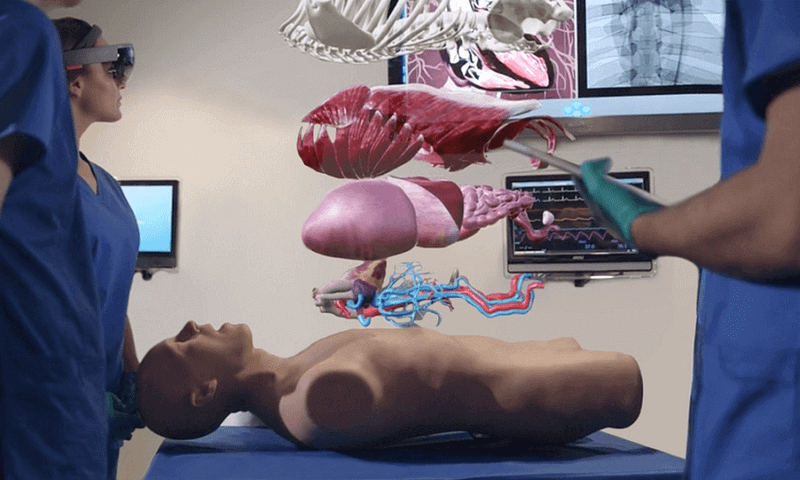
If we shift to something less critical, education, we also have something revolutionary to consider: the healthcare sector studies super complex mechanisms.
Traditionally and even now, operating on cadavers to see how things are and study is very common for healthcare professionals, but now it’s unnecessary. We can create a digital replica in augmented reality and see it as if it were present in real life, study it as if we had it right in front of us, and have a more realistic, interactive, and frankly, enjoyable learning experience.
We can train better professionals who have reality closer than ever before and are prepared for many situations because they’ve already seen them.
We could even program scenarios and replicate them in these augmented reality systems and play like in a video game to practice if an operation would be done correctly, assign a score, and gamify the learning process, making it much more practical, educational, and useful.
The figures speak for themselves
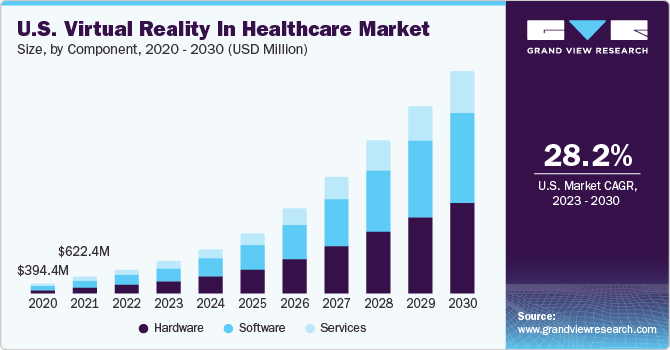
The global AR in the healthcare market size was valued at USD 1.6 billion in 2022. It is estimated to reach USD 12.26 billion by 2031, growing at a CAGR of 25.4% during the forecast period (2023–2031). — Straits Research, Market Overview
The use of technology in the medical field has become increasingly prevalent. By 2026, the healthcare market is projected to reach $88.4 billion, with over $4 billion allocated to the advancement of augmented reality (AR). Several factors contribute to the growing adoption of AR in healthcare.
The COVID-19 pandemic has been a significant driver of the increased demand for AR in healthcare. Between 2019 and 2020, the augmented and virtual reality market in the medical sector saw a 27% growth. Despite the economic downturn caused by the pandemic, the demand for augmented and virtual reality technologies has continued to rise in the period from 2020 to 2021.
GlobalData reports the presence of over 50 established medical device companies, including both technology giants and emerging startups, actively involved in the development and utilization of AR/VR eyewear.
In 2022, venture capital firms invested more than $250 million in startups specializing in virtual and augmented reality, as documented by Digital Health Business & Technology’s database.
In a notable instance, virtual reality training platform OssoVR secured $66 million in funding in March 2023, marking one of the largest VR startup rounds of the year.
The Working Mechanism of AR in Healthcare
The operational foundation of AR within healthcare relies on a meticulously orchestrated ensemble of critical components:
- Cameras and Sensors: These indispensable tools meticulously scan and analyze the physical surroundings, meticulously gathering data to pinpoint precise locations where AR elements will seamlessly integrate.
- Processor: Serving as the cognitive powerhouse akin to a computer’s CPU, the processor diligently manages the intricate data processing tasks. It ingeniously coordinates the logistics of displaying AR elements, meticulously determining their optimal placement and interaction within the environment.
- Display: Whether manifested through the crisp interface of a smartphone screen or the immersive experience provided by AR glasses, the display serves as the canvas for presenting the augmented elements. It adeptly merges these elements with the real-world vista captured by the cameras, offering users an unparalleled augmented reality experience.
- Input Devices: Endowing users with the ability to interact and manipulate augmented elements, input devices play a pivotal role. These devices encompass a spectrum of interfaces, ranging from intuitive touch screens to sophisticated gesture controls and voice commands, facilitating seamless user engagement and control.
- AR Software: At the heart of the system lies the AR software, a sophisticated digital conductor orchestrating a symphony of data. This intricate software meticulously analyzes inputs from cameras and sensors, employing advanced algorithms to generate and position augmented elements with pinpoint accuracy within the real-world environment. Its prowess ensures a seamless fusion of digital and physical realms, delivering a transformative augmented reality experience.
Challenges in Technical Implementation and Integration
One of the primary concerns revolves around seamlessly integrating digital information into existing healthcare systems.
For instance, the smooth functioning of AR technology in surgery requires high-precision tools and real-time data analytics, demanding substantial investments in technology and training.
Moreover, the daily surge in data volume presents a significant challenge, requiring robust algorithms capable of managing complex data while ensuring the security and privacy of sensitive information.
Data Security and Privacy Concerns
The growing use of AR in healthcare increases the risk of data breaches and privacy violations.
When integrating AR and VR in healthcare, you should understand that it requires collecting and handling sensitive patient data while opening new security vulnerabilities.
It can become an alluring target for cyber-attackers. For instance, a security loophole in an AR solution could allow a hacker to access and misuse a patient’s confidential health records, with all that it implies.
There also exists the ever-present concern of unauthorized data sharing with third-party companies, raising serious privacy issues.
Healthcare institutions must implement strict data security measures and use data encryption to create a safe environment. The road ahead demands a thorough approach to data governance and avoidance of data mishandling to embrace the full potential of AR technology.
Digital Twins and Synthetic Data

One of the most common and actively explored solutions involves the use of digital twins and synthetic data. A digital twin is a digital replica of a system that adheres to the same standards and specifications as the original, while synthetic data, to elaborate with an example, involves creating a synthetic dataset.
For instance, consider a scenario where we have a database of patient records and need our algorithm to learn from this dataset. Instead of using the original patient data directly, we can generate synthetic data that mimics the relationships, correlations, and patterns present in the original dataset.
This allows the algorithm to learn from the synthetic data while preserving the privacy of the original patient records. In this way, we can leverage medical data for our algorithms and data science projects while ensuring privacy protection.
Conclusion
Augmented reality (AR) stands poised at the forefront of a healthcare revolution, offering transformative solutions that promise to reshape the industry landscape.
Through a comprehensive examination of its uses, market analysis, and operational mechanisms, it becomes evident that AR holds immense potential to enhance patient care, streamline medical procedures, and advance healthcare outcomes.
As we continue to witness the integration of AR technology into various facets of healthcare, stakeholders must embrace this paradigm shift and capitalize on its benefits.
Hence, by harnessing the power of AR, we not only unlock new opportunities for innovation, but also pave the way for a more efficient, accessible, and patient-centric healthcare ecosystem.
The future of healthcare is here, and augmented reality is leading the charge toward a brighter, more efficient, and healthier tomorrow.


