
April is the cruelest month, breeding

Lilacs out of the dead land, mixing Memory and desire, stirring Dull roots with spring rain. Winter kept us warm, covering Earth in forgetful snow, feeding A little life with dried tubers. Summer surprised us, coming over the Starnbergersee With a shower of rain; we stopped in the colonnade, And went on in sunlight, into the Hofgarten, And drank coffee, and talked for an hour. Bin gar keine Russin, stamm’ aus Litauen, echt deutsch. And when we were children, staying at the arch-duke’s, My cousin’s, he took me out on a sled, And I was frightened. He said, Marie, Marie, hold on tight. And down we went. In the mountains, there you feel free. I read, much of the night, and go south in the winter.
— — From The Waste Land by T.S. Eliot
April is also National Poetry Month. I wouldn’t know that but Lisa Renee mentioned it here:
At the end of a very good poem.
When I found out that it was National Poetry Month I mentioned it to the Boss. We decided that the way to celebrate was to read one poem a day out loud to each other. We decided to use her copy of “Good Poems”.
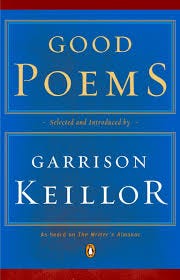
The idea of picking poems was overwhelming. We just started at the beginning of the book.
We read one poem out loud to each other each night before bed. She reads it to me, then I read the same poem to her. The next night our order is reversed. We’ve managed to do it three times so far. Total pleasure. She reads the poems better than I do. I take my turn anyway.
I have written some poems in my life. My favorite is from third grade. You have to understand that when I say “third grade” I mean “sometime before I started smoking pot” (which was in seventh grade). In third grade I was in a hippied-out “open classroom” where I made great friends and did no work. It’s natural to conflate everything good from elementary school with “third grade”. Here is the poem:
The Poem, by Gutbloom
The wind will blow And it shall show That you are afraid You are afraid And the shudders bang And the bell will clang And you are in bed Just like I said
Thank you. Thank you very much. I can hear the snaps through the tubes. I think I got a big assist from my third grade teacher, Miss Mervis.
My mother went to boarding school in the 1940s. During her time at Westover each girl was expected to memorize a poem a week. The after dinner entertainment was someone standing up and reciting their poem to the entire dining room. If a girl failed to do what they were supposed to do, I guess everyone at the school looked at them with disapproval. Like a lot of things in my mother’s life, the stakes were admiration vs. humiliation. She was never humiliated when it came to poems.
You didn’t want to get her started. Martinis and poems make a potent cocktail. A weaponized art form. She could recite poetry for a long time. Of all of the poems that she recited, I only have one etched into my memory so that I, too, can recite it. It is a piece of doggerel that goes:
Willie fell down the elevator Wasn’t found till ten days later All the neighbors sniffed “Gee Wiz, What a spoiled boy Willie is.”
I also went to boarding school. I was forced to memorize the first fourteen lines of Chaucer’s Canterbury tales and recite it to the school. At some point every spring I say to the clouds:
Whan that Aprille with his shoures soote, The droghte of March hath perced to the roote, And bathed every veyne in swich licóur Of which vertú engendred is the flour; Whan Zephirus eek with his swete breeth Inspired hath in every holt and heeth The tendre croppes, and the yonge sonne Hath in the Ram his halfe cours y-ronne, And smale foweles maken melodye, That slepen al the nyght with open ye, So priketh hem Natúre in hir corages, Thanne longen folk to goon on pilgrimages, And palmeres for to seken straunge strondes, To ferne halwes, kowthe in sondry londes;
I also say, “I’m going out to clean the pasture spring;” at this time of year even though I don’t have a pasture or a spring on my property.
I can recite the following “on demand”: some snippets from Shakespeare, When I Was One-and-Twenty by AE Housman (near contact memorization from my mother reciting it),When I Have Fears That I May Cease to Be by John Keats, If — by Rudyard Kipling, The Road Not Taken and Stopping by Woods on a Snowy Evening by Robert Frost, and We Real Cool by Gwendolyn Brooks. The last was learned by playing this video countless times to students:
As I go through the list, I realize some of these nuggets are kind of rusty. I thought they were 100% there. Maybe I need some review. Age and the Internet have robbed my teaming brain.
I’ll leave you with one last “Favorite Poem Project” video. I love it:
Other Things Like This From the Backlist:


