
April 25th, Why This Day Is So Important for the Portuguese
And why we must celebrate it now more than ever
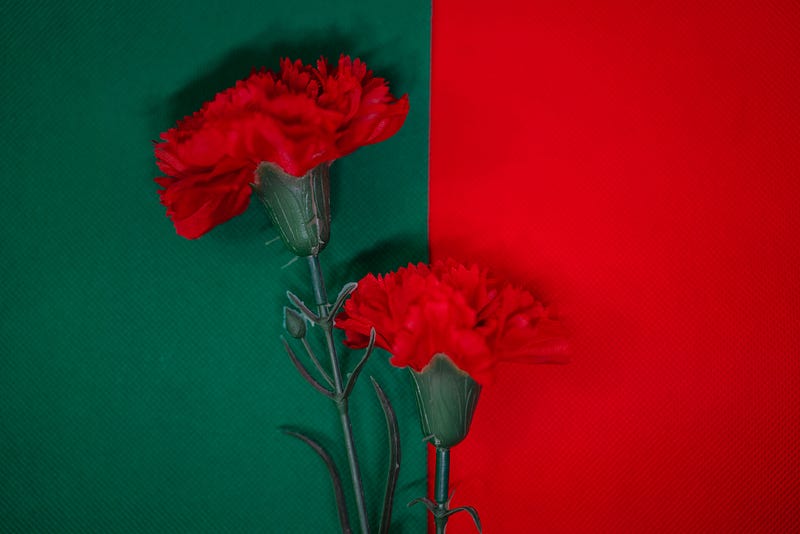
Another year goes by, and once again, as long as the memory still exists, we, the Portuguese, celebrate this beautiful day with joy— if not all of us, at least the best of us.
But while it is sad that it is only beautiful for us and for some Portuguese speakers—those who share a little of our culture— it is a fact that we all live in our own worlds, our own realities, and that there will always be more that we don’t know than the opposite. As such, if you are reading this and not understanding anything, don’t worry. It’s understandable.
But then, what was and is the 25th of April in Portugal?
The story is always the same, depending on who tells it. And I have told it year after year, dreaming that if one day I have children, I will also tell them about this day that was never lived by me but of which I have no doubt harvested fruit.
If one day, I have children, I will go out with them early in the morning, almost as if in homage to those captains who, at dawn on that April 25, 1974, invaded the streets of Lisbon and managed to depose a fascist government that had lasted for forty-eight years!
Yes, forty-eight years, Portugal was plunged into one of the saddest and darkest periods we have ever lived through.
In brief, after the death of King D. Carlos in 1908 and the end of one of the longest European monarchies, the Republic was established in Portugal in 1910. Poor Republicans would not know what conditions the world would be in a few years later.
The First World War and Portugal’s participation in it would not make this new regime very popular. And of course, for those who already know it, and in much the same way as we live today, the inflation of precisely one hundred years ago, the birth of fascism, and the instability of the post-war period also marked Portugal, which was unable to continue its stability and in 1926 began a military dictatorship.
The year 1933 would mark the official beginning of the new regime called the “Estado Novo” (New State), the rise to power of António Oliveira de Salazar, the conservative, Catholic “redneck” who basically embodied the worst of the Portuguese mentality.
Later in 1968, he would be replaced by Marcelo Caetano (fun fact, the godfather of our current President), who would bring the so-called Marcelist Spring, supposedly an opening of the country that never really translated into that.
Repression continued, elitism continued, and the war continued.
And it was this last factor that culminated in the fatigue of the military. It was then on that night of April 24, 1975, that Salgueiro Maia, in a speech that was as poetic as it was brave, gathered the troops at the barracks in Santarém, and without anyone knowing what he was talking about, he said:
“As you know, there are several types of State. The socialist states, the capitalist states, and the state we have reached. We are going to march to Lisbon to put an end to the state we have reached. Those who want to stay can abandon the parade and retire to their barracks. Whoever wants to come can step forward.”
And in a beautiful gesture, here’s what happened, everyone stepped forward.
Every soldier that night, tired of being sent to war, tired of seeing brothers die in war, tired of having to try to escape their country, joined that brave captain and marched to Lisbon, having no idea what could happen to them.
The result would be fascinating; these men would manage to end a regime, and their movement would be the root of the establishment of democracy in my country.
A whole new culture blossomed after April, which became a word with a meaning greater than the mere representation of a month of the year.
It became synonymous with :
- freedom;
- Access to education;
- The end of political repression;
- The end of the concentration camp at Tarrafal Island in Cape Verde;
- The end of the war against the former colonies that were killing both Portuguese and all people who were justly fighting for their independence against the oppressor called Portugal, but above all called fascism.
April brought us democracy, the creation of a national health system, the emergence from obscurantism where at that time only 3% of the population could have access to higher education, and where 25% of the population in 1970 was illiterate, and the illiteracy rate was higher among women, about 30%.
April brought us the simple possibility of meeting with friends without any police officer ordering us to disperse, afraid that this mere meeting was a sign of some demonstration.
April brought us the conquest of the right to vacations and paid vacations, as well as the existence of the national minimum wage;
April brought us the freedom to unionize and the right to strike;
April gave us access to unemployment benefits and the conquest of the right to maternity leave — America, how much longer do you need? But of course, April finally brought us access to free elections, the right to vote at 18.
My grandfather, who was born in 1933, got to vote for the first time in his life on April 25, 1975, at the age of 42! — It really upsets me how people just have the disrespect of not going to vote because they are lazy!
Those elections were, to this day, the ones with the most civic participation in Portugal.
I wasn’t alive then, but I heard the testimonies, I saw the pictures, I saw the videos. Everyone with eyes could see that there was a joy and, above all, an almost palpable hope among all the people about the future of my country.
Men, women, young and old, healthy and sick, all went to the polls to exercise their right to vote for the first time in their lives. The turnout was over 90% of the population, a feat not accomplished since then.
Democracy also brought other times, some dreams that were dashed, some hopes that got away. But I have written about this in the following article for those who are interested:
And for me, as a woman, April and the revolution of precisely 49 years ago brought an end to discrimination against women and the full consecration of their equal rights.
On this last point, the fight was clearly not done overnight; nothing happens that way. Laws can be made, but the culture of a people is not suddenly changed. And the struggle of women continues, namely with the right to abortion, something that was only conquered in 2007.
Given recent history, namely that of the United States, I now see that no right is guaranteed forever, and I hope this right will continue to exist as long as there is common sense.
Today Portugal celebrates 49 years of democracy! It is only forty-nine years, perhaps to the astonishment of many who look at Portugal without knowing these facts.
It’s been 49 years that, on that beautiful dawn, also due to the courage of that man, Salgueiro Maia, we finally overcame those 48 years of dictatorship, fascism, repression, illiteracy, fear, torture, and of a time and regime that had plunged Portugal into enormous cultural backwardness and into poverty that could hardly be found in other European countries at the same time.
It is imperative to celebrate the 25th of April and, above all, to continue to sing loudly all the songs that were synonymous with struggle.
Today more than ever, especially when the generation that fought in April is disappearing, and their memory is being erased with them, we need to celebrate this day.
Celebrating April is even more critical when today, unfortunately, we have as the third political force in my country, a far-right party that has captured all the slogans of our former dictator, which is once again dividing society and convincing in its mumbo-jumbo and continuous fallacies, the most ignorant who think that the solution to the problems is again in the hands of a dictator.
As such, since nothing is guaranteed, not democracy, not life, not anything, today, more than ever, we must always celebrate April.
Here is a film, if you care, about this memorable day:
Hello, I’m Araci, a female writer from Portugal. I like to write about my country, Portugal. But I also enjoy politics, economics, and issues concerning the climate crisis I’m witnessing in my life and where I live.
If you have enjoyed this article, maybe you would like to buy me a “coffee” here https://ko-fi.com/joanaaraci. You can also join Medium now for only 5$ a month! This gives you access to thousands of articles!
If you do it through my referral link, part of your membership fee directly supports me. Here it is:
You can also find more about me here:


