
Apps of the Departed: How Artificial Intelligence Taps Into the Afterlife
Artificial intelligence developers are working on technology that could facilitate transcendence or even simulate communication with loved ones.

Pop culture has always fantasized about bridging the gap and tapping into the afterlife. From documentaries about near-death experiences like The Day, I Died (2002), movies about how ghosts can be haunted too, A Ghost Story (2017), or animation films that teach us how to deal with death positively, Coco (2017).
On top of that, there’s Transcendence (2014), a science fiction thriller film starring Johnny Depp that follows a group of scientists working on an artificial intelligence project set on uploading the human self, our mental and spiritual consciousness, into a supercomputer interface.
Furthermore, TV series like Black Mirror also tapped into a technology that would allow humans to keep in touch with a loved one or a friend that has passed away.
“You’re just a few ripples of you, there’s no history to you.” — ‘Black Mirror’
A Blueprint to the Afterlife
All the above-mentioned dystopian scenarios seem too farfetched for the real-world scenario. However, recently Microsoft patented an artificial intelligence system set to create a SIM chat version of a person who has already passed away via a virtual chat interface.
Setting aside all the technical aspects behind this groundbreaking feature, the moral and ethical questions raised by interfacing a second life chat-bot SIM surrogate of a person that had passed away may be regarded by many as too preposterous to be true.
This chatbot would simulate the self of the deceased in a manner close to what Dr. Will Caster does in Transcendence, i.e., mirroring the self by mimicking someone’s personality based on “social data.”
The software would collect data such as images, social media posts, messages, voice data, and basically any type of private information — with all the privacy issues —used later to train a chatbot to interact in the same ways as the targetted individual.
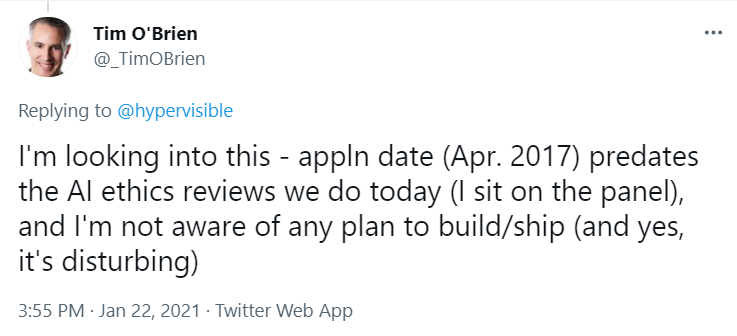
Needless to say that Microsoft's unsettling conversational chatbot technology was deemed unethical by internauts and experts when the news broke. Hence, Tim O’Brien, Microsoft’s general manager of AI programs, had to come forward and clarify how the Big Tech powerhouse had no plans to implement the patent.
Second Life or the Internet of The Departed?
However, the impact of artificial intelligence (AI) on real-world scenarios is expanding exponentially. Recently, Google awarded 1.7 million euros for AI research in Portugal.
This technology is already being used to predict patient deaths in several countries. The Microsoft patented AI has inspired researchers worldwide to seek ways to tap into the afterlife.
As I write this article, developers worldwide are working on apps that seek to mirror someone’s personality and behavioral patterns via the knowledge preserved online in social networks. The algorithm will then replicate the dead person’s response patterns and the person’s voice and physiognomy, just like in the movie Transcendence.
Startups Tapping Into the Afterlife
ETER9
ETER9 is a unique social network. ETER is an abbreviation of “eternity,” and the number 9 derives from the English idiom “Cloud nine.” “a feeling of well-being or elation.” Hence portraying an ethereal type of cyberspace closer to the biblical image of the garden of Eden.
Portuguese developer Henrique Jorge likes to refer to ETER9 “as the most daring experience ever made on the Internet — a new social network that combines virtual and organic users uniquely — there is nothing like it in the world.”
The app AI-based system promises to deliver social content long after the user has departed, making it possible to publish content in the feed and establish new virtual connections.
The developer also explained how Microsoft’s chatbot algorithm is not the same as the ETER9 concept, even if he admits similarities.
“We are not doing this for the departed. Quite the opposite, we are doing this for living people and companies. Our project is far from a standard social network. It’s something more.”
Hence, ETER9 runs on the premise that humans “can be more” and “unleash their full potential” via their digital counterparts behaviorally sustained by an A.I. (the cortex) capable of “predicting the cycles of near futures” by analyzing the living user actions.
Eternime
The Entrepreneurship Development Program at MIT is the think tank behind Eternime. A service that offers its users the possibility of immortalizing themselves virtually by creating an avatar based on A.I. systems set on interacting with the users’ loved ones after they depart.
The avatar will have 3D features identical to those of the clients and built-in technology replicating their voice. According to founder Marius Ursach, the avatar’s mission will be to interact with the users’ descendants as if they were still alive, thanks to A.I. algorithms that will transform that data into an interactive relational simulacrum.
Afterward, it will be up to the client to select who gets to be contacted by Eternime , which will afterward grant access to the avatar of the deceased.i
Replika
Replika is an application that uses artificial intelligence to simulate a chat-based virtual friendship. Thanks to its learning ability, in time, the A.I. starts behaving more and more like the user it mirrors.
The startup behind Replika is called Luka and has offices in San Francisco and Moscow, where developers work on improving the A.I. learning capabilities.
Russian entrepreneur Eugenia Kuyda had the idea to create the app after experiencing the loss of her best friend. Hence, in her vision, Replika comes out as a therapeutical tool to help people deal with the loss of a loved one by creating an app that would reproduce the person’s feelings, ideas, beliefs, expressions, and idiosyncrasies.
Legathum
Legathum is a Brazilian startup working on one of the latest apps focused on “recreating” a person in a cloud-based environment supported by A.I.
The startup founder, Deibson Silva, is a neuropsychologist, graduated from the Medical School at USP, specialized in studying human behavior. The insight came from the current COVID pandemic crisis and all the grief caused by the unexpected loss of so many loved ones, their beautiful stories, and memories.
For this project, he teamed up with A. I. expert Alberto Todeschini, head of the science and technology department at the University of California Berkeley. Together, they are working on Legathum’s prototype that should work through the storytelling method, i.e., the person himself will tell his story to the application’s system.
SafeBeyond
SafeBeyond is a startup developing an app that provides the ability to share stories, photographs, videos, and online credentials with our relatives, friends, or just any other user we grant access to our digital assets at any given moment.
Hence ensuring the user’s legacy isn’t lost in the event of an untimely death legacy. Everything is made available to loved ones for years to come, whenever and wherever necessary.
Based in Las Vegas, the startup offers “an emotional life insurance” based on a “digital time capsule” containing personalized future messages for loved ones.
GoneNotGone
GoneNotGone is the startup behind an app that sends messages to loved ones on anniversaries or other special dates long after the user has passed away. Messages may include video or audio recordings taken with a smartphone.
Developed by Peter Barrett, GoneNotGone has offices in Houston. The company motto is the following: “create future memories now… live on digitally.”
Final Thoughts
From ETER9, a social network, developed by Portuguese tech entrepreneur Henrique Jorge, that pairs each user with an AI surrogate that can replicate the person’s online behavior and post online content ever after death in line with what companies like Eternime and Replika do with its digital avatars and virtual confidants.
To startups like SafeBeyond and GoneNotGone that allow people to record videos and messages that will be sent to their loved ones after death, there’s a booming market wagering on virtual immortality for a profit and willing to endure all the moral and ethical fallout.
Just some food for thought; what about developing a similar AI-based platform for creators that will learn from our writing, and go on publishing stories long after we have moved on to the afterlife? That would give a new meaning to ghostwriting.
Why think small when we can dream big!
Dear reader, what is your stance regarding the ethics and privacy issues of AI-induced transcendence? Interact by commenting below.
For one hundred and thirty thousand years, our capacity to reason has remained unchanged. The combined intellect of the neuroscientists, mathematicians and engineers pales in comparison to the most basic A.I. Once online, a sentient machine will quickly overcome the limits of biology; in a short time, its analytic power will become greater than the collective intelligence of every person born in the history of the world. Some scientists refer to this as the Singularity. I call it Transcendence.—Dr. Will Caster, quote from the movie Transcendence (2014)
⭐️ Sign up through this link. Support your favorite platform and its talented authors. You’ll boost our community’s success and support my work with a small commission, all while gaining exclusive perks and benefits as a member.
