
Appreciate The Fact That You Know Nothing
We can all use a dash of humility in our approach to learning and to sharing information.
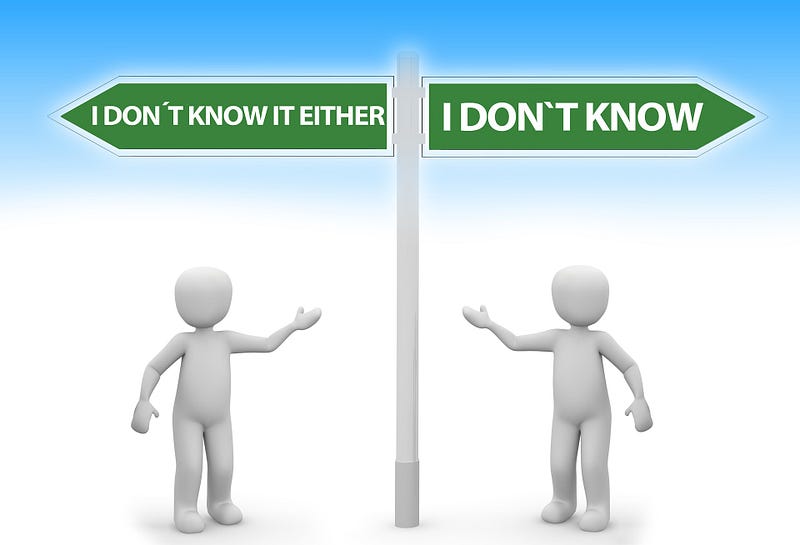
I know nothing
“One thing I know is that I know nothing; this is the source of my wisdom.”
Socrates
Let me put the reader at ease with a humility signpost early on: I know very little about anything. Yes, I can humbly express this bold statement with emphatic confidence. Much like Socrates, it is the core of what I know; nothing.
Over the arduous span of my professional and personal upbringing, this reality of limited knowledge has consistently come at me like a loaded freight train, knocking me off my feet when I least appreciated it. This vindictive curse has repeatedly hit me with stress and anxiety: in front of a classroom of peers, playing trivia games with friends, sitting for interviews with prospective employers, trying to impress girls; the curse of finite knowledge is an inevitable situation for my less-than-perfect human brain.
Lacking an objective and indifferent perspective, I often fell for it in the past. I indulged my hyper-sensitivities and emotional triggers by feeling sorry for myself. I complained internally that the answer to happiness was more knowledge; I used it conveniently as a denial tool and programmed my mind into using it as a procrastinating feature for why I was never accomplishing anything.
How can I compete with the strongest minds out there? How can I match-up to individuals that know more than me? What will the professional world be like for an ignoramus who can’t remember anything at all?
Then it finally hit me!
You know nothing as well!
A fleeting realization tore into my stream of thought the other day as I was out walking in the hot sun.
What if I’m not the only one that knows nothing? What if we humans all lie doomed together, wallowing hopelessly in the filthy mud in parallel?
I allowed for the idea to simmer for some time before putting in some research. Was the anxiety of knowing nothing something innately inherited by only me and not others or was there something more at play here?
The traditional idea of having authority over a field of knowledge seems to have dissipated over the years, particularly in the last few. While infinite streams of available information haemorrhage in front of our eyes, it’s hard to hone in on any one direction of focus. I have taken keen and discerning notice of this in recent times. It is simply too easy-to-read information these days and to pass it off as authority.
The truth is harsh yet believable: None of us knows anything anymore — not me, not you, not your annoying next-door neighbor. Don’t believe me, then try the Feynman Technique to test the gaps in your knowledge and understanding of any topic surrounding you.
The Feynman Technique is a simple and effective way of learning something. The first step is in trying to explain the concept to a child. Try it now. It is stammeringly humbling.
How does my computer work? How does caffeine keep me awake? How do the reading glasses on my face help me improve my vision?
Try explaining any of these to a child; a mountain of doubt and humiliation will come tumbling into view.
The good news: we all know nothing together! It’s time to embrace it.
The need for humility in an age of feigned authority
“The greatest enemy of knowledge is not ignorance, it is the illusion of knowledge.”
Stephen Hawking
The problem we face as a society in this growing age of information overload can be easily summed up by a study: the Dunning-Kruger effect.
The Dunning-Kruger effect explores a cognitive bias in which people who know a lot about a particular topic are less confident about their abilities than those who know very little. This wicked paradox is easily explained in the study and circles back nicely to the Socratic quote about the wisdom of knowing nothing.
When an individual is incredibly informed and knowledgeable of a topic, he/she begins asking more questions about it. The ability to ponder inquisitive questioning opens up a dichotomy: the realization that you ultimately have so much to find out still. Given that Socrates was all about asking questions, it makes perfect sense that he came to this conclusion so long ago.
The ugly flip side of this research shows how incompetency can lead to overconfidence. In the study, subjects deemed incompetent were more likely to overestimate their knowledge and skills while also failing to recognize their mistakes. They were also less likely to recognize the aptitude and expertise of others.
Ignorance is not bliss.
The virtue of knowing that we know nothing!
Humility is the goal and should exemplify a benchmark for everyone to strive after. When speaking of knowledge, it is more beneficial to assume you know nothing. The wisdom of knowing you know nothing(as Socrates explained it) is what allows you to continue learning by asking more questions. Get it out of the way. It is better to know that you know nothing than to be ignorant of the fact.
This humility is a virtue that everyone should endow themselves with. It represents the hopeful clarity to a future that seems hopeless at times; a future hellbent on allowing every individual(knowledgeable or not) to project any opinion and thought as authoritative. As it has become easier to access information, a parallel proliferation of available broadcasting channels has made it easier to reach more people by faster means. Without humility, that shared information can become noise and thought pollution.
Be humble when exploring new information. Be more humble when choosing to disseminate that information to the world.
Embrace the fact that you know nothing and hope that others have made the same realization. If not, you could always nudge them in the right, or wrong direction.