
Apple’s Right To Repair Cave Could Backfire
First came the lower Apple Tax for app developers, then we got back the ports on the MacBook Pro, and now Apple does a huge 180 and allows all customers to fix their own phones and Macs. The first was great, and while much too late, definitely welcome. The second was great too, but we did get fat and heavy machines out of it, which is not so great. This last one though, makes me wonder already…
I am a lot of things, but certainly not your average garden-variety Right to Repair activist. I support it, I’m all for it but not in a full-on blind extremist way many out there seem to be. I believe in devices needing to be built in a way that they’re either repairable or carbon net-positively recyclable. I always believed in this. Every time something of mine broke, my first reaction was to fix it, and I often did. From a chipped mug, to my walkman, discman, mobile phone, laptop, washing machine, I have repaired a lot of things in my 36 years of life. So yeah, from hammering things back together to replacing microchips, I’ve done it all — the latter — even profesionally. And still, I don’t think Apple’s latest announcement is a cause for celebration. For neither camps really.
Another PR stunt?
I am known to be someone who likes Apple products and writes about them enough to be labelled a “sheeple”, but when two years ago the Independent Repair Program was launched, it very quickly turned into smoke and mirrors, because really, like Louis Rossman says in his video, it turned out to cause more trouble than solve:
The newly announced Self Service Repair program shares some of the traits of the program launched two years ago, but because I want to believe in good things happening over bad, I will assume it goes further. At least that’s the promise — a site with around 200 individual components available to anyone for purchase should they want to replace the component. And not just that! Also repair manuals. Sweet, right? Except it isn’t. No really.
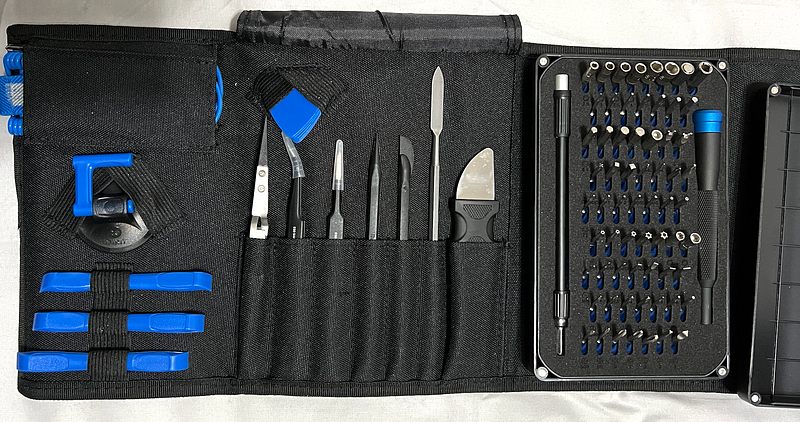
As I said before, I’m pretty good with the soldering iron, I own a lot of tools useful in repairing electronics. I have entire sets. One of those is even by iFixit!
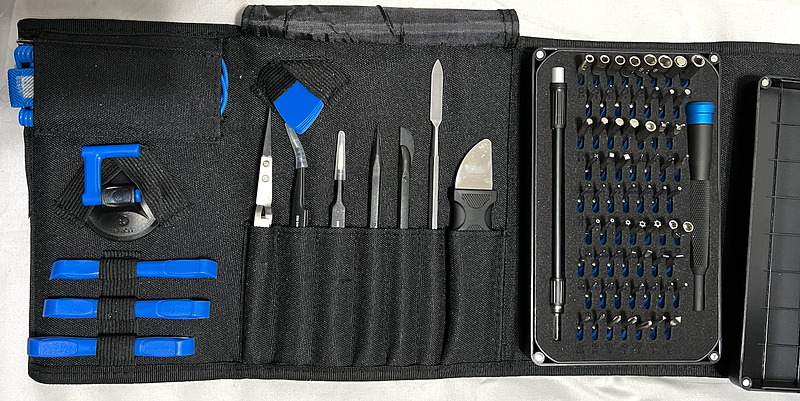
I have replaced and programmed microchips in the past by the thousands, and yet I would not go at my $1500 phone or $3000 laptop with any of these tools, for a number of reasons:
- I don’t have the proper diagnostics tools. If I don’t have that how can I be sure what’s exactly broken? Sure, an entirely cracked screen might be obvious, but there are plenty issues that aren’t.
- I don’t have the necessary setup and environment to do repairs like these. What regular customer does?!? Having a screw-driver and a spudger, no matter how iFixit or not it is, it would never give me the confidence to have a crack at replacing my own screen.
- The sad outcome of a potentially failed repair. Now you don’t only have a broken device, but also a broken replacement part, and you’re back to square one, having to use an authorised Apple service provider or Apple themselves, only to be told you might have done more damage than you initially had. That’s not great, is it?
In light of all of this, I wonder how many customers will actually take avail of the new repair service? Very few. And those who will, have a high likelihood of failing at it and just give more ammo to Apple to shut down the program, having enough data to prove “look what happens when we allow customers to fix their stuff — they break them even more”. How is that great for Right to Repair? It’s not.
But what if it isn’t a stunt?
You’d think that’s a much better story, but you’ll see that it’s equally problematic. Indeed, the new program essentially is open to anyone, and that includes your neighbour’s twin teenagers Judy and Joe who both like tinkering with electronics, so you’ll take the shiny new part to them, because they’re brave enough to do it and you’re not. It’s a genuine option, everybody knows a neighbourhood tinkerer, I used to be be one! But if they mess it up, who is to blame then? What happens with the warranty or your consumer rights? Grey area? Well, when it comes to $1500 phones and $3000 laptops, grey areas make me very anxious!
But maybe you won’t go the neighbourhood tinkerer, you’ll go to the corner shop called “A-Z FixMe”. Well, Apple starts with “A” so they must be able to fix things for you. And they probably will, except that it isn’t exactly a perfect fix. Feels a bit off. You don’t think it happens? Oh but it does. Trust me, Louis Rossman is not your average repair guy and his kind of shop aint everywhere. Here’s an example of how “imperfect” repair jobs can be:
So what if the repair job isn’t perfect you say? It cost you less than half of what Apple would have charged, so kind of worth it, no? No. Absolutely not! Apple positions itself as a premium brand with premium products that last. As a customer, getting a sub-par repair job on a premium product, devalues the item. Over time, the more of these botched and mediocre repair jobs get done, the more these devices flood the market in second-hand shops, scoring a worse and worse resale value and suddenly even when you try and sell your untouched three year old MacBook Air, it will be suspected as having been tampered with by either yourself, the neighbourhood tinkerer or the corner repair-shop, and who’s to tell when and how well that job was done, if it’s an internal part?
One of the reasons I and many other Apple “fans” are loyal to the brand, is because we know these devices have good resale value compared to the alternatives, and that is in part thanks to the fact that it’s common knowledge that repairs can’t be done by just anyone with a screw-driver. I cannot believe that I am swimming against the tide here, but Apple and any manufacturer really should not be forced to hand over repair rights to literally anyone.
If you built a super cool product, would you just let any randomer do whatever the heck they wanted to it, and then come to you crying when it went belly-up, expecting an under-warranty, consumer-protected repair and say “yes, please”? I certainly wouldn’t. Many Right to Repair activists claim they want a consumer-first solution to planned obsolescence, but this won’t give consumers that. The problem is not so much the repairability of the devices we use today, but the cost of repairing them. If Apple and many other would suddenly slash their repair prices in half, many activists would actually feel they succeeded, and rightly so, because frankly, the best thing for the customer is to get their devices repaired by same company who built them. The next best option is an authorised service provider. Beyond that? May the Gods of Kobol help you. No warranty, no consumer rights, no nothing, your device is dead to the manufacturer!
I’d love to live in a world where everything is repairable, replaceable and that includes all the Apple products and it appears that Apple wants to finally allow that world to exist, but I don’t want to live in a world of trashed Apple products, where every rehomed device is a potential disaster waiting to happen. What we really want is to take our precious technological marvels, our extensions to ourselves, to the very people who created them or their best friends and not have to pay an arm and a leg for it. That’s what we want. This, this DIY road we’re supposedly taking is more of a hell paved with good intentions than the pearly gates of repair heaven.
While I have you here…
Just in case you’d like to read some more of my thoughts on Apple or technology in general, here’s a few you might find useful or intriguing:
Did you know that whenever you subscribe to become a Medium Member, us writers, get a cut? You get a ton of great articles, we get a coffee. Sounds like a fair deal to me…
Attila Vago — Software engineer, editor, writer, and occasional music critic. Pragmatic doer, Lego fan, Mac user, cool nerd. JS and Flutter enthusiast. Accessibility advocate.


