
Apple’s AI on-Device Speech Recognition Rests on Your Hands Not on the Cloud
Siri will process requests without an internet connection, says Apple.

When I received the unexpected writing bonus, I bought myself a Google Nest Mini speaker, and I am enjoying it. Well, it is an ongoing love affair with Hey, Google, who I secretly call Ethan.
Audio never leaves the device, says Apple.
Audio on-device will run on default on IOS 15. So I guess it is time to upgrade to a new iPhone and say goodbye to my old but very functioning iPhone 6.
“Privacy has been central to our work at Apple from the very beginning,” said Craig Federighi, Apple’s senior vice president of Software Engineering.
Siri will now be able to “help” or “talk” to you without an active Internet connection. This is possible because Apple’s new “neural engine” inside the A11 Bionic chip powers the latest iPhone models starting with the iPhone X series.
Of course, for now, you can’t ask Siri for something you need to look at on the web. We don’t know how the future will be like, as Apple continues to innovate with the way it incorporates Artificial Intelligence in its product line.
Apple is big on Privacy.
These features represent the latest innovations in Apple’s legacy of privacy leadership, as the company has continually expanded its commitment to privacy and encouraged change across the industry with features like App Tracking Transparency and Privacy Nutrition Labels on the App Store. — Excerpt: Apple Newsroom Update June 2021
Apple’s AI on-Device Speech solves the issue of unwanted audio recording. I know that the future is looking at how tech companies will mine audio recordings, a concern people have with Alexa, Google Nest, and Spotify.
Artificial Intelligence uses data sets for machine learning, and soon technology will be able to match facial recognition with voice.
Imagine what that would mean for marketers. Audio provides more than visuals. It can capture emotions from the tone of our voice. It is why it matters that unless we have explicitly given our permission for companies to access audio recordings as we interact with IoT devices like smart speakers and smartphones that our data privacy is protected.
Apple is doing the right thing to be the pioneer or the gatekeeper of privacy.
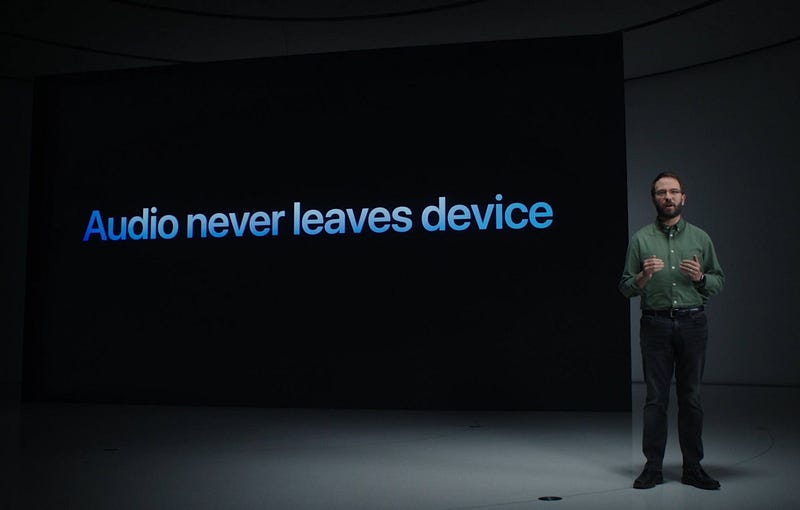
Siri processing is also moving on device, enabling requests to be processed without an internet connection, such as launching apps, setting timers and alarms, changing settings, or controlling music. — Excerpt: Apple Newsroom Post on the WWDC 2021 Event.
Google isn’t far behind with its own Federated Learning
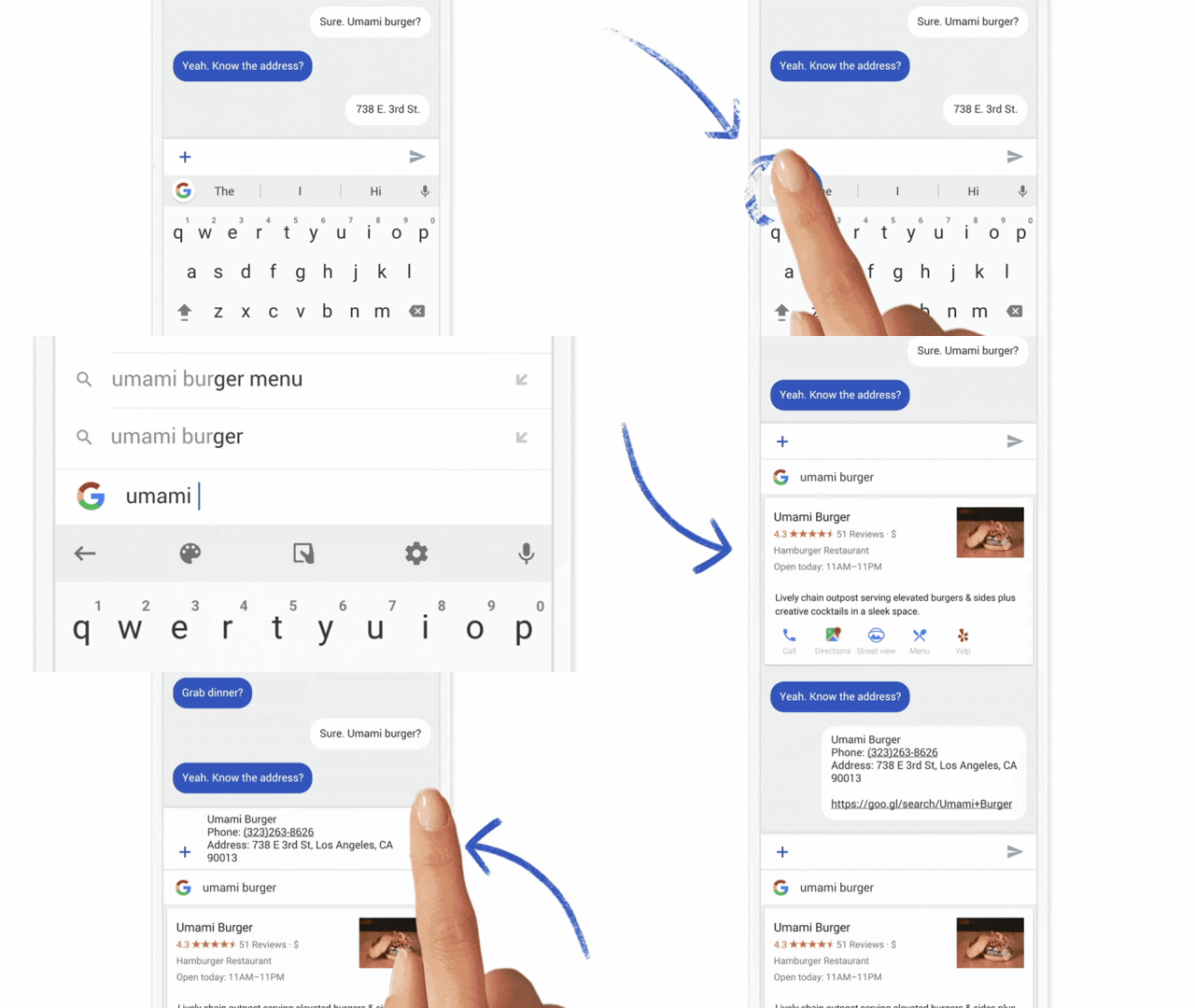
Federated Learning enables mobile phones to collaboratively learn a shared prediction model while keeping all the training data on device, decoupling the ability to do machine learning from the need to store the data in the cloud. This goes beyond the use of local models that make predictions on mobile devices (like the Mobile Vision API and On-Device Smart Reply) by bringing model training to the device as well. — Excerpt: Federated Learning: Collaborative Machine Learning without Centralized Training Data
Federated Learning is already inside Google Keyboard (GBoard) on Android Phones. It allows artificial intelligence to learn more about your choices and train your device based on predictive results from the data sets powered inside your device, similar to Apple’s AI on-Device Speech Recognition, your data isn’t stored in the cloud.
Recap
Apple’s AI on-Device Speech Recognition is a positive step towards protecting our data privacy. However, as artificial intelligence becomes more ubiquitous in our lives we need to weigh its advantages and disadvantages.
When artificial intelligence uses a less than perfect facial recognition for security and surveillance system by the police, it could pose more harm than good in society.
The future should still rest in our hands, and not with the artificial intelligence resting in the cloud.
Further readings:
- Apple’s Siri will finally work without an internet connection with on-device speech recognition
- Video — Apple WWDC 2021 keynote in 23 minutes
- A review of on-device fully neural end-to-end automatic speech recognition algorithms
- Press Release — Apple advances its privacy leadership with iOS 15, iPadOS 15, macOS Monterey, and watchOS 8
- Google is testing a new way of training its AI algorithms directly on your phone
- Federated Learning: Collaborative Machine Learning without Centralized Training Data
- How Do You Feel Being Watched, New York?