
Apple Says We Need Their Cables
And yet they’re hardly the best quality
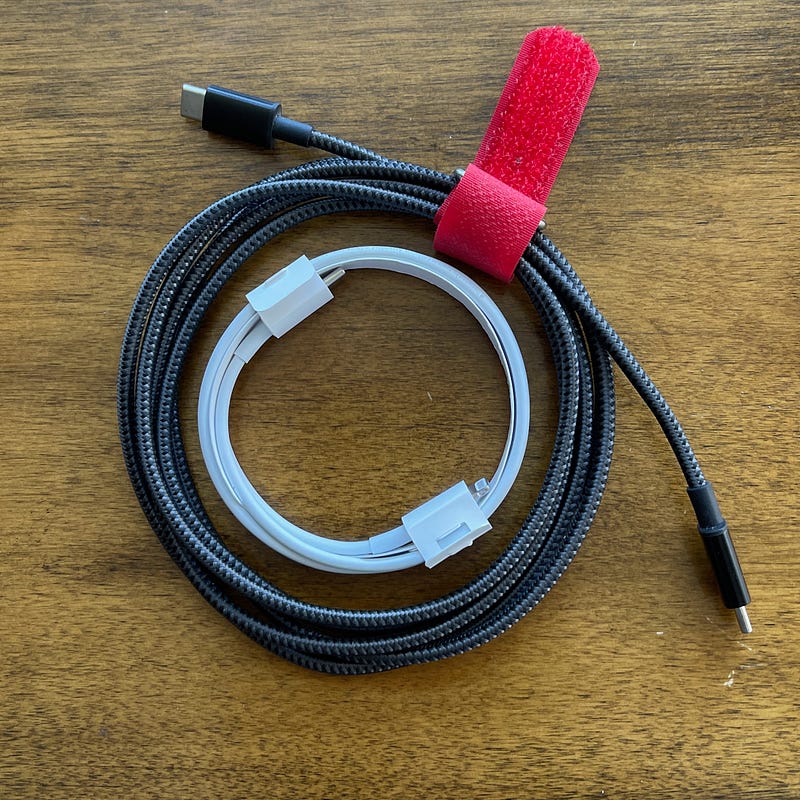
Apple makes a big deal about its cables.
I once saw a demonstration showing an Apple USB cable and a third-party cable with the ends opened up. It was meant to showcase how the parts in a non-Apple cable are inferior. We were told that the generic parts of third-party cables were dangerous and capable of causing fires.
Some cheap cables also have trouble being inserted into iPads and iPhones. They slip out easily or are hard to put in. Occasionally they’re not recognized by Apple devices, which Apple says is a failsafe.
To be fair, those cheap cables are dangerous and will fail early and often. Don’t buy them.
However, if you stick with Apple cables, there is still a problem.
Apple’s cables are not much better, especially for the high price.
The main reason is not the connectors. It’s what they use to wrap the wires.
Apple doesn’t talk about the materials used for the sheath, and it’s difficult to find statistics on their failure rate. I can only offer firsthand anecdotal knowledge.
After seeing thousands of broken Apple cables, the vast majority suffered fraying from kinks. The outer sheath becomes damaged quickly if the cable is bent on either end while your device is charging.
No one thinks about periodically checking their cables. We use them until they stop working or worse.
One day I was surprised to see the cable to my iPhone was smoking.
I immediately yanked it out of the power supply. No harm done, but what if I hadn’t been looking at the cable at that moment?
Plan on replacing the cable early if there’s a bend where you plug it into a charger or your device.
The good news is the warranty covers Apple’s cables for a year, and longer if you bought the cable with a device covered by AppleCare.
As long as you have receipts, the exchange is relatively simple. By the way, you should keep the receipt for ALL of the Apple products you buy. Trust me on this.
There are alternatives to a cable from Apple.
Apple has their Mfi program. This is where Apple’s partners like Belkin and Anker can make their own cables meeting Apple’s standards.
You are better off buying these cables because Mfi partners raise the bar quite a bit.
These partners make silicon cables with double braided cords, which are much harder to kink or fray. I’ve been traveling with Belkin cables for seven years and have yet to replace one.
But here’s the thing; if Belkin and Anker can make a better cable than Apple, then why doesn’t Apple make a better cable, especially since the price of an Apple-branded cable is high?
We’ve all heard the myths of planned obsolescence, but I can’t shake the feeling it’s true here.
Apple is working towards getting rid of most cables anyway.
A push for the USB-C standard in Europe is forcing their hand to eliminate the lightning cable after over a decade. But rather than join the crowded USB-C cable market, Apple is leaning heavily into wireless charging by reintroducing MagSafe technology.
For those devices that need a physical USB-C cable, like some iPads, Apple is still trying to force their perceived standards. The EU likely won’t allow it.
As a luxury brand, Apple gets away with murder on pricing, but it would be nice if they would play fairer in the cable department. Apple claims many alternatives exist, but I’ve just shown this is not the case.
I love Apple products. I’ve used them for over two decades, but sometimes their efforts can fall short. Cables are one of the places for improvements.