
Apple Does Not Want Google Gemini To Be On The iPhone — They Just Want To Get Back In The Game.
Don't let the news fool you. It's 100% strategic and probably won't see the light of day.
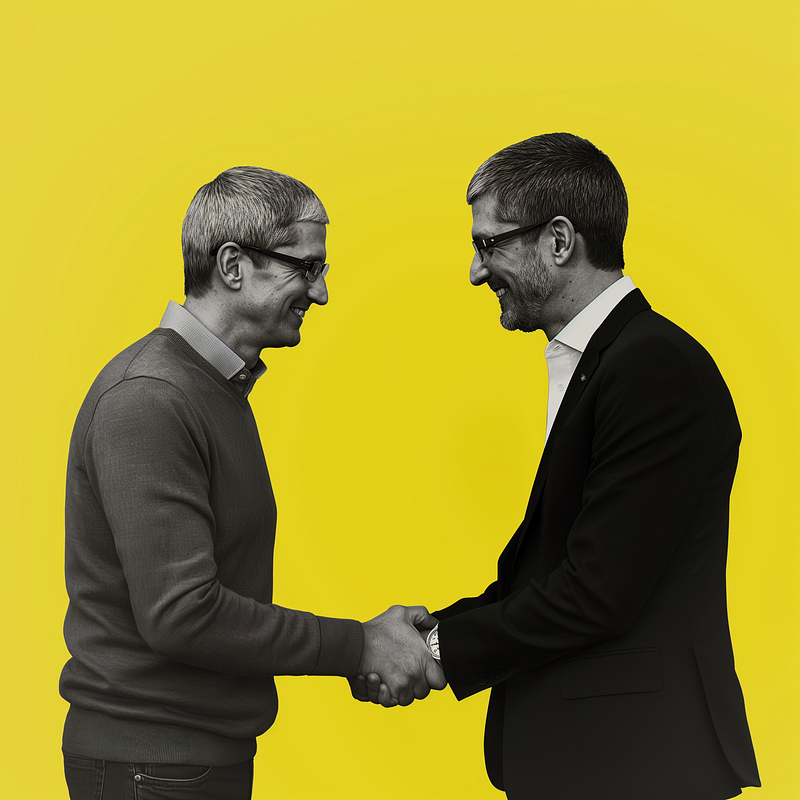
In a few years, you'll find your iPhone powered by Google Gemini in many tasks, making it the phone of the future.
- I know what you're thinking: it's an iOS, not an Android.
- I also know what you're thinking: how will that work? Tasks like what? Taking notes? We already have Siri.
- Oh, wait, I misread this: you own an Android; here's what you're thinking: They're just copying Samsung. It's sad.
You're all correct. It doesn't make sense for a second. But let me help you zoom out and see the bigger picture. Let's look at each character (Google, Apple) of our story and their journey in the past year.
Google — AI freakout, Bard, and Gemini.
You're Google. You've been doing the same thing for 26 years (yes, that's how old Google is).
Then, some new startup gets all the attention you're used to. They even have a worse name and logo than you.
- Google is a cool name.
- OpenAI is a boring name (Aside from this analysis, I actually agree with that one.)
Here's what happens next:
- New outlets start saying that OpenAI is a threat to Google.
- The media likes OpenAI and brands it as the AI company of the future.
- Microsoft, having an obstacle called Google for years, decides to incubate OpenAI; converting it to MS OpenAI (Don't let them make you think otherwise.)
- Investors in Google start to freak out and leave Google to invest in Microsoft (Because they can't really invest in OpenAI, and Microsoft is a relatively safer investment)
- Google freaks the hell out and starts telling the world, "We are all about AI!" – The world doesn't believe it. ChatGPT is in the average consumer's hands. Google Deepmind isn't. Everyone's talking about ChatGPT. Nobody is talking about Google's AI.
- They launch a desperate attempt in the name of Google Bard. Just to participate in the conversation. It's like that one student in class who raises their hand and says they have a great idea just to be a part of it.
- They then delete Bard and launch Gemini, claiming that it's much better than Bard and as good as ChatGPT.
Two things to consider.
1. Is it really better than Bard/GPT?
The average consumer does not care. The hype of talking about ChatGPT is over. So even if they had launched Bard now, it wouldn't have been that bad. The truth is, to most people, Bard, Gemini, Claude, GPT, and even Grok all do the same functionality.
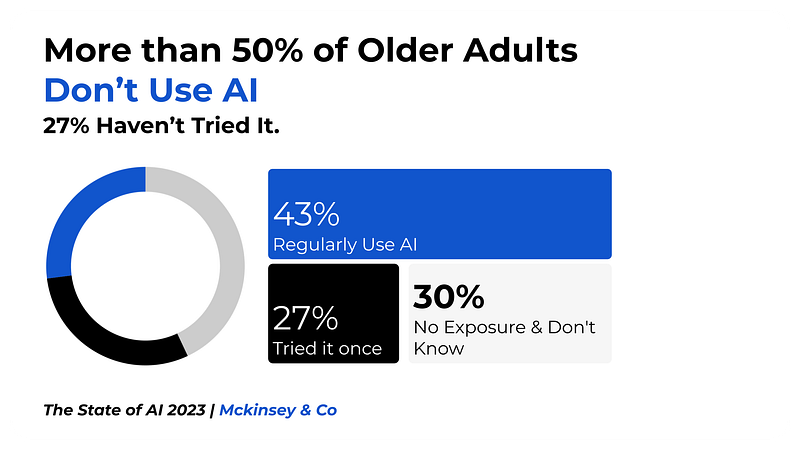
In fact, just to put you in perspective, 57% of "older adults" don't actually use this stuff.
2. More AI, More Chips.
While AI was growing, the need for chips was growing even more. The market knew that and added $1.8 trillion to the market cap of Nvidia, the pioneer in making those chips.
Nvidia became the hype. Leaving Google and OpenAI behind. Then, it closed up on our second character of this story, Steve Jobs' Apple.
Apple — the wrong time to ignore AI.
Apple works with a certain mentality—the customers don't know what they want until we show it to them. That's Steve Jobs's legacy. But here's the thing: it doesn't work forever.
When the whole world heard about AI, Apple was doing nothing in this area and kept working on their super expensive mixed reality headset.
Some liked it, some didn't. That was expected. However, those people who believed in the power of AI kept pouring money out of Apple and into Nvidia and Microsoft.
In a few months, Microsoft was a bigger company than Apple. The margin increased daily. One was an AI company; the other was the same old creative company.
The world chose AI. Tim Cook was stubborn in this sense. But there's a limit to anything. They launched their headset. Now it's the perfect time to announce that they're working on AI to please the world.
They ditched a project that was huge for many people working there — The Apple Car. Then they started saying they're focusing on AI. But words mean nothing at that stage. They needed a grand gesture.
They needed to get on their knees and propose with a ring that had a huge AI diamond. They needed to do this to have a chance to remain on top. So, they started planning this proposal.
The arranged marriage of two strugglers.
It was the perfect match.
- Google was struggling to be viewed as an AI company.
- Apple wanted to be viewed as part of the AI game.
Apple won't just go ahead and tell the world; it has created a new LLM like GPT, Gemini, Claude, and Grok. We have too many of those already, and this will be viewed as super desperate.
So they took door number two — a "potential" partnership. This ought to show the world that both companies are benefiting. Google got the most instant benefit, gaining around $80 billion in market cap just because of this news.
Apple also gained a bit, but not as much. Now, here's why this won't work.
The iPhone and Google are in a lifelong battle.
iPhone and Android have been battling for years. Apple's users choose the iPhone because it's not Android (and vice versa.)
- The core of Google products are accepted by Android users and not Apple users.
- The core of Apple products are accepted and loved by Apple users but not Android users.
Putting Gemini on the iPhone is simply not compatible with the long-term vision of AI and Apple. If AI is to dominate the phone market, then Apple won't hand Google the opportunity to control that.
Strategically, it's a win-win.
Practically, it probably won't happen.
Let me know what you think in the comments. It'll be fun.
I'm AL, a business consultant in Zurich, Switzerland. I believe in the power of delivering value to you, the reader. Follow me on various social media platforms if you're interested in the value of my content.


