
Apple AirTags — Friend or foe?
Are they making you a victim?
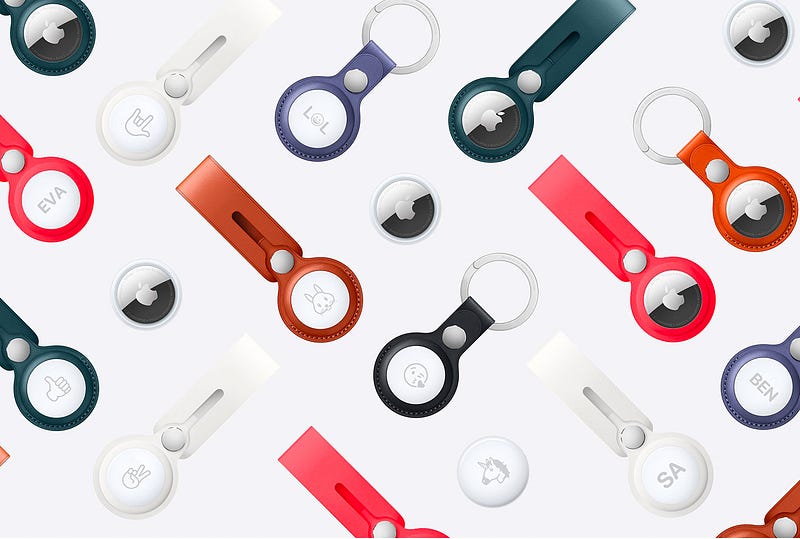
When AirTags were unveiled last year, they were seen as a great and convenient way of finding lost items; you know, those silly little things that always get left somewhere such as keys, wallets, and purses. Even pets can have one on their collar to help them be found in the event of them being lost. And whilst yes, they are great in those scenarios, it was not long until headlines started to appear citing instances where AirTags were being used in a highly nefarious manner. Reports of people being tracked, clearly without their knowledge, were becoming all too common. Many of these reports were from single women, and being the father of a young daughter now living in London, these stories clearly gained my attention. Other groups worried about their misuse could be domestic or relationship abuse victims and, of course, children.
How they work
AirTags operate on very low energy bluetooth, via the Find My app for iPhone users. It uses very little energy thus not greatly affecting battery life and are synced over all your devices. By using the Find My network, it has access to over a billion active Apple devices.
You’d connect an AirTag to your belongings (you can have up to 16 registered to a single Apple ID) and if you lose something, you can track it via your Find My app. If it’s local, say at home, you can emit a beep to help you find it and if further afield, you’ll be able to locate it with details on your Find My screen.
Moreover, if you find a lost item with an AirTag, you can notify the owner too. These messages are end-end encrypted. The sender merely sends a notification to you via the number associated to your Apple ID, but the number will never be seen.
Clearly, their strength is also their weakness. If someone has placed an AirTag on you without your knowledge, in theory, they will be able to see where you are. You’ll know soon enough if there is an air tag on you, as you’ll be notified with a beep on your iPhone anywhere from 8 hours to 24 hours after it is detected. Some of course argue that is too long. And, if you are an Android user without access to Find My, the AirTag will still emit a beep to notify you a tag is close by (eventually!).
Stay Safe
Crazy as this may sound, a little of the responsibility does or possibly, should, fall on your shoulders to be vigilant. If you’ve been out, check your bags, pockets, and clothing. There are certain things you can set up on your devices too that will help mitigate any wrongdoings.
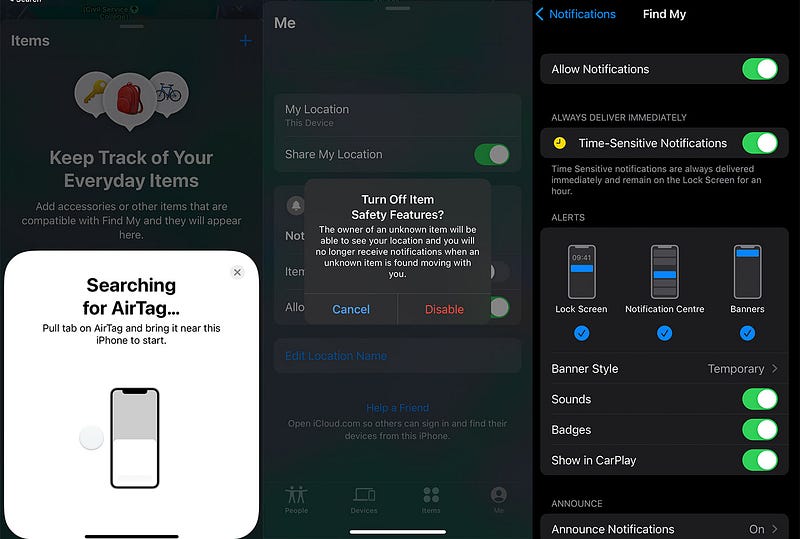
Firstly, to find if an AirTag is currently near you, grab your phone and go to the Find My app. It is inbuilt to your iOS device and cannot be removed. Once opened, go to items, tap the plus button and add AirTag. No AirTags should show up there that aren’t yours. The other feature that Apple implemented, particularly to avoid trackers and stalkers, is found by tapping the Me section (this can be found in the right-hand corner). Make sure that Item Safety Alerts is on, which it is by default. Switching that off will mean you can be followed without alerts. Furthermore, under Notifications, make sure that Immediate Delivery and Time Sensitive are both enabled.
So, What’s the problem?
BBC News published an article with women who had discovered their whereabouts was being tracked. A rather worrying message popped up saying that an unknown device had been following them around. Some ladies in the interview ended up finding AirTag in their cars, and one woman discovered it taped to the inner part of her bag. As one of the victims went to the local police station, she was told it was not the first report about the AirTag following someone.
Is this all the fault of Apple?
Let’s be clear, Apple were not the first to have an affordable tracker available. Tile have had one on the market for years now, it’s just that when Apple do anything, it creates headlines. Fact.
I don’t think the fault can be laid entirely at Apple’s feet here though. Over the years, love or hate Apple, privacy has always been at their very core. It has and is something upon which they pride themselves. These devices have been around for an age, and are of use, but bad people will always find bad ways. Sadly, another fact. I am confident, their teams will be working on even better and more stringent security to go along with AirTags.
As I mentioned earlier, a few simple checks of how your iOS device is set up will help protect you. Is it right that the onus should fall on the innocent? Probably not, but then again, we are not living in utopia. And it is also true that you will be notified much quicker if you are an iOS user. That is part of Apple’s ecosystem. They want to keep you in their network, buying and using their products. So whilst Android users will get notified, it’ll be nowhere near as quickly as their iPhone counterparts.
The answer?
Even if Apple could somehow miraculously take back all their AirTags tomorrow, the lowlife that would like to track people and not belongings or pets would simply turn to another solution, such as Tile or a number of other affordable Bluetooth trackers you can quickly find online.
Perversely, if you are going to be tracked and traced, then would it not be better if that tracking was being done via one of the largest, most honest and quickly notified networks, i.e., Apple? With so many worldwide users, the ability for the good to shine through and help you find lost belongings is like no other out there.
And if you are to be tracked, at least with Apple, you’ll be notified quickly. I am confident that the period of notification for a nearby AirTag to notify you will be brought down; that stands to reason.
But, it the meantime, check your device. Make sure those simple steps I mentioned are all switched on, and check them too on the devices of loved ones or the potentially vulnerable. We can all do our bit to make our families and friends safe.
Get subscribed
If you have a spare moment, leave me your email at talkingtechandaudio.com. You’ll be notified of blogs and soon podcasts and weekly video newsletters too.


