
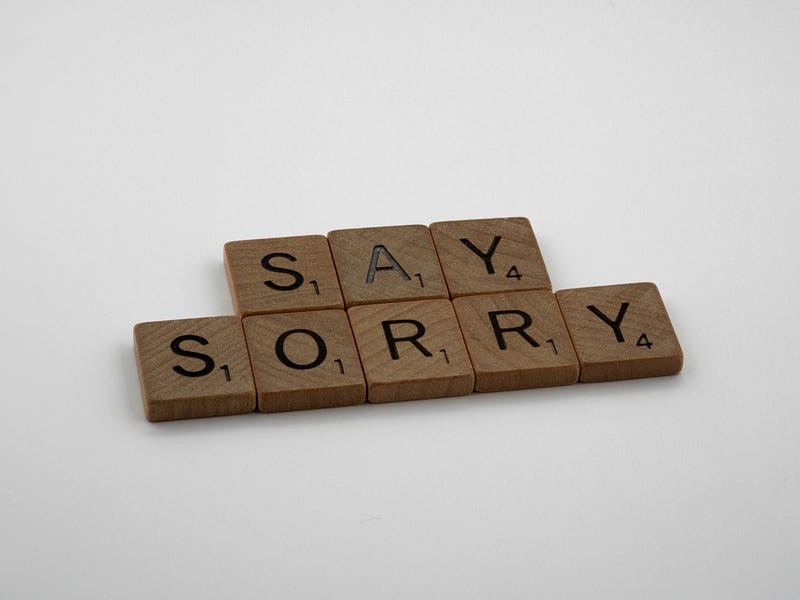
Apologizing Won't Kill You
Unfortunately, the threatened ego is not capable of apologizing, that would mean it is bad and that would spiral into even more shame.
Where I come from originally is an interesting place. It is filled with fun unique characters and the most amazing sense of humour. It also comes with big egos and explosive anger fueled by PTSD, war trauma and horrible relationship patterns.
A common pattern I witnessed is the threatened ego. Terrified inside but explosive to keep itself perceived as big and scary. To show people who are in control. That anger doesn’t last long. It unravels into the shame that is underneath.
Unfortunately, the threatened ego is not capable of apologizing, that would mean it thinks it’s bad and spirals into more shame. Because in childhood, we got the message that whoever apologizes is weak. It’s also the one that becomes the scapegoat, someone always needs to be blamed.
Toxic shame is dangerous.
It is painful and it spills over like everything toxic. Shame is not the same as guilt. Shame convinces us we are worthless as a person and that nothing we do has any effect on the world. The problem is, it does. This becomes a downward spiral, one hard to get out of.
This is at the core of narcissism, and co-dependency.
Being raised by narcissistic parents is a childhood filled with constant criticism. We then internalize it and it devours our light. If we don’t work on healing it from the core, we are in huge danger of passing it on to our children.
The cycle then continues.
Another pattern is the lack of conflict resolution. Someone gets upset, yells and criticises. Instead of having an open, vulnerable conversation, we joke to lighten the mood. And everyone else is expected to have forgotten all about what happened. But hurt feelings don’t just evaporate, they stay and fester.
Or worse, we take it out on the person we perceive as defenceless. In the end, this creates more shame and drags us further away from our souls.
This is a breeding ground for unhealthy attachment.
We spend our lives wondering why we can’t manage relationships and why emotions seem to be so hard to handle.
Emotions, if not expressed, make a loop back to the self and get stuck. They get stuck all over the body depending on what emotion it is. If we continue this way, we get very sick both mentally and physically.
Admitting to ourselves that we act like toddlers emotionally is not fun. It makes us want to put our heads back into the sand and hopes the boogieman will go away.
Let’s not do this. It takes bravery to grow emotionally and to change ourselves to have healthier relationships.
Feeling uncomfortable is usually an indication that there is a potential for major growth. The first steps are always the hardest.
If we know we need to have hard conversations, let’s not put them off and repeat the pattern. Let’s take a breath and say something. Either that we feel hurt, or being humble enough to apologize without making excuses.
If we care about each other it’s time to break patterns of narcissism in our relationships.
This pattern is not unique to my culture, it’s everywhere to different degrees. As humans, we need to mature emotionally, urgently.
We need to ask ourselves, is my need for being right overriding my desire for healthy attachment? If yes, we need to accept the consequences that come with that. And they are not pretty, as we all know.