
Anybody Heard of a ‘Pocket Gay’?
‘Devil’s Chew Toy’ by Rob Osler brings us a charming amateur sleuth
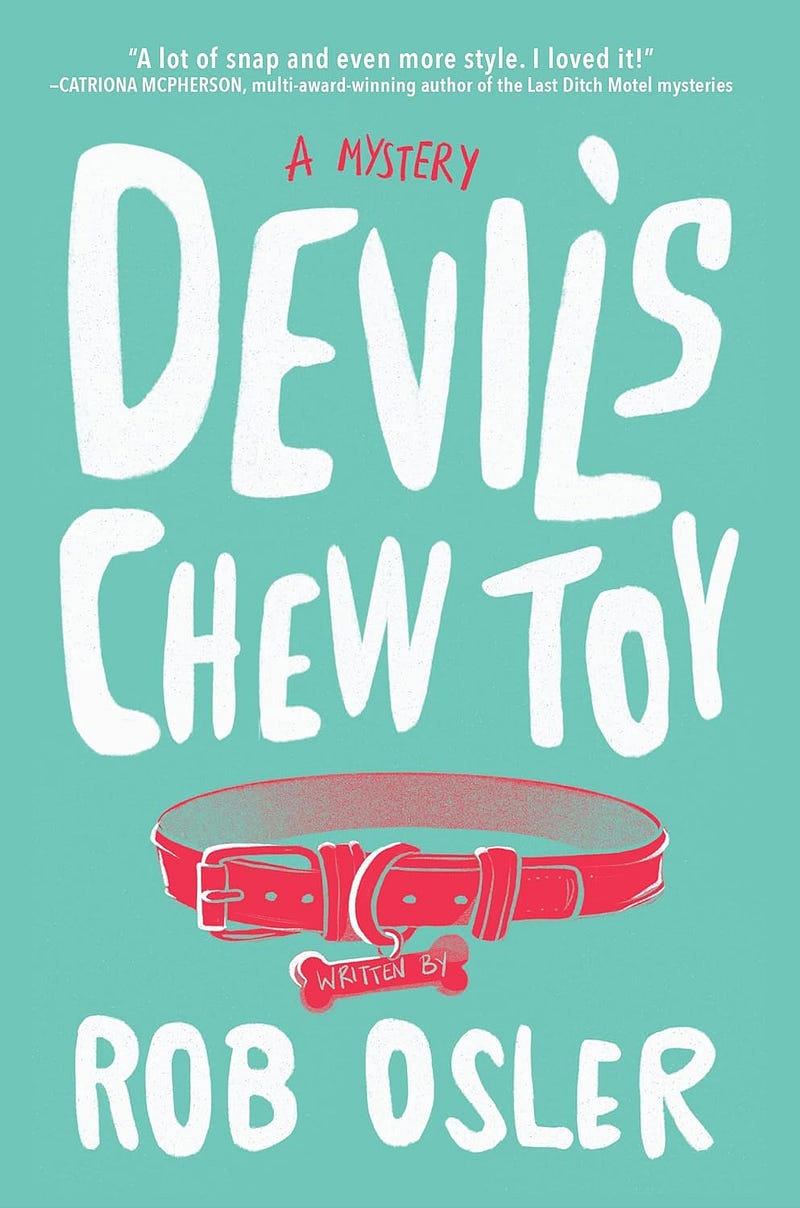
Book review: Rob Osler, Devil’s Chew Toy, New York: Crooked Lane, 2022.
A petite gay man and a couple of tall, strong sisters (OK, lesbians) search for a beautiful male go-go dancer who has disappeared.
There is nonstop action, from the narrator’s bloody nose to multiple kidnappings to hanky panky in a weird pet shop to hair pulling in a warehouse to an amphibious invasion of a Seattle area mansion. Despite the title, the least violence-prone character in the book is Commander, the bull terrier, who just wants to pee, eat, and chase sticks.
Aside from the bloody nose, the story begins with a sweet pick-up as the dancer Camilo Rodriguez invites our narrator, Hayden McCall, home for the night. Hayden is 25, short and slim, freckled, ginger-haired, a blogger and eighth-grade teacher. He is all for a one-night stand with this gorgeous guy, but can’t figure out why he’s been invited.
Instead of joining me on the sofa, Camilo tilted his head toward the hallway. “I’m beat. You coming?”
My knees quivered as I got to my feet. Despite my desire to sprint into the bedroom, I measured my steps, not wanting to appear too eager, too desperate. The speakers on the dresser sounded the soft return of Stanley Kellogg: Because the easiest thing I’ve done is falling hard for you.
…
As Camilo mercifully stopped singing and pulled me onto the bed, the improbable night delivered one last surprise.
“There is something you should know,” Camilo said as he propped himself up on an elbow, his expression suddenly serious. “So you don’t get the wrong idea…”
My throat went dry. I’d heard this same preamble before — the last time it had ended in the word girlfriend.
Camilo grinned. “I generally just cuddle on a first date. I hope you’re okay with that.”
And with those words, what I thought I’d wanted most was replaced by something altogether better.
— Devil’s Chew Toy, chapter one.
And then Camilo disappears.
To make the ensuing story line plausible, we have to posit that Hayden is a nice guy: a really nice guy on the cusp of making some choices, not to be less nice, but to be less cautious.
That’s not very difficult, as Rob Osler, the author, gives Hayden a credible voice. I read instead of listened to this novel, and I realize it would’ve been fun to meet the audiobook narrator. But the great thing about Osler’s style — fluid, unobtrusive, and compact — is that it allows the story to tumble forward in a series of short chapters that drive the narrative toward a satisfyingly action-packed conclusion.
Hayden’s determination to find Camilo takes him back to the bar where his new friend works, and from there to Camilo’s lesbian friends Hollister and Burley. There’s no time or opportunity to get backstory on either of these larger than life characters, but we meet their friends and relatives who tell us as much as we need to know. Osler crams the book full of characters, not all of whom one would like to meet, but all of whom — Osler knows his craft — play active parts in this quest narrative.
For that is what this is, of course: a quest narrative, an odyssey. Every character along the way gives the seeker and his allies a tool or insight that they must have to complete the mission. There is Aunt Sally, a fundamentalist who has raised Hayden lovingly, including lending him her Christian-sticker-coated Prius when his car is in the shop. They just don’t talk about, well, you know. There is an old man who falls in love with the tag-along dog and offers Hayden much-needed wisdom about how to solve a problem: wisdom that he insists Hayden already possesses.
And then there are Hollister and Burley, along with Burley’s gun-toting antisocial brother, who ends up playing a vital role in the conclusion. Tall Mohawk-sporting mad-driving Hollister has a history of questionable relationship choices and a wildly successful furniture crafting business. Big Burley runs a popular Seattle coffee shop that sells great espresso and delicious huge pastries.
And there are others. The bad guys are both bad and hilarious. They engage in a disgusting illegal business venture which shall remain unnamed here. Spoiler reduction.
Hayden, Hollister, and Burley all have different reasons for not calling the police, who pursue the case from the beginning, asking all the right questions and not being particularly nasty. This is the challenging part of any amateur sleuth tale: to keep the authorities sidelined in a way that allows the non-police to solve, or mostly solve, the central mystery.
In this kind of narrative, the police can be brutal and obnoxious, or they can be stupid, or they can be eager or reluctant allies, or the amateur protagonists can have compelling reasons not to call on police guns, cruisers, bullet-proof vests and badges to arrest bad guys.
In Devil’s Chew Toy, I found the reasons to keep the police on the sidelines just barely credible. However, the story is so enjoyable, so edge-of-the-seat exciting, that I just gave the author a pass on this point.
One of the things Osler achieves is to write a gay cozy. There is serious action, and there are real lives at stake, and the issues raised by the narrative are real world problems. As a long time resident of the Pacific Northwest, I think I’m entitled to suggest that situating the story in Seattle is a stroke of genius, because, well, Seattle: the home of island ferries, gay bars, traffic jams, coffee shops, the Pike Place Market, and general weirdness. (My beloved Portland is smaller but also, you know, weird.)
But what I’m trying to get at (I got sidetracked by homesickness for the northwest) is that Osler uses the setting not to minimize or trivialize the issues at the heart of the book, but to craft an action story that raises the issues but keeps reminding us that there are good, caring, normal-though-fringy people in the world who are willing to address those problems.
Osler’s acknowledgments at the end of the novel include a bow to the literary community building of Armistead Maupin (and I trust that a second edition will correct the spelling of his name, doggone it). “[T]his world is WAY more colorful and vibrant thanks to each of you who identify as lesbian, gay, bisexual, trans, queer, or other gendered or oriented,” Osler writes. “…This story is for you, our allies, and anyone with a soft spot for pocket gays, Black girls with Mohawks, and gentle giants.”
Amen to that. Hayden emerges from his quest braver and surer, though just as nice as ever. Take an afternoon or two and read this fun book. You won’t regret it.
Another LGBTQ+-inclusive detective story:
Thanks for reading!