
Automated testing anti-patterns
Sometimes it’s easier to learn from what not to do rather than from what to do. Anti-patterns represent common bad practices, code smells, and pitfalls; in this case, when creating automated tests. You should learn them so that you can spot them.

Automated testing is fundamental to software quality. “But this is only a test” is always a bad argument.
[…] we developers make a mental divide. On one hand we have the application code, and we know that it’s vital to keep it clean and easy to evolve. On the other hand we have the test code, which we know isn’t part of our production environment. The consequence is that the test code often receives considerably less love. This is a dangerous fallacy because from a maintenance perspective there’s really no difference between the two. If our tests lack quality, they will hold us back. Software Design X-Rays
No clear structure within the test
Not following an expectable structure in each test makes it hard to maintain it. Tests are living code documentation, so everyone should be able to quickly read/change them.
Arrange, Act, Assert is a pattern for structuring code in test methods. You organize your code in phases for the sake of clarity. It can be mapped to Setup, Exercise, Verify, Teardown in the four-phase test pattern and to Given, When, Then in BDD:
- Arrange⇢Given⇢Setup: initialization of the SUT (system under test, whatever you’re testing) and other dependencies like mocks and fakes;
- Act⇢When⇢Exercise: the call to the method being tested — ideally a single-liner;
- Assert⇢Then⇢Verify assertions of the output or verifications of calls made;
- (Optional) Teardown: if there are resources to be freed.
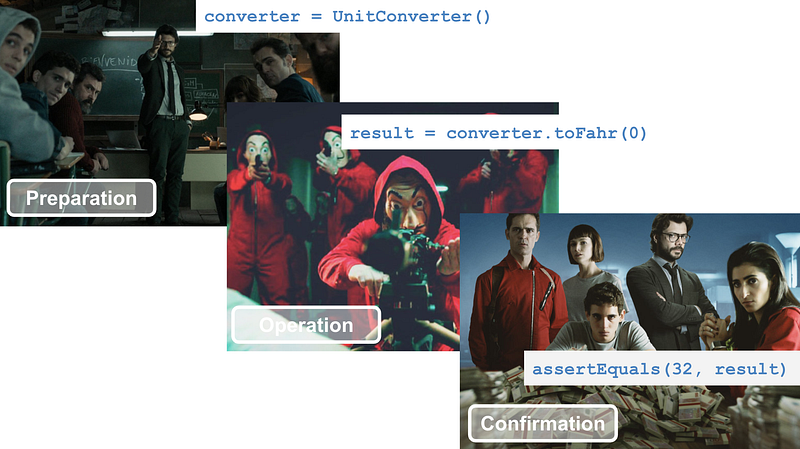
As a consequence, I usually have 3 phases visually separated by empty lines. If you reply with: “But I have lots of code in my test! I need more than 2 empty lines!”, I’d say “That’s likely a design smell”: you might need to split your SUT, consider creating a “local DSL” — high-level helper methods, or maybe extracting the creation of SUT to a factory method.
TL;DR
👎 Having no consistent test structure, harming readability; 👍 Applying Arrange/Act/Assert consistently, visually separated by newlines.
Refactoring when adding a feature
Adding a new feature bears some risk and stress, even when you do TDD. So, why would you make things worse by fixing this or improving that simultaneously? This can lead to an explosion of untested cases and hard-to-track-down bugs, but the worse is the anxiety it brings.

So the bottom line is to focus on the current feature. You should indeed leave the code in a better state than you found it — opportunistic refactoring, but please do it:
- before the feature, if it helps to implement it, or
- after the feature; in this case, consider writing the refactoring ideas on a sheet of paper, as TODOs in the code, in tasks/stories in your tracker, to reduce the “fear of forgetting”.
When you find you have to add a feature to a program, and the program’s code is not structured in a convenient way to add the feature, first refactor the program to make it easy to add the feature, then add the feature. Refactoring
TL;DR
👎 Improving things you step into, while you create a feature; 👍 Doing the refactor before the feature or noting it down for later.
Changing implementation to make tests possible
I recently read Test-Driven Development by Example by Kent Beck and I was a bit disappointed that he was teaching why and how to test private methods (using Java reflection). Later, I think he made up his mind:
I never faced a situation where I needed to test private methods; it always feels like a big red flag.
In “unit test”, the word unit represents a piece of a public interface. Private methods are an implementation detail — auxiliaries of public methods — and are to be tested indirectly through them! There’s probably no exception to this rule. It usually means you’re doing something wrong.
“Ah.. but I can make the method public!”. That’s even worse… you should not change the code implementation just to make testing possible. Testing private methods is just an example, but there’s much more:
⚠️ Increasing visibility: Besides trying to test private functions by making them public, it’s bad to augment the visibility of other things like constants.
⚠️ Adding a return to a previously void function: Test the consequence in the system instead. Do it by verifying the mock (behavior verification) or even better, by relying on a pre-existing function that allows asserting the new system state (state verification).
⚠️ Creating a new function only to assert in the tests: Don’t create new functions only to assert a side-effect. Likely, there’s a way to assert it already in place. Why would you develop a new feature if there was no way to verify it?
⚠️ Having a “test mode”: I’ve seen code that checks a variable to probe if we’re running tests. The fix would depend on the case, but please, don’t do it.
TL;DR
👎 Changing the implementation solely for the sake of making testing possible; 👍 Be hinted to redesign the implementation code because the tests are hard to write.
The test is hard to write
A common reason for a hard-to-write test is that you’re new to the problem and need to get more familiar with it. In that case, try explaining the problem to someone (or even to a duck) or take a break to get your ideas organized.
If you’re using TDD, you can try the starter test (a basic one) or the explanatory test (the one you’d use to explain to someone).

However, if the test ends up being too complicated, too long (e.g. lots of setup code), or feels like a hack, probably there’s a better way. A good way of finding out if your code is too complicated is the need to add comments to explain it: code should speak for itself.
Generally speaking, tests that are hard to write or understand are a symptom of bad code design. Tests are a client of the implementation code — when tests of a component are hard to write, you can extrapolate how hard is to use that component.
If it’s hard to write a test, it’s a signal that you have a design problem, not a testing problem. Loosely coupled, highly cohesive code is easy to test. Extreme Programming Explained
In that case, you should consider if the implementation code needs a refactor to make it easier to test and maintain. The solution may be to divide and conquer, as your SUT may be a “god object”. It may also be worth questioning if you’re doing TDD with too high-level tests (e.g. acceptance).
TL;DR
👎 Making hacks that need an explanation or having complicated setups, so that a scenario can be tested; 👍 Considering a code redesign when a test is hard to write.
Optimizing DRY
This is the most common mistake I encounter. People see a repeated value and they will immediately create a variable for it. That’s not an early optimization: it’s just making documentation (tests) harder to read.
In tests, some repetition is bearable for the sake of clarity. This is one of the few differences between test code and implementation code. Test code ≠ implementation code. Tests should be more DAMP (Descriptive And Meaningful Phrases) than DRY (Don’t Repeat Yourself).
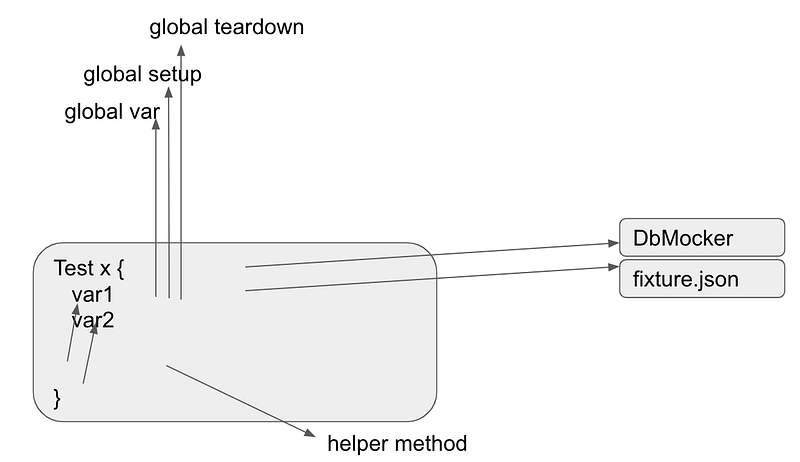
On a related note, I hate having to scroll up and down or open multiple files to understand a single test. A typical case is a folder full of sample data that is used everywhere. Sometimes it’s fine to leave repeated setup and teardown in all tests in all cases. Tests should be self-evident. Tests are documentation. Therefore, I’d prefer to read tests top-down, like in a user manual (imagine if you had to swap pages multiple times when reading your washing machine manual…). This is also a callout to avoid using globals in tests (i.e., class or file globals).
TL;DR
👎 Pursuing DRYness by creating variables and functions in tests; 👍 Starting with everything local and evident; break the rule only if it brings more value.
Very similar test cases
Copy-pasting of more than one line of code should generally raise an alarm in your head. Well… it’s OK to do it just to make it work, but you should fix it later. It’s worse if you copy an entire test where only the initial values vary. This calls out loud to resort to table-driven testing, which allows running the same test multiple times, one per set of inputs and expected output (or other consequences).
   Input | Output
   -----------------
       1 | 1
       2 | 2
       3 | Fizz
       5 | Buzz
      15 | Fizz Buzz
⚠️ Manually iterating test cases is an anti-pattern (e.g. a for in a test). Leave that to the testing framework. I’ll leave a few links: - JUnit parameterized tests (Java, Kotlin); - NUnit parameterized tests (C#); - Jest each method (JavaScript, TypeScript); - RSpec shared_examples (Ruby); - Table-driven testing in Go, Python, and PHP.
Bottom line: use table-driven testing if you keep duplicating the same test with different data. As advantages, you’ll have:
- Less code because you don’t repeat very similar tests — hence, easier to read and maintain;
- Easy comparison of test cases;
- Ability to quickly add, edit, or remove test cases;
- Better documentation, because positive, negative, and edge cases are explicit.
⚠️ In table-driven testing, do not mix the happy path with the error scenarios. These should be kept apart for clarity reasons.
Finally, consider the trade-off you’re making, given that the tests become less DAMP when applying this technique.
TL;DR
👎 Copy-pasting many similar chunks of test code to add new test cases; 👍 Learning how to do table-driven testing with your language/library.
Testing everything
According to the law of diminishing returns, there’s a point where the cost to add tests does not compensate for its benefits anymore.
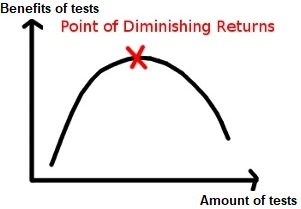
In other words, not every possibility needs to be tested:
- some are too rare but with low impact;
- others will quickly arise when using the software (e.g. missing env. var.)
- many won’t have a big impact if they fail (e.g. CSS styling, animations).
How to determine if a certain test is worth it? You should roughly calculate its benefit-cost ratio: is benefit/cost ≥ 1? Within benefit consider the permanent prevention of the problem (testing as a safety net). For the cost, take into account the effort to simulate the test scenario and the resources (lines of code to maintain, time to run) it will require from thereon.
TL;DR
👎 Religiously trying to test everything; 👍 Analyzing the cost-ratio test by test, to decide if it’s worth it.
Other smells and anti-patterns
- Using the word “and” when describing a test: hints that you should split the test in two, each asserting/verifying different things (check code example above);
- Testing lots of combinations (combinatorial explosion): this is a code smell hinting that you have multiple components into one; the solution is to recognize them and slowly split them apart.
- Treating test code as a second-class citizen: test code is your safety net so take good care of it; most good code practices are transversal to any source code (e.g. avoid globals);
- Not discarding a spike’s code, especially when doing TDD: a spike is a learning tool; its code should not be kept and evolve;
- Testing business rules through the UI: business rules should be tested regardless of the UI being used. Of course, end-to-end testing is an exception;
- Quantity without diversity: test cases should be different somehow — do not add cases for the sake of quantity; the same applies to test scenarios: they should vary;
- Mocking what you don’t own: avoid leakage of libraries into your software (runtime or external); there are alternatives like wrappers and mock servers;
- Conditionals in tests: having “ifs” in tests is wrong; it’s proof that you need another test scenario;
- Overvaluing test coverage: coverage shouldn’t be something you pursue just for the sake of it because you may be near 100% and still have crappy tests. Anyway, with TDD, coverage is almost an irrelevant concept.
- Early optimization: in TDD, always reduce the “distance” between a red (now) and a green state (future). Do the “quick and dirty” implementation even if it means returning a constant or doing an ugly or slow implementation. Make it pass, then make it beautiful. The reason is not only psychological — it’s dopamine-freeing to see a green state — but it’s also about learning sooner. You learn, from the start, more about the problem and the solution (e.g. code design) if you just make it pass.
Further reading
- Why Good Developers Write Bad Unit Tests
- Automated testing patterns
- TDD, Where Did It All Go Wrong (Ian Cooper)
- StackOverflow’s catalog
- Yegor Bugayenko’s list
- Software Testing Anti-patterns (Kostis Kapelonis)
- Part III of Test-Driven Development by Example (Kent Beck)
- Parts II and III of xUnit Test Patterns


