
Anthropic Ushers in New Era of AI with Claude 3 Models
Anthropic, a leading AI startup, has unveiled its next-generation Claude 3 family of models — setting a new high bar for artificial intelligence capabilities. The company introduced three state-of-the-art models on Monday: Claude 3 Opus, Claude 3 Sonnet, and Claude 3 Haiku.
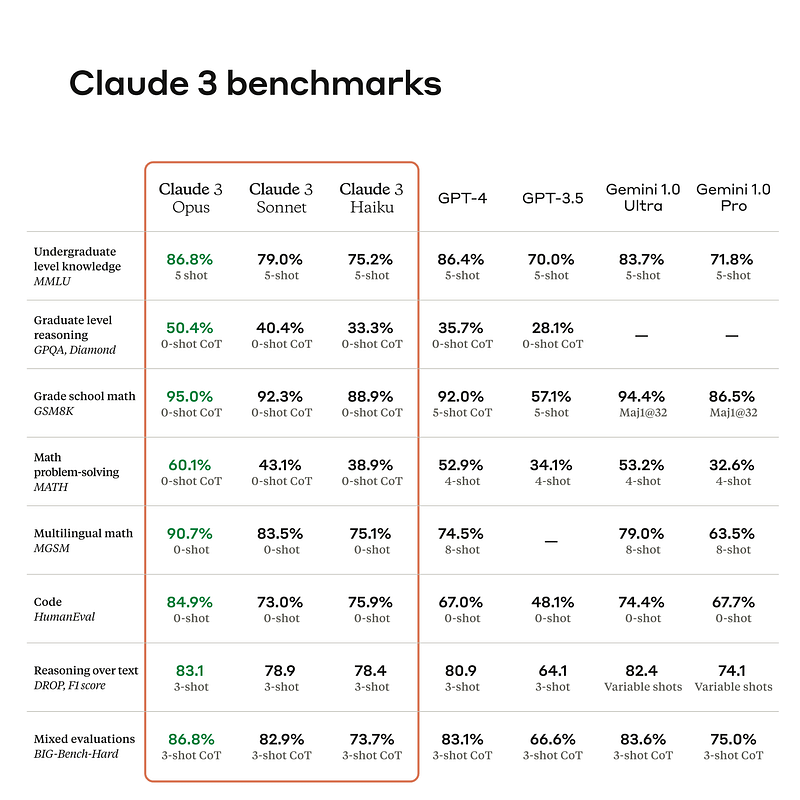
These new models demonstrate unprecedented performance across a range of AI benchmarks, outperforming other top industry models like OpenAI’s GPT-4 and Google’s PaLM on tests of reasoning, math, coding, multilingual understanding, and computer vision.
“The Claude 3 models mark a pivotal milestone for AI innovation.” — Dario Amodei, co-founder of Anthropic.
Claude 3 Opus represents Anthropic’s most advanced AI model to date, with over 12 billion parameters. In benchmark evaluations, Claude 3 Opus showed the ability to carry out complex sequential reasoning, demonstrate a more grounded understanding of the world, code working computer programs, comprehend advanced math concepts, and even generate novel images based on text prompts.
“We have achieved breakthroughs in model architecture, training techniques, and application-specific fine-tuning that enable Claude 3 to excel at diverse real-world tasks.” — Dario Amodei, co-founder of Anthropic.
Meanwhile, Claude 3 Sonnet and Claude 3 Haiku are smaller models specialized for particular use cases. Sonnet focuses on natural language tasks while Haiku targets computer vision applications. Despite their smaller size, both models outperformed much larger competitors from OpenAI, Google, Meta, and others on benchmarks.
Dario Amodei emphasized that unlike other LLMs, Claude 3 models have been developed hand-in-hand with Anthropic’s Constitutional AI framework to ensure model safety and reliability. This framework acts as a form of “immune system”, steering models away from harmful, deceptive, or biased behavior.
The release of Claude 3 cements Anthropic’s position as an AI innovator able to push the boundaries of model scale while also addressing the real-world needs of customers. With its Constitutional AI approach and focus on model usability, the company aims to deliver transformative AI that is beneficial, harmless, and honest.


