
Another One Bites the Bottom of the Sea: Caesar Kunikov Landing Ship Hit by Ukrainian Drones!
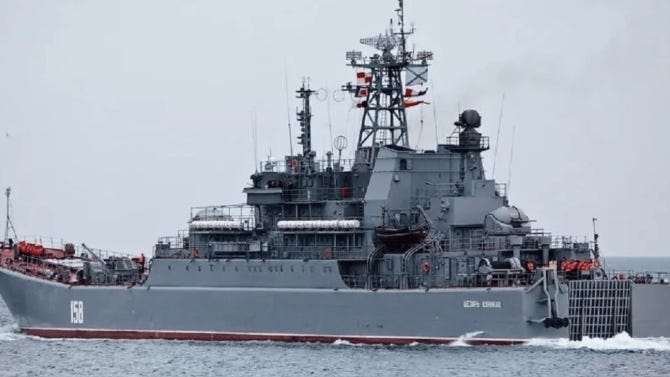
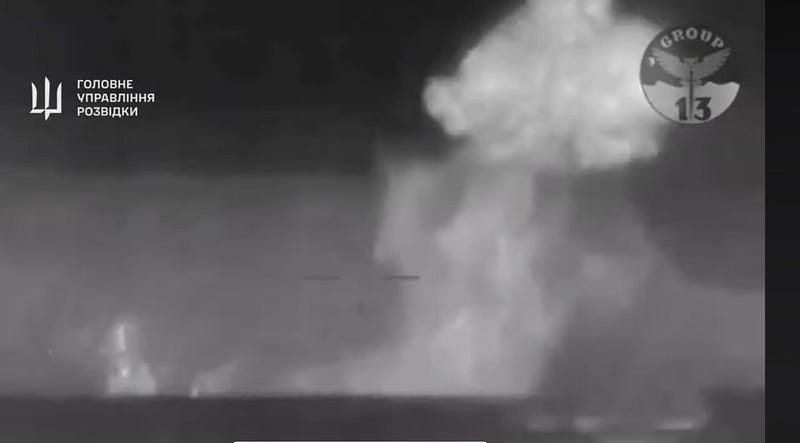
Today 14.02.2024 the Ukrainian military intelligence (HUR) confirmed the sinking of the Russian landing ship Caesar Kunikov. This operation, executed near the Crimean city of Alupka, represents a significant escalation in the maritime domain of the conflict, highlighting Ukraine’s increasing reliance on innovative warfare tactics. The use of Magura V5 marine drones to neutralize this key asset of the Russian Black Sea Fleet on the night of February 14, 2024, marks a notable shift towards asymmetric naval engagements. This incident is not just another loss for Russia but the fourth landing ship sunk since the onset of the full-scale invasion, pointing to a pattern of targeted Ukrainian attacks against Russian naval capabilities.
The Caesar Kunikov, a Project 775 Ropucha-I class large landing ship of the Russian Navy, was not merely a vessel; it was a symbol of Russian naval capability and historical continuity. Named after Caesar Lvovich Kunikov, a Soviet hero and the commanding officer of a landing party during World War II, this ship carried a legacy that bridged past and present military endeavors. The Kunikov’s operational history, stretching back to its commissioning on October 30, 1986, reflects the evolving nature of naval warfare and the strategic importance of amphibious ships in projecting power and conducting operations beyond a nation’s shores.
Built at the Stocznia Północna shipyard in Gdańsk, Poland, the Caesar Kunikov served as a testament to the Cold War era’s shipbuilding prowess and the strategic collaborations within the Warsaw Pact. With a displacement of up to 4,076 tons at full load, a length of 112.5 meters, and equipped with bow and stern ramps for rapid deployment of forces, the Kunikov was designed for efficiency and versatility in amphibious operations. Its significant capacity – able to transport 10 main battle tanks and 340 troops, among other configurations – made it a vital asset for the Black Sea Fleet’s 197th Landing Ship Brigade.
A quick heads-up: Medium’s been tweaking its algorithms and it’s getting trickier for my stories to land in your feed. So, if you enjoy my work, please make some noise! Hit that clap button, light up the highlights, or drop a comment. Every interaction helps keep the stories flowing. Thanks for your support!
The ship’s propulsion system, powered by two Zgoda-Sulzer 16ZVB40/48 diesel engines, enabled it to reach speeds of up to 17.59 knots and to sustain operations across a range of 6,000 nautical miles at 12 knots. This operational range and endurance of 30 days allowed the Caesar Kunikov to project Russian naval power across the Black Sea and beyond, participating in various operations throughout its service life.
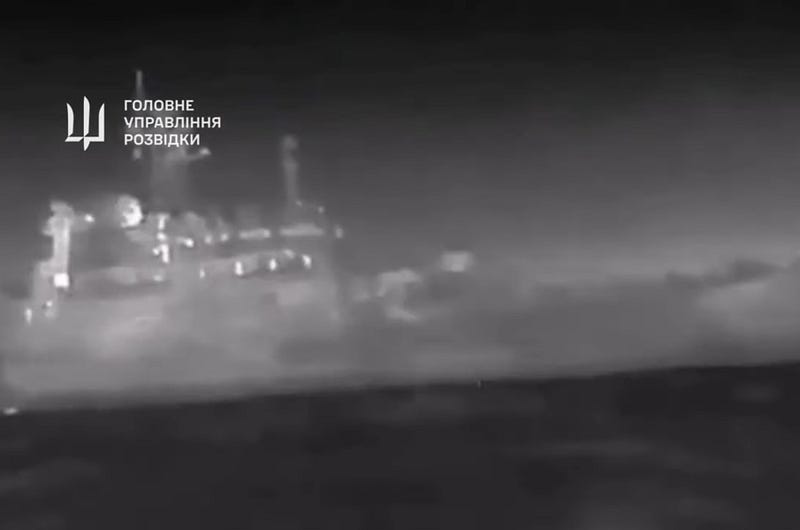
The armament of the Caesar Kunikov, including twin 57 mm DP guns, Strela 2 SAM launchers, and A-215 Grad-M rocket launchers, equipped it to engage in both offensive operations and self-defense against air and surface threats. This firepower, combined with its capacity for carrying troops and vehicles, underscored the ship’s role as a self-contained unit for amphibious assaults and logistical support.
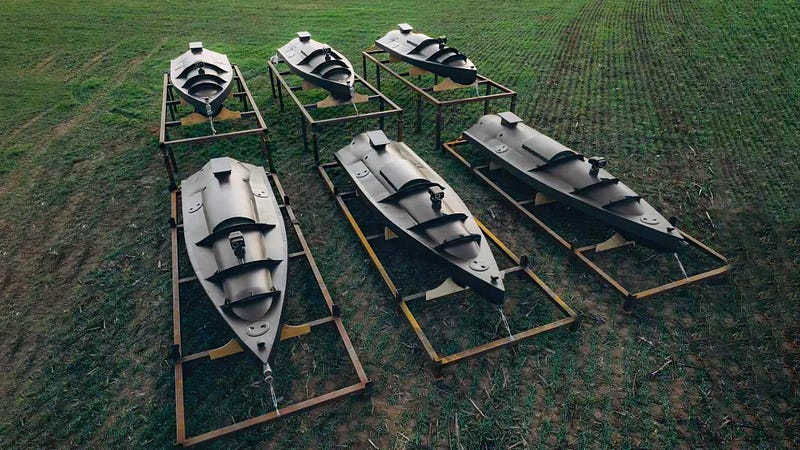
The destruction of the Russian landing ship Caesar Kunikov by Ukrainian naval forces using MAGURA V5 drones is a stark testament to the transformative impact of unmanned maritime technologies on modern warfare. This strategic victory, achieved near the coastal city of Alupka, not only signifies a pivotal moment in the Ukraine-Russia conflict but also highlights the operational effectiveness and versatility of the MAGURA V5 (Maritime Autonomous Guard Unmanned Robotic Apparatus V-type). As a multi-purpose surface unmanned boat, the MAGURA V5 has been designed to fulfill a broad spectrum of tasks including surveillance, reconnaissance, patrolling, search and rescue, mine countermeasures, maritime security, and direct combat missions, marking a significant evolution in naval capabilities.
The inception of the MAGURA V5 in November 2022 and its subsequent unveiling at the International Defense Industry Fair (IDEF) in Istanbul in July 2023, underscored Ukraine’s commitment to integrating advanced technologies in its military strategy. The transition of the MAGURA V5 from an exhibition model to a fully operational platform, as reported by CNN in July 2023, exemplifies the rapid advancement in autonomous warfare technologies. The operational deployment of these drones has been particularly notable in their role in neutralizing significant naval assets of the Russian fleet, as seen in the sinking of the Caesar Kunikov and other documented engagements against Russian naval forces in Crimea.
With a comprehensive set of tactical and technical characteristics tailored for maritime operations, the MAGURA V5 represents a leap forward in naval warfare. Its specifications, including a 5.5-meter length, a gross weight under 1000 kg, and a significant payload and combat load capacity, coupled with an operational range of up to 800 km and autonomy of up to 60 hours, make it an invaluable asset for long-duration, high-impact maritime missions. The MAGURA V5's high cruising and maximum speeds enhance its capability to engage swiftly and effectively in various operational scenarios. Equipped with state-of-the-art navigation and communication systems, including automatic GNSS, inertial, visual navigation, and encrypted video transmission, the drone embodies the cutting-edge in naval warfare technology.
The strategic application of MAGURA V5 drones in the conflict, particularly in the recent operation against the Caesar Kunikov, sheds light on the evolving nature of maritime combat. These drones not only offer a cost-effective solution to complex operational challenges but also challenge the conventional paradigms of naval engagement with their autonomous and multifaceted operational capabilities. The deployment of such advanced unmanned systems signifies a shift towards more agile, precise, and technologically sophisticated forms of warfare, where traditional naval assets face new vulnerabilities and the dynamics of maritime strategic engagements are fundamentally altered.
The integration of MAGURA V5 drones into Ukraine’s military operations against Russian naval forces demonstrates a forward-thinking approach to defense and offensive strategy. By leveraging the technological superiority and operational versatility of the MAGURA V5, Ukraine has not only managed to inflict significant losses on Russian naval capabilities but has also underscored the increasing importance of unmanned systems in achieving strategic military objectives. This evolution in naval warfare, exemplified by the operational success of the MAGURA V5, heralds a new era in military engagement, where autonomy, innovation, and strategic foresight define the path to victory.
As we delve into the implications of these advancements in warfare technology, your engagement through clapping for and commenting on this analysis is highly valued. Together, let’s continue to explore the unfolding narrative of modern conflict and the revolutionary tools shaping its course.