
Annie Ernaux’s “Simple Passion” Reminds Us of the Intensity Of love
This small, perfectly formed novella, is an ode to the power of writing and will take your breath away

Simple Passion documents the myriad of feelings that come with love, desire and infatuation. Written by Annie Ernaux, a renowned French writer, this novel adopts a stark and revealing writing style, as she doesn’t stray away from depicting romantic obsession with the human rawness it deserves.
The novel is concise, but the density of emotion it portrays provides the reader with raw anecdotes on the short and intense two-year affair her unnamed narrator has with a married man. This experience is explored so honestly, and Ernaux depicts what it feels like to have an “existence lived entirely for someone else.”
As a first-time Ernaux reader, I had no idea what to expect, but Simple Passion certainly took my breath away.
Many thanks to Fitzcarraldo Editions for giving me a copy in exchange for an honest review.
About the Author
Annie Ernaux grew up in Normandy, and despite being relatively unknown in the UK, her books are considered contemporary classics in France.
The Years won the Prix Renaudot in France in 2008. Her books are usually short, totalling less than 100 pages, and Ernaux likes to write about her life experience, women, sexuality, intimate relationships, memory and issues of social inequality.
She is known for narrowing the line between fiction and non-fiction and producing novels that border on creative non-fiction and memoir.
“To write,” says Annie Ernaux, “is to save things from vanishing forever.”
Fitzcarraldo Editions
Fitzcarraldo is an independent publisher specialising in contemporary fiction and long-form essays. They often feature translated works in paperback form, with French flaps, using a custom typeface called Fitzcarraldo.
Simple Passion was translated into English by Tanya Leslie and is due to be published by Fitzcarraldo on March 10, 2021.
My Review
4/5 stars
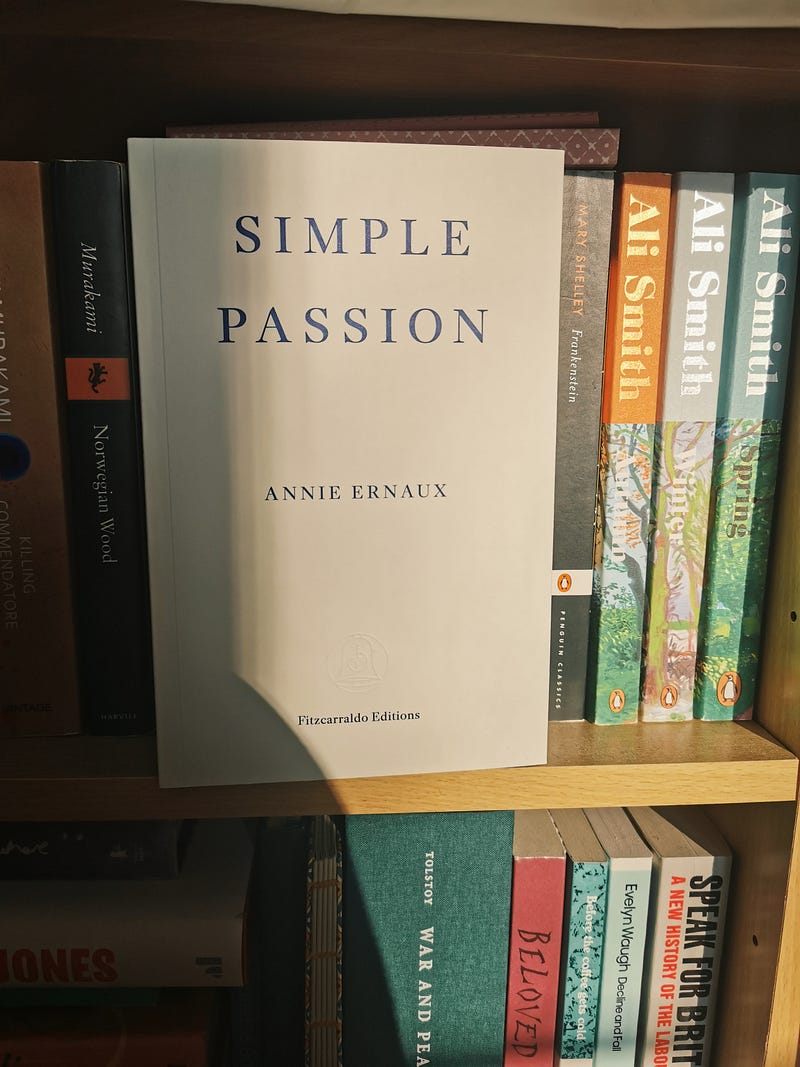
I’m just going to preface this by saying I was (before reading this) a debut Annie Ernaux reader. Simple Passion was my first taste of her work. After reading about her, I’m almost ashamed to admit I have never come across her before, but I will certainly be looking out for her now.
First Impressions
As soon as I started reading this, I had a feeling I would like it. Ernaux writes in such a down to earth but stark way, it’s hard not to feel drawn in by the story of infatuation she reveals. When I had finished reading the final pages and was sitting in that haze of discombobulation that almost always comes with me after finishing a good book, I thought to myself; this was a wonderful, raw and emotional insight into the depths of love and desire.
Ernaux captures the intensity of all these emotions with an unnamed narrator who has an affair with a married man. She reflects on how this can cause a suspension from everyday life due to the constant anticipation of not knowing when her narrator will next see her lover. The narrator's life is up in the air as she lives it in the pure pursuit of this other person. It is a reminder of how love can be a powerful force.
Nothing is ever lost in translation, but alas, I can only say that because I can’t read French. But as an English reader, everything came across to me in such a human and raw way — that I can only assume that is what she intended. The minute details about everyday life are a true insight into one person’s mind and the power that obsession can have.
A few definitive themes stood out to me, so I will structure this review in that way.
On Love
A raw account of a woman having an affair with a married man is often sidestepped in literature. Or, if it is featured, it will be presented with scrutiny. But there’s none of that here. Ernaux’s narrator is completely infatuated with this man and lives every stage of her life, either thinking about him or waiting for him to arrive. She cannot send letters to him or directly contact him herself in fear of his wife finding out.
“I was entirely at the mercy of that crucial moment when I would hear the car brake, the door slam, and his footsteps on the concrete porch — a moment which I always anticipated with unspeakable terror.”
For the narrator, the two-year relationship is lived with constant infatuation, obsession and desire. But they always acknowledge there’s going to come a time when it will end. In that respect, the narrator tries to stretch out every moment with that person.
Because Ernaux’s writing is so raw, it reflects upon the universality of love and desire, and I feel every reader who has ever been in love or had a deep connection with another person will be able to empathise.
On Time
As the entire novel is concerned with documenting the feelings that come with a two-year-long affair, time is inexplicably altered. The narrator spends her days waiting for her lover to come to her; it gives the impression that every hour feels like a day and every minute a week.
“I measured time differently, with all my body.”
But when they are together, time speeds up and runs away with her. Love often alters the course of time and how we perceive it. The narrator notices every tiny thing in her life when her lover is not in her presence, which forces time to slow down. And she often abandons any activity that prevents her from being able to think and daydream about him.
Love and time are often written about alongside in literature, but this stark account written from one narrator’s perspective is truly enlightening.
On Writing
The narrator even reflects on the act of writing her thoughts and anecdotes down on paper and doesn’t shy away from reflecting on what a cathartic experience it can be. Although, as readers, we never know whether this is based on the author’s experience, we certainly get the sense that the narrator relinquishes the value of writing.
Writing can be a form of cathartic release, as they try to cope with the range of emotions that come with having a two-year relationship with a married man.
“Once I start typing out the text, once it appears before me in public characters, I shall be through with innocence.”
Interestingly, the narrator believes by writing about this; it helps break down the taboo that can come with women having affairs. In doing so, they aim to encourage readers to reflect on their own experiences.
“Sometimes I wonder if the purpose of my writing is to find out whether other people have done or felt the same things or not, for them to consider experiencing such things as normal. Maybe I would also like them to live out these very emotions in turn, forgetting that they had once read about them somewhere.”
In many ways, Simple Passion could be compared to Virginia Woolf’s Mrs Dalloway — where the course of a day is narrated in-depth and detail for the entire novel. But there is something far more human and revealing about Ernaux’s writing. It is down to earth, simple, and this allows her to get to the point of exposing the intensity of love and desire for what it really is.
Final Thoughts
I was fully moved by Ernaux long essay on love, desire and human relationships. I read it a couple of sittings, and during the process, I found myself wanting to underline everything. I think there’s a part of this that will speak to everyone.
Simple Passion reminds us that love is a universal emotion but can have many facets. It can bind us, drive us mad, and taint our senses of the world. But when it’s good, nothing can ever feel better.
It is a wonderful, revealing and unique short novel that places the human experience of love and desire and the forefront.


