
Anna Karenina’s Principle And Some Non-Bach’s Fugues.
All happy families are alike; each unhappy family is unhappy in its way.
The current pandemic is interesting in many aspects. For example, let put focus on the close relationship among different biological worlds. In concrete, on three life forms: microbes, animals, and humans.

Coronaviruses stand out as the protagonists of the first biological group. The second one is an assembly of several animals. As bats, palm civets, Arabian dromedaries, pangolins, minks, felines, dogs, and pigs. These animals have flown and grazed by social and by media networks.
And, without leaving the animal world, humans. Remember, we, the humans, are the star genus, the most evolved species of hominids. I suppose.

Although the issue of the microbe-animal-human trio may seem novel, it is not. The relationship between each other is ancient. It dates to the advent of domestication. About 10,000–15,000 years ago. It was the time when the crossing and exchange of microbiomes began.
A microbiome is a set or consortium of microbes (microbiota) plus the sum of each of its members’ genes (genome). In short: microbiota plus genome equals microbiome. However, the correct definition is more complex.
The human being has a very complex microbiome. It is on the surface: skin and mucous membranes. Also, the body interior hides the oropharynx, respiratory tract, intestine, and vagina’s microbiomes. But the human microbiome does not travel alone by the Nature roads. It is one more member of a more complex ecological system.
It interacts with the internal and external microbiomes of animals. That to say: with microbes from their mouth/saliva, intestines/feces, and urine. And with microbes from skin, hairs, feathers, nails, hooves, and claws too. The long process started with domestication. Since then, it has not stopped evolving.
Humans and their predecessors first interacted with the microbiomes of the environment. I mean soil, water, vegetation, food, caves, and dwellings. It happened as soon as the hominids came down from the African trees. It means microbes, animals, and hominids maintain biological relations for millions of years. Or, if you prefer, seen with an evolutionary view, exchanging genes among them.
The exchange of genes can be positive or negative. It is like the exchange of human goods. It is positive (trade, spices, currency) or negative (slaves, weapons, drugs). The little market stall where this happens is the planet Earth.
Genomes and microbiomes.
To some people, this natural fact is surprising, but it is the case. For example, in the human genome, there are many viral fragments. They are into its chemical structure. Its function is unknown.
The colon contains the microbiome of the microbiomes. It harbors so many microbes as cells make up the human body. For some, the ratio is 1/1, while for others, it is 10/1.
In other words, humans are much more microbes than humans. This view is if we look at them from the perspective of gene balance. It happens even if we talk of Madonna, Georges Clooney, you, or me. I am sorry!
The relationship between microbes and animals, although ancient, is very complex. For example, microbes may respect animals and humans because they are friends. They are commensal or saprophytic microbes. Or they may be able to break the equilibrium when conditions are favorable. They are pathobionts. Sometimes they may be professionals pathogenic from the start. They come this way from the factory, with a particular warrior vocation.
In the last case, this happens after colonizing an organ or apparatus and multiplying in the body. In this way, after occupying some anatomical places, microbes can invade the whole organism. Then they can cause damage of varying intensity (mild, moderate, or severe infectious disease).
Sometimes they cause the death of the colonized and invaded subject. Examples of pathogenic microbes are many. For instance, I cite HIV/AIDS, tuberculosis, histoplasmosis, or malaria.
Whether there is harm or not depends on many factors. Some are specific to the microbe (pathogenicity, virulence). Others rely on the host (age, previous diseases, drugs, immune status). And many of those factors have a link with the environment (the ecosystem).
Most of the microbes surrounding us or live inside our bodies have a good relationship with us. It is a non-aggression pact. But they are not mere witnesses to the course of existence. They perform a multitude of functions; in general, they favor us. Think of the invaluable work of fermenting microbes in wine, beer, or cheese. Only a minority of microbes cause harm as soon as they encounter humans.
Many animals and bugs surround us.
The aggressor microbe usually comes from outside (environmental microbiome). Sometimes it comes from an intermediate animal. Or it comes from an animal reservoir. Not from the environment.
Microbes located in the animal will reach the human in various ways. Without losing sight of a fact: the animal is also part of or an actor in the ecosystem.
A typical example of an intermediary animal is the palm civet. SARS CoV-1 before resided in a reservoir animal (several species of bats). Later, the coronavirus infected palm civet. Then, as is well known, the virus arrived in humans, and it produced the SARS epidemic in November 2002.
One can further widen this relationship with the intervention of a fourth actor. I mean a tiny biological entity (millimeter scale). But more significant than microbes (micron or nanometer scale). And much more diminutive than animals and humans (centimeter and meter scales). They are vectors.
I am talking about insects. They belong to the most diverse classes, families, genus, and species. It is an enormous family from a female mosquito Anopheles to an Ixodes tick infected by viruses, rickettsia, or borrelia. Also, the rat’s flea (Xenopsylla cheopis). The flea is the Trojan horse carrying a dreaded bacterium (Yersinia pestis). This bacterium causes the plague related by Giovanni Boccaccio in his Decameron.
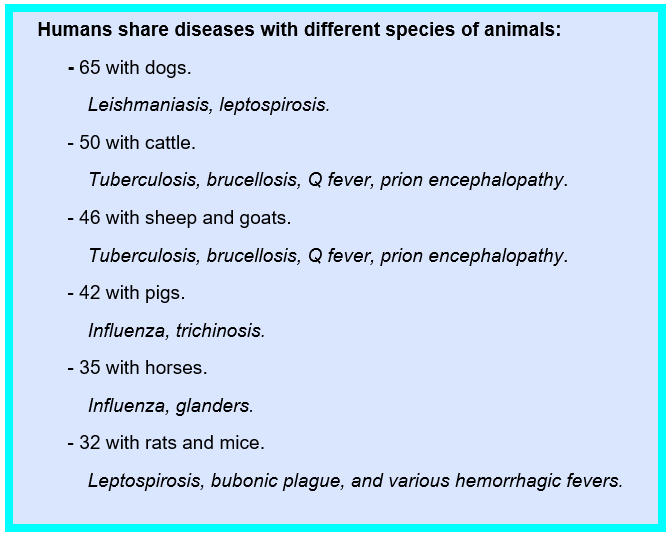
The technical name of an animal origin infection is zoonoses. They account for about 70% of human infectious diseases. Some are viral diseases as avian or swine flu, dengue, Zika, chikungunya, yellow fever, Ebola). Other are bacterial (bubonic plague, leptospirosis, Q fever, brucellosis, bovine tuberculosis). Some more are mycotic (histoplasmosis). Finally, there are protozoans too (malaria, leishmaniasis).
The script of the existential drama of biology can be further complicated. For example, if one adds that the origin of the microbes or the source of contagion comes from humans. This assumption occurs in Nature by a direct community microbe transmission among humans. An example is any seasonal or epidemic influenza.
Second, the contagion can be from a healthy infected person to an uninfected and healthy one. SARS-CoV-2 is a good model. There is a transmission from asymptomatic infected persons in 80% of cases.
Finally, a third assumption is rare but frightening. An example is when human beings manipulate a virus or bacterium in a laboratory.
When the infecting beast proceeds from the brother-in-law.
Manipulation happens while studying or modifying the properties of the microbe. It is usually through intervention in its genes. Other times the intervention is on some of its membrane proteins. In all cases is because of the pathogenic potential.
We enter another dimension of the problem. For example, now there is suspicion about the current pandemic originated in Wuhan (China).
The confirmation of the suspicion may never occur. I am speaking here of a microbe originating from research laboratories. Or in the places where people carry out investigations about infections with epidemic and pandemic potential. And in the centers dedicated to researching vaccines to prevent them. Sometimes, both coincide.
The fact is happening now in many public and private laboratories. All have BSL4 or BSL3 levels (BSL is Biosafety Level). Thus, they dispose of the most significant security for workers and their families. Also, to protect the social environment. But sometimes, safety fails. The BSL is only 2. Then most intensive security becomes insecurity. The system pass from stable to unstable. One cannot work at BSL-2 if the microbe requires a BSL-3/4. Elemental, dear Watson.
Human manipulation of microbes is, in technical terms, a gain-of-function study. It is a very controversial issue. It concerns and occupies decision-makers at the highest level of international politics. And it worries some of us humans in the troop as well.
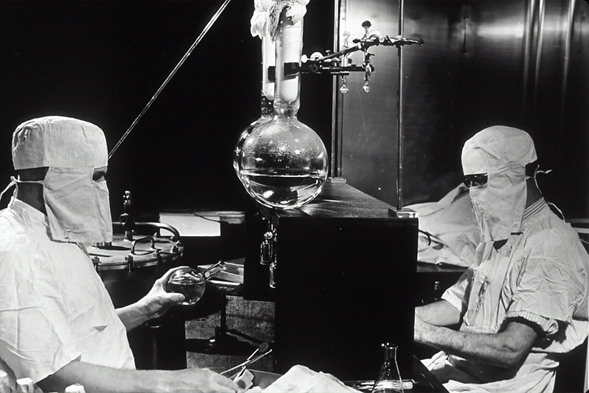
If human manipulates microbes ─in a high-level research laboratory─ the contagion uses to occur by chance. Or be voluntary. The first form is a laboratory accident. One calls a leak or escape (in Spanish, as in Italian, Fuga from Latin fugare, meaning to flight).
The fugue or Fuga is a musical composition characterized by repeating a theme and its counterpoint. Something similar occurs in some laboratory leaks with proven capacity for repetition.
Zeynep Tufecki’s excellent article in The New York Times documents this matter. Here is an example of what he says about SARS:
“Nearly all SARS cases since the original epidemic have been due to laboratory leaks: six incidents in three countries, including two in a single month at a laboratory in Beijing. In one case, the mother of a lab worker died.”
(If you want to enjoy another good article published in MIT Technology Review, please, click here).
The sample handler suffers contagion by an unintentional prick. Or by a splash of blood, saliva, urine, or feces from the experimental animal. Also, from cell cultures.
The casualty can then export the microbe analyzed out of the laboratory. If the bug has a pathogenic capacity, the worker can infect third parties in his environment.
In this scenario, one can expect several sporadic cases or an outbreak of greater or lesser size. Rarer is the generation of a significant epidemic or be the origin of a pandemic. It is what some appeal to on the current covid-19 pandemic. Not only conspiracy hooligans.
A second possibility is to change a microbe for perverse purposes. I mean making an engineered microbe an intimidating weapon against enemies or adversaries. Or, in the worst case, a lethal biological missile to act to wipe out the beloved enemies.
This case drives to the fictional bioterrorism. Think about Netflix/HBO series and Hollywood movies. But it is also a real threat.
Some influential countries promote this situation to the chagrin and uncertainty of humanity. The heterogeneous and massive human group where you and I are. We, the simple mortals.
The greatness of the small.
A complex phenomenon has been going on in Nature ever. Since the beginning of time is a conflict between genomes. Most of the time, it is a cold, latent war. But, sometimes, it is a partial war or, the least and worst, total conflict.
Oscar Wilde (1854–1900) says in The Decline of Lies life imitates art much more than art imitates life. Likewise, we can assume that Nature also can copy humans. The relationships between genomes are like relationships between humans throughout history.
Nothing should be underestimated, no matter how insignificant it may seem. One link is not the whole chain, but the most potent chains do not exist without the presence of humble links.
In Nature, everything matters. In life and in society, too. A non-transcendent event can be the herald of a catastrophe. As the butterfly effect and Edward Norton Lorenz’s chaos theory teach.
I appeal to Ramón y Cajal (1852–1934) authority. Cajal is author of Reglas y consejos sobre investigación científica. In chapter II he said the following (in Spanish, my free translation to English):
“In Nature, there is no superior and inferior, no accessory and principal things. These hierarchies that our spirit is pleased to assign to natural phenomena come from the fact. We look at them only for the utility or pleasure they can give us instead of considering things in themselves and their internal chaining. In the chain of life, all the links are valuable because they are all necessary. We judge small what we see from afar or do not know how to see.”
We give little importance to what we refuse to see, acting as blind people. As a result, we did not see the epidemic that originated in China when the year 2019 was ending.
A year and a half later, there are hundreds of millions infected and almost four million dead. But some people still do not get to see the disaster size. They do not feel the tragedy caused by a tiny microbe. Instead, I mean to a virus hidden in bats that can jump into human noses. As a rule, humans’ activities encourage the viral jump.
Once again, Cajal enlightens us:
“In short, there are no small matters; those that seem so are large matters not understood. Instead of trifles unworthy of the thinker’s consideration, we have men whose intellectual smallness cannot penetrate the transcendence of the minuscule. Nature makes up a harmonious mechanism. Where the parts, even those that seem to play an accessory role, conspire in the functional whole. In contemplating this mechanism, the light man distinguishes its principal organs into essential and secondary. The discreet thinker is content to classify them. Disregarding size, and their immediate useful effects, into known and little known. On their future transcendence, no one can be a prophet.”
Without prophetic eagerness, let us at least be discreet in our thinking. Because if anything is missing in this mess, it is a lack of reasoning.
The Anna Karenina’s Principle.
There are times of peace and conflict times. In the old biological relationship between microbes, animals, and humans too. Times of tolerance and other of aggression. Nature never ceases to send us warnings in the second case. It uses the trumpets that announce calamities.
It is worth quoting Leo Tolstoy (1828–1910), author of the excellent novel Anna Karenina. The so-called Ana Karenina’s Principle tries to explain the relationship between microbiomes.
The principle’s text is the novel’s opening sentence. There are several translations. One is: “All happy families are alike; each unhappy family is unhappy in its way.”
The remote antecedent of this idea comes back to Aristotle’s Nicomachean Ethics. Jared Mason Diamond publicized the famous principle. He did it in his 1997 book Guns, Germs, and Steel: The Fate of Human Societies. In chapter 9, he explains the complex phenomenon of domestication. Remember that the epidemics’ history began with the encounter between animals and humans.
The metaphor applies to many scenarios and disciplines. Many things must go right to achieve success in most events. It is Tolstoy’s happy family. The failure of a single element leads to the loss of the event. It is Tolstoy’s unhappy family.
One can extrapolate the “Anakarenian” principle to several disciplines. Suppose applied to the genomes of each living being and the microbiomes. In a broad sense, external natural disturbances of very diverse origin and causes. We can think of the current heatwave melting people and goods in California and Canada. The insult to Nature alters the stability of the ecosystem and each living being. Without any doubt.
The aggression, whatever it may be, makes stable systems unstable. Disruption leads from health to disease, from good to evil. An example is corals dying due to climate change. Or the proliferation of ugly bats’ gangs pregnant with coronaviruses. Those nasty viruses are eager to enter the caves of nostril-nosed of young boozers.
And in the exasperated jaws of the less young soccer fans. People without masks bellowing the anthem “Lo-lo-lo” in the European stadiums. A kind of toccata and fugue (escape) from the most basic sanity.

One question final to end this homily.
What good is to society all the initiatives, money, pain, anxiety, sickness, and death? Why make such a considerable effort if a group of villains does not respect the convivence rules?
I am afraid it will be challenging to put an end to covid-19, the paradigm of anthropozoonosis. Or, in other words, a pure zoonosis spurred by the freak behavior of many animal-human. The cleverest among hominids.
I suppose.