
Civility?
Animosity in Hate-Filled Comments and Responses
The study is based on 1,051 comments from four conflicting, controversial articles. Only 50% were logical responses to something!

Example
Recently, my letter-to-the-editor was published in the Villages-News, an online local newspaper. Readers are encouraged to make comments. Some were the most hate-filled, ignorant posts I have ever seen, even worse than Twitter. Here are a few examples. I discovered I was a:
Radical Democrat, RINO, communist, Nazi, demoRat, Trumpublican, Brain addled leftist, uneducated cultist, QAnon, Democult, racist fool, homophobe, white supremacist, MAGA, tRumptard, and Republican criminal. Then, I should go back to middle school, visit the priest or Rabbi, lay off the drugs, or drink some Kool-Aid (kill myself). Finally someone said, “His mother should have aborted him, preferable during the third term of the trimester.”
Are hate-filled comments normal?
I wondered if such remarks were typical, or if they were attacking me personally. So, I decided to find out by reviewing 1,051 comments.
Analysis
I chose four articles — my letter, another letter taking an opposite position, an article by a Villages-News reporter, and an article from Medium.com as a control. All were about Trump. Their links are at the end.
After copying comments from each one into spreadsheets, I categorized them with the following criteria. The terms “letter” and “article” are used interchangeably here.
- Personal attack (A)- everything from simple name-calling to suggestions to commit suicide.
- Soapbox/Sermon (S)- a long diatribe not related to the original article. Some would be 2 or 3 printed pages.
- Nonsense (N)- no way to relate the comment to anything. Either unusual slang or a meaning known only to the writer.
- Direct response- discussed something in the article. It could support the premise, refute it, or add more information. It could be something simple, like “Good point.”
- Reply — A (R-A)- attacks the prior comment’s author, may have nothing to do with the original article.
- Reply –S (R-S)- soapbox speech not related to the comment it is attached to or the original article.
- Reply — D (R-D)- direct response to another comment, not the original article.
Each comment was assigned one of these codes. I later discovered that a reply or attack could contain parts that replied to the original article, so I added a second count for those.
- On-Point for Article (P)- could be a direct comment or a reply, even if the reply was not to the prior comment.
Writing style differed greatly between the comments in Medium and the Villages-News.
Medium articles are by professional or semi-professional writers, not the general public. They mostly use their real names and even use comments to demonstrate their writing proficiency. The downside was that some comments were long, sometimes longer than this article for some soapbox speeches.
The Villages-News is more open to everyone. Some write well, but others are more casual. Many write just like they talk and use terms that would not appear in more professional writing.
Some of the statistics are surprising.
Villages-News rules about comments
The Villages-News does have rules about personal attacks and the AI prevents comments containing specific words, like “kill,” but writers get around the AI by changing the spelling or adding fillers, like “k-ill and M-0-r-o-n.” Then, if a comment makes it past the AI, editors review the comments and remove some of them.
Here is an excerpt from the Villages-News terms and conditions webpage:
3. Use of our products to submit content that is threatening, defaming, abusive, harassing, degrading, intimidating, hate speech, suggestive, inappropriate, or explicit is strictly prohibited.
I guess none of the names in my highlighted paragraph at the top fits this section.
I have had comments rejected that in no way violated these rules and have yet to be told why. There is no way to ask on their website.
The computer reject-messages should at least contain or show the part that was offensive to the AI — it’s poor programming not to do so.
Displayed with each letter before the comment section:
“COMMENTS DISCLAIMER: We encourage civil discourse and comments that are well-informed and relevant to the article in question. To be approved for publication, comments should not include name-calling, personal attacks, obscenity, vulgarity, profanity, commercial promotion, CAPS LOCK, or misleading statements about one’s identity, to name a few. Any comments that fail to meet our criteria may be removed.”
I was going to quote the worst 4-line comment I ever read, but when I went back two days later to copy it, the comment had been removed by the editors. Nearly every word was hateful. However, the joke is on him. He was probably looking at a mirror while saying them and just wrote them down.
Results
Since there are two distinct writing styles, I’ve summarized the results for the Villages-News and used Medium as a control.
Hate-Filled attacks:
About 29% of the Villages-News comments were personal attacks, whereas only 8% on Medium were attacks and they were usually more subtle.
The tone was much more malicious in the News. One reason may be anonymity. People on Medium generally use their real name. Most people in the News hide behind pseudonyms, such as doctorcrime, bikingwarrior, and OliveTooth. My name is on all of my comments on both sites.
Direct responses
There wasn’t much difference between Medium and the News, 49% vs 53%. Around half posted comments related to the article or a previous comment. However, very few actually discussed points in the article or letter, less than 6% with Medium percentage being four times higher.
Based on several of the comments my letter received, I wonder if many just read the title and commented. Also, I have been told by my boss and my writers club that what is obvious to me may not be obvious to anybody else. That may be why so few mentioned the main point, but they didn’t on the other three either.
Soapbox/Sermon
A surprising number of people posted comments that had nothing to do with the original letter or comment the post was attached to. Only 19% of the News responders did this, while 38% of the Medium responders made long-winded speeches, some longer than this article.
The most ridiculous personal attack
One person attributed my Medium article to someone else. I had posted the link to the original Medium article that the Villages-News letter was derived from.
Who he attributed my Medium article to:
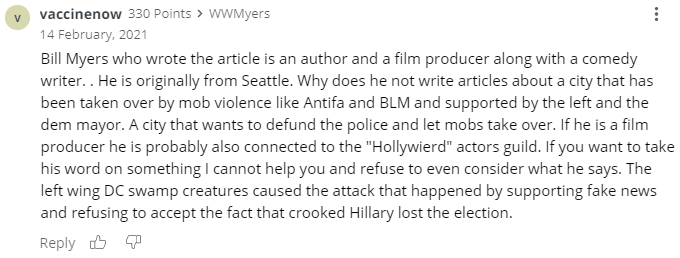
My profile on that article says: William “Bill” Myers, Analyzes all, Programmer, retired.
Here is the rest of the thread:
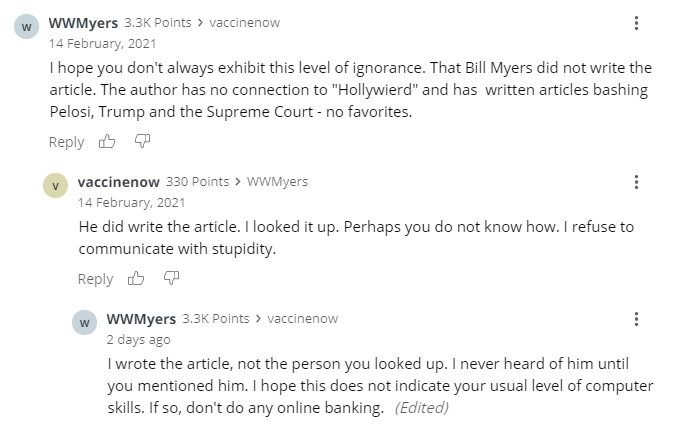
He wrote back saying I shouldn’t tell him what to do, so I apologized for suggesting he be careful with online banking.
One fairly unusual thing about the thread was that all four posts were related to each other.
This demonstrates just how much ignorance some of the attackers show, and it is not unusual. Some people write without knowing anything, probably out of habit.
The level of ignorance is incredible!
Look at the number of contradictory names I was called in the list. People assign these names and actions without even knowing the commenter, and frequently not even associating with what the person wrote.
I wonder if they talk to strangers that way in person.
Conclusion
I suspect that most people can’t apply cold, unemotional logic to anything, so almost half revert to long unrelated comments or personal attacks that don’t make any sense. Surprisingly few stick to the subject of the letter or article.
So, after analyzing these comments and scanning comments from the same people on other articles, I saw similar patterns.
Some people can’t comment without including an attack Nothing personal, so I ignore them