Animal Farm: Impermanent Loss. What you NEED to know before you Yield Farm!
Impermanent Loss (IL) is a yield farming issue that every yield farming investor needs to know about and consider. What is it, and how concerned should you be about it? We will explore in this article.
First, the most important question:
DO I NEED TO EVEN CARE/WORRY ABOUT IMPERMANENT LOSS? I MEAN, HOW DOES IT AFFECT ME?
Answer: Yes, you need to care about it. However, you MAY not need to worry about it. It will affect you by incurring an overall loss on your position, even with yield farming.
To understand Impermanent Loss, we need to discuss the difference between price actions of common coins.
Stablecoins, like BUSD, USDC, and USDT (generally) don’t fluctuate in price. Or, if they do, it’s only a tiny bit, and most generally completely recover. They are usually designed to be pegged (or matched) to a fiat currency. In this case, the US dollar. There are other stablecoins, but all stablecoins in the Animal Farm are pegged to the US dollar.
Blue chip cryptos, like Bitcoin, Ethereum, and BNB usually follow market swings together. In general, although not precisely, Bitcoin, Ethereum, and BNB are likely to move greatly in relation to BUSD, but NOT greatly relative to each other. Mostly, they move proportionally to each other. Compare these three charts.
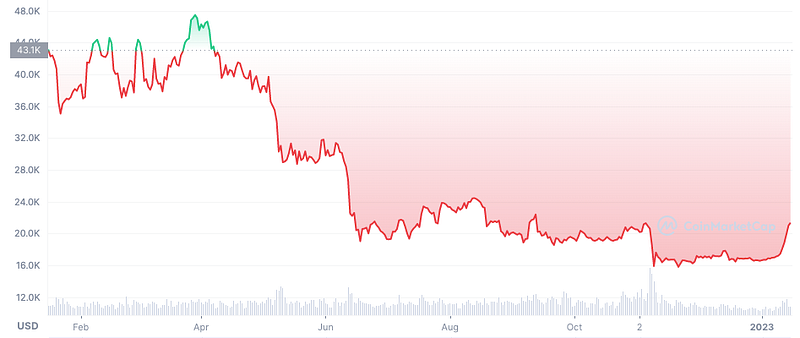
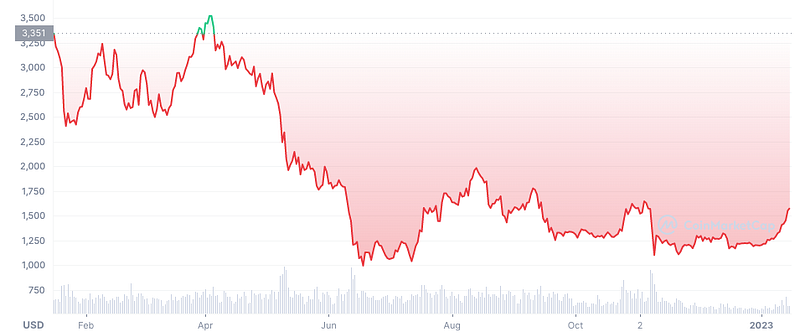
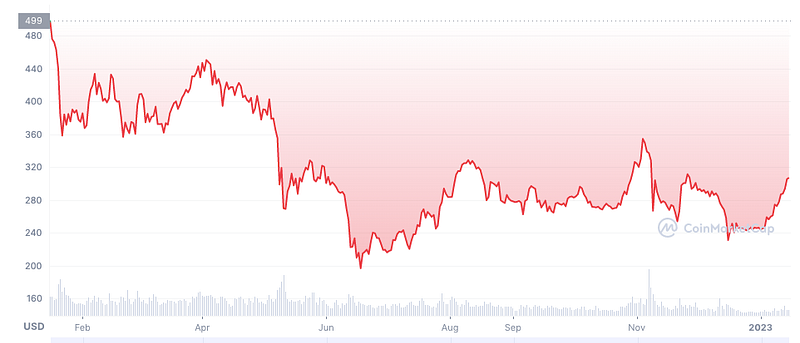
The three coins don’t have major price movement relative to each other. Now, compare these charts to some other cryptocurrencies with related farms on the Animal Farm:
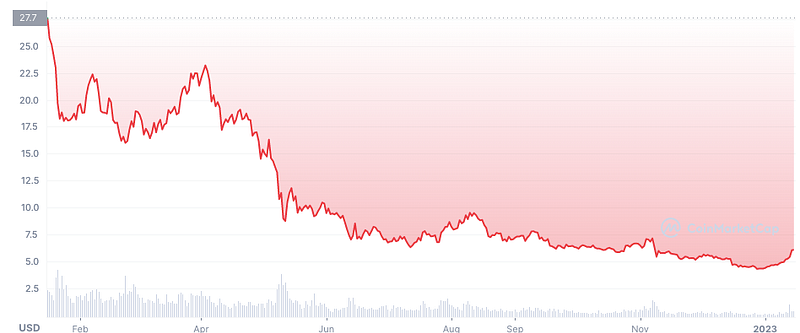
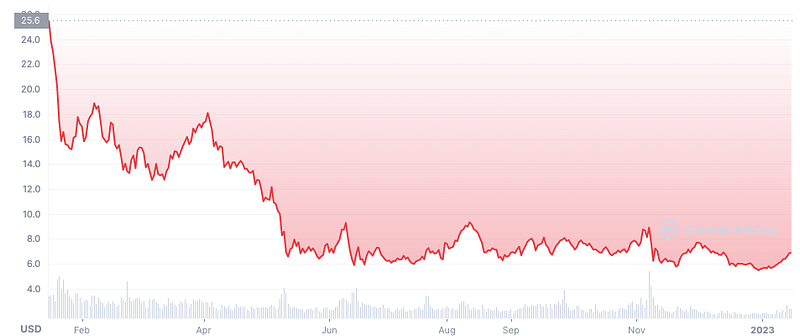
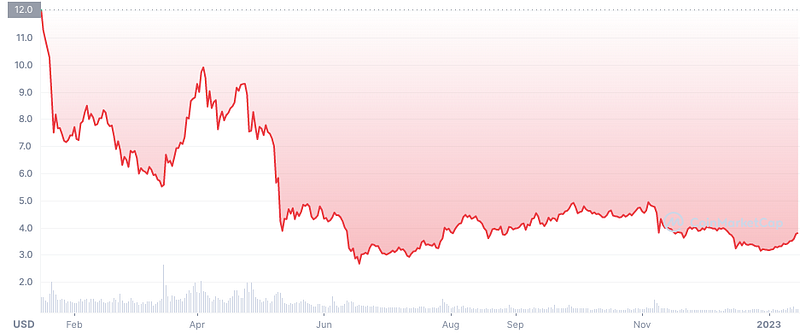
This next category of coins are not blue-chip cryptos, but small market-cap cryptos, and ones that don’t always move the same relative the Bitcoin, etc. The do have basic movement up until the market downturn in May-June, but have some unique shapes after that.
It is important to know the basic coin patterns. You won’t be able to predict the day-to-day markets, but you can predict if the coins will have movement relative to each-other.
So, what is impermanent loss?
Impermanent is the loss of value over time due to the value of two coins in an LP token separating in relative value. I’ll illustrate the implications by showing some examples:
Ex. 1. Simpling holding two crypto coins, individually. 250 BUSD coins and 1 BNB coin. Let’s assume that today, they are both worth the same. In other words, 250 BUSD = 1 BNB. You start with $500 in value (250 BUSD + 1 BNB worth $250). Now, let’s say BNB doubles in value to $500 per 1 BNB. You now have $750 in value (250 BUSD + 1 BNB worth $500). Because you kept these coins separate, and DIDN’T make an LP token, you have no impermanent loss, and no loss of value.
Ex. 2. You pair 250 BUSD with 1 BNB. At the point of pairing they are worth the same amount. So, you now create some LP token of BUSD/BNB LPs worth a total of $500. Now, when BNB increases in value to $500, the LP becomes IMBALANCED. And, LPs NEED to be balanced. So, in order to maintain balance, some BNB must be removed as its value increases, and BUSD must be added. And, in doing so, some value is lost. When BNB is worth $500, there is now 353.55 BUSD and .705 BNB in your LP token. So, because of the balance necessary, you now have a value of $707.1 ($353.55 of BUSD and $353.55 of BNB). Your “hold” value of the two coins would have been $750, and your LP value is worth $707.1, so you have a loss of $42.9 compared to if you would have just held. That is your impermanent loss.
Ex. 3 You pair $250 worth of ETH with $250 worth of BTC, and create some LP token of ETH/BTC LPs worth a total of $500. After a time, they both double in price. Now, you have $500 worth of ETH in your LP and $500 worth of BTC in your LP, with a value of $1000. Since they didn’t have to re-balance, since they both increased at the same ratio, there is no loss. There is no impermanent loss.
Comparing Examples 1 and 2 reveal the perils of creating LP tokens, especially when using a stablecoin as ONE of the input coins, but a non-stablecoin as the OTHER of the input coins. The LP pair must remain balanced, and that causes loss in value relative to just holding.
However, pairing two blue-chip cryptos that often move in the same ratios can usually produce little to no impermanent loss.
When you participate in yield farming, you’ll be taking two coins and pairing them together, creating LP tokens. Then, your LP tokens are deposited into a staking contract, where they earn rewards tokens. In the case of the Animal Farm, you’ll be earning DOGS.
Before I get into the specifics of impermanent loss and yield farming, I’m going to lay out the conclusions. Then, I’ll provide more details. But, once you know where I’m heading, the details will make more sense.
- If you’re a long term investor in the Animal Farm, and you plan to earn LOTS of DOGS and PIGS over a long time (as in more than 1 year), you probably don’t need to worry too much about impermanent loss.
- If your LP tokens are blue chip cryptos paired with each other, like ETH and BTCB, or BNB and BTCB, you probably don’t need to worry too much about impermanent loss.
- If your LP tokens are a blue chip crypto (ETH, BTCB, BNB) or a small-cap crypto, paired with a stablecoin (BUSD, USDC, etc), and you don’t plan to leave your crypto in for at least a year, you may need to worry about impermanent loss.
- If your LP tokens include one stablecoin and one non-stablecoin, AND the market moves a lot during your time yield farming, you might need to worry about impermanent loss.
Let’s look at all of these scenarios in more detail. Remember that impermanent loss is the loss in value due to rebalancing equal sides of an LP token.
- The longer you stay in the farm, the more rewards you are going to earn. If you experience $300 in impermanent loss, but your rewards total $500 for the same time interval, you have $200 profit. Generally, the longer you stay in a yield farm, the more the rewards outweigh the impermanent loss.
- If two blue-chip cryptos are paired with each other, then the impermanent loss is going to be greatly reduced, to the point of not even worrying about it.
- If you are pairing a non-stablecoin with a stablecoin, and you don’t plan to leave the LP in the farm long enough to make the rewards outpace the impermanent loss, you may want to seek a different LP token with minimal impermanent loss.
- If you are pairing a non-stablecoin with a stablecoin and the market moves a lot, there will be a lot of impermanent loss and you may wish to avoid this yield farm. Let me give an example here. Let’s say you paired when ETH is $1500, and ETH rises to $8000 in a bull market. And, you originally put $500 BUSD and $500 ETH, so it was valued at $1000. After the price rise of ETH from $1500 to $8000, your LP tokens are now worth $2,309.40 (you can find the impermanent loss calculator at DailyDefi.org). If you would have simply held the ETH and BUSD separetely, you would have $3166.67 ($500 worth of BUSD and $2666.67 worth of ETH). During that time, you would have needed to make $857.27 worth of rewards tokens for that yield farm to be worth your while.
Let’s make this easy. Here’s what I would do.
Of course, I’m about to say what I would do, and it is not to be taken as financial advice. That being said, here are some rules I follow:
Rules to Avoid Negative Effects of Impermanent Loss
- If approaching a bull market, don’t use half-stablecoin pairs. Instead use blue-chip cryptos for both side. In other words, favor ETH/BTC instead of ETH/BUSD. This lets you take advantage of the price rises in ETH and BTC in the bull market, while avoiding impermanent loss.
- If approaching a bear market, don’t use half-stablecoin pairs. Instead, use stablecoins for both sides. Favor BUSD/USDC instead of ETH/BUSD. This lets you completely avoid the negative effects of the bear market price decline with also completely avoiding impermanent loss.
Wait, so when can I use ETH/BUSD LP tokens (or others that have one-side only of stablecoin)?
Answer: Only in a sideways market! If the coins are not fluctuating, you don’t have to worry about impermanent loss!
Make it EVEN SIMPLER!
Here’s a chart:

Did you enjoy this article? Please CLAP! And please follow me on Medium.
Also, you may enjoy these other recent articles on DRIP and the Animal Farm: