
Animal Agriculture Is a Mirror Image of Trump’s America
Animal agriculture has built a world of misery for the many and impunity for the few; where is the leftist coalition that should oppose it?

Covid-19 has upended everything that we’ve been told is inevitable about life in the United States. The horror of living in a plutocracy that is incapable of providing for the health of its citizens has been shocking even to those of us who have always known that Donald Trump’s goal is to destroy government. In response, Americans have called for the radical reforms this country has always needed, from universal healthcare to paid sick leave to emptying prisons and immigration detention camps. All of these ideas are urgent, yet each one on its own does not seem to match the state-inflicted calamity we’re facing.
Even amid all this, I managed to be stunned when Trump used his authority under the Defense Production Act in April to order slaughterhouses to remain open after they had become among the nation’s biggest Coronavirus hot spots. Maybe all the discourse in my Twitter feed, about how the pandemic was finally exposing the death cult of animal agriculture, had fooled me into thinking it was becoming a mainstream issue. I quickly caught on: Oh, of course Trump was not about to preside over a meat shortage. Mass death among the poor and people of color is not only banal, but practically welcomed by Trump and his apologists, but a shock to the meat supply? No, that could never happen.
It should be obvious to everyone by now that animal agriculture is a monstrous, irredeemable industry built on crushing not only animal life, but human life too.
Few moments could have better captured who matters in this country, and who is condemned to annihilation, than Donald Trump’s demand that meat packers go back to work. Perhaps one salve of Trump’s presidency, if it can be called one, is that it has discredited specious nonsense about the unstoppable march of liberal progress. Trump’s groveling personality cult amid his blustering failures and unconcealed violence has shown that the fascist impulse is never far beneath the surface — and as those of us in animal liberation know, it has been there all along.
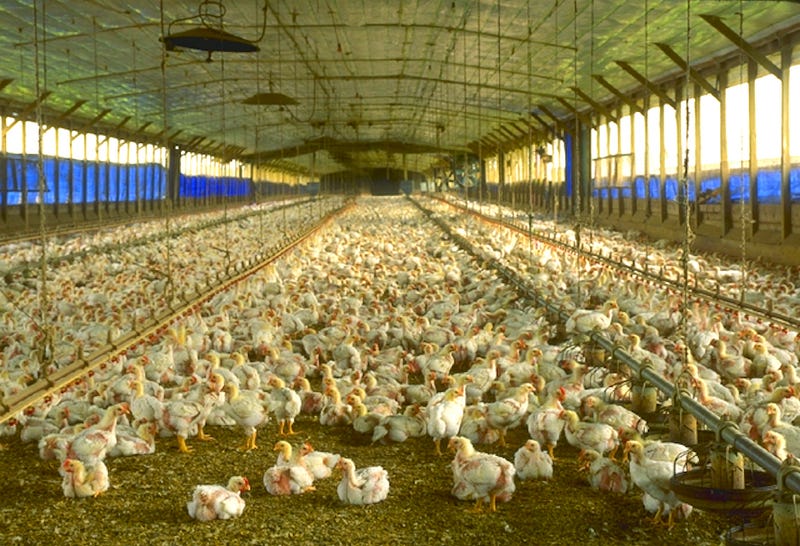
It should be obvious to everyone by now that animal agriculture is a monstrous, irredeemable industry built on crushing not only animal life, but human life too. Stories of millions of farm animals shot dead, gassed, roasted alive, and buried alive in mass graves as meat production halts due to the pandemic, under the diabolical industry euphemism “depopulation,” defy comprehension. Virtually all news accounts of the killings center not the animals, but farm owners and the concern-trolling PR copy of Smithfield and Tyson Foods, casting themselves as the victims. Like Donald Trump, animal agriculture still manages to shock me with its brazen and unfathomable evil, even when I think I can never be shocked again. Fascism depends on such acts of shock and total domination. The point of these atrocities is “to demonstrate absolute superiority of one group over another,” as John Sanbonmatsu puts it in Critical Theory and Animal Liberation: “to see those wielding total power annihilate those who have no power at all.”
It would be literally impossible to sustain the level of cheap meat consumption we have in the United States without an abused underclass, kept in constant fear of deportation, working at dangerous speed for sub-poverty wages.
Is it any surprise that the same industry that grinds up chicks alive to save a dollar will also force its workers to risk death (and blame them for getting sick) to keep the meat production line running? Capital will do absolutely anything that it is socially licensed to do. A lot has already been written about the deplorable working conditions at U.S. slaughterhouses, but it’s worth fully threading the needle from the exploitation of workers to the American meat economy. It would be literally impossible to sustain the level of cheap meat consumption we have in the United States without an abused underclass, kept in constant fear of deportation, working at dangerous, traumatizing speed for sub-poverty wages. No free person would choose to work these jobs, as Trump and his friends in the meat industry know, and maintaining the meat supply depends on keeping it that way.
Even though they are at the center of our civilization’s moral, ecological, and public health crises, farm animals are always the last that we think about. Confronted with the billions on billions of innocent animals bred for lives of confinement, torture, and painful death, it is easier for most people to just look away. I’ve spent most of my life wondering how this can be. How is our unmitigated violence against non-human animals allowed to persist, while those who try to sound the alarm, even on the left, are ignored or laughed at?
I don’t think animal advocates will ever find a satisfying answer. Domination needs no justification; it justifies itself. Fascist atrocities, Sanbonmatsu writes, make real “the idea of the worthlessness of the other, the other’s lack of a right to exist.” Or, as Adam Serwer once explained: “The cruelty is the point.” The dominant animal rights narrative tends to tell us that the reason we have factory farming is merely taste, or the difficulty of asking people to abandon their appetite for cheap meat. That is one part of the story, but it ignores what’s probably even more important: that animal agriculture is about enacting our supremacy over animals, much as Trump and his base thrill at crushing the weak, the immigrant, and the poor on whose unfree labor we depend.
To the extent that environmentalism cares about animals, it cares about them as ambassadors for nature: members of charismatic wild species. But the animals that we breed to suffer and die have no voice at all.
Animal liberation has never been embraced by the left coalition, though animals are, by all accounts, the missing link between the profit-driven destruction of our biosphere and the violent subjugation of powerless social groups. The environmental movement should be a natural home for animal rights, yet American environmentalism and conservationism have a deep history of indifference or outright contempt for animals raised for food.
Environmental philosopher J. Baird Callicott wrote in a much-quoted 1980 paper that farm animals “have been bred to docility, tractability, stupidity, and dependency. It is literally meaningless to suggest that they be liberated.” Everyone, it seems, left or right, wants to see farm animals suffer, to see our superiority to them confirmed in their abject torment and weakness. Farm animals are erased even from mainstream environmentalist discourse about factory farming. Groups like the Sierra Club talk about the ecological and human health impacts of industrial animal agriculture, but the welfare of the animals themselves is never discussed; they’re treated as pollutants, not as lives. To the extent that environmentalism cares about animals, it cares about them as ambassadors for nature: members of charismatic wild species and ecosystems. But the animals that we breed to suffer and die have no voice at all.
Covid-19 has revealed the limits of our anthropocentric environmentalism. The environmental movement’s uneasy relationship with farm animals has prevented it from treating animal agriculture as a first-order crisis, responsible for the attendant climate disaster and world-altering pandemics. It’s been reluctant to say loud and clear that factory farming is the cause of mass extinction, replacing wildlife with farm animals consigned to agony in infernal warehouses.
But if animal agriculture is the ultimate fascist industry, then maybe animal liberation and the anti-Trump left share a common fate. In the last decade or so, the U.S. environmental movement has undergone a welcome revolution, from old-school conservationism to a focus on climate justice and restitution to those most harmed by the extraction economy. Farm animals must be part of that new alignment. And there are already good models for how to do it: UK-based Animal Rebellion and Canadian-founded Climate Save have built influential movements that center animal and human liberation in climate discourse.
Animal agriculture has built a world of misery for the many and impunity for the few; it has plundered our planet’s abundance while pretending to secure and feed humanity.
A true alliance between the animal rights movement and climate justice activists could be one of the most welcome breakthroughs on the American left. That would mean groups like Sunrise and Extinction Rebellion calling for a just, plant-based food system, and an immediate stop to expansion of meat production — because anything less is ruinous to our climate, to workers, and to animals most of all. For animal liberation, it should also mean less of an overriding focus on persuading individual consumers to go vegan, and more emphasis on the production side of the animal economy. Climate activists have rightly moved away from a solely consumer choice-driven theory of change, and we should, too.
Every animal advocate knows the frustration of being asked by our progressive fellow travelers: How can we care about animals when life for most people is so violently unjust? One of the most important things the rising climate movement can do now is to reveal this as a false choice. Animal agriculture has built a world of misery for the many and impunity for the few; it has plundered our planet’s abundance while pretending to secure and feed humanity. Climate emergency gives us a chance to envision a world worth having, where no one is slaughtered, confined, or subject to the will of another.