avatarJonathan Poletti

Free AI web copilot to create summaries, insights and extended knowledge, download it at here

3821

Abstract

twined with one another, and they would be thus addressed: Look! You are beloved before God as the love between man and woman.” (<i>b. Yoma </i>54a)</p></blockquote><p id="d802">Rabbi Louis Jacobs <a href="https://www.myjewishlearning.com/article/cherubim/">unpacks</a> the scene:</p><blockquote id="a2ff"><p>“A curious Talmudic legend has it that the cherubim in Solomon’s Temple were in the form of male and female. When the Israelites came to the Temple on pilgrimage, the curtain in front of the Ark was drawn aside and the cherubim were seen interlocked as if in sexual congress. This was said to be a miraculous indication that God’s love for Israel resembles the love of man and woman.”</p></blockquote><p id="2a5d">Scholars puzzled over the scene. Raphael Patai, in <i>The Hebrew Goddess,</i> <a href="https://www.google.com/books/edition/The_Hebrew_Goddess/Z0iRAwAAQBAJ?hl=en&amp;gbpv=1&amp;dq=%22an+orgiastic+outburst+of+sexual+license.%22&amp;pg=PA85&amp;printsec=frontcover">understood</a> that both men and women had been able to view the cherubim, and afterward “used to mingle and commit what is euphemistically referred to as ‘lightheadedness’,” which he thinks was really “an orgiastic outburst of sexual license.”</p><p id="42fb">A study of the sexual cherubim was done by Eugene Seaich, titled <i>A Great Mystery: The Secret of the Jerusalem Temple,</i> published in 2008.</p><p id="19ec">He discusses a range of hints, as when Philo, the Jewish sage, believed the two figures of cherubim to represent the male and female principles, and offered that what was seen in the Holy of Holies was “the beginning and end of happiness.”</p><p id="0af3">A later scene in the Talmud, Seaich notes, seems to reflect the sexual idea. This would be dated later — when the First Temple was ransacked by Babylonians.</p><blockquote id="002b"><p>“When the heathens entered the Temple and saw the Cherubim whose bodies were intertwisted with one another, they carried them out and said: These Israelites, whose blessing is a blessing, and whose curse is a curse, occupy themselves with such things!” (<i>b. Yoma </i>54b)</p></blockquote><p id="8224">Then a midrash had preserved a <a href="https://www.jstor.org/stable/10.1086/674426">story</a> in which the invaders gloat over the statues they have found.</p><blockquote id="0564"><p>“and they took them and put them in a cage and went around with them in all the streets of Jerusalem and said, ‘You used to say that this nation was not serving idols. Now you see what we have found and what they were worshipping’” <i>(Lamentations rabbah, proem 9)</i></p></blockquote><p id="d67b">A similar scene might even happen when the Second Temple is sacked by Roman troops, as narrated with curious vagueness by Josephus, the Jewish historian:</p><blockquote id="a52d"><p>“And last of all Titus Caesar, have conquered us in war, and gotten possession of our temple, yet have they none of them found any such thing there, nor indeed anything but what was agreeable to the strictest piety; although what they found we are not at liberty to reveal to other nations.” <i>(Contra Apion</i> 2:7).</p></blockquote><h1 id="666f">Was there support in rabbinic thought?</h1><p id="606d">Rashi, writing in the eleventh century, had believed the cherubim were “joined together and were clinging to, and embracing each other like a male who embraces a female.”</p><p id="19c0">The “spreading” of their wings had reminded some of the language of marital intimacy in passages like Ezekiel 16:8 and Ruth 3:9, where the husband “spreads” his cloak over the wife.</p><p id="d155">The Zohar, the mystical text of Jewish interpretations, seems to <a href="https://doi.org/10.1086/674426">affirm</a> the idea: <i>“The Cherubs, when Israel was with merit, were face to face, entwined with each othe

Options

r…” </i>(2:278a).</p><p id="754a">Isaac Luria added: “From this we learn that where there is no union of male and female men are not worthy to behold the divine presence.”</p><p id="5117">It recalled, for some, a possible conceptual backdrop around biblical narratives: God and Israel are <i>married</i>. The Song of Songs, an erotic narrative, has often been seen as speaking of their bond.</p><p id="1a40">There were, however, problems with the Talmud’s scene. Weren’t the cherubim hidden away in the Holy of Holies, accessible only by the High Priest? From descriptions, one wouldn’t seem to have been able to lift a curtain to see them.</p><h1 id="b159">Scholars, on occasion, discuss the Talmud’s story</h1><p id="878a">André Villeneuve, in <i>Nuptial Symbolism in Second Temple Writings, the New Testament and Rabbinic Literature </i>(2016), <a href="https://www.google.com/books/edition/Nuptial_Symbolism_in_Second_Temple_Writi/1SgiDAAAQBAJ?hl=en&amp;gbpv=1&amp;dq=%22impossible+that+the+Talmud+may+have+preserved+elements+of+an+authentic%22&amp;pg=PA99&amp;printsec=frontcover">thinks</a>:</p><blockquote id="5cf4"><p>“it is not impossible that the Talmud may have preserved elements of an authentic historical tradition in its account of the embracing cherubim in the Second Temple.”</p></blockquote><p id="8b83">He traces how the Bible describes Israel as a ‘woman’, as in Ezekiel 16:8, who ‘marries’ God. The wedding would be the scene on top of Mount Sinai.</p><p id="371e">Villeneuve writes:</p><blockquote id="b277"><p>“The implication is that while the children of Israel were in the desert during the Exodus, they were bashful and could not yet directly look at the Shekhinah, the awesome visible presence (<i>panim</i>) of God. Once settled in their land, however, Israel reached sufficient maturity and familiarity with her divine Husband so that she could feast her eyes upon Him.”</p></blockquote><p id="7c23">Rachel Elior had some <a href="https://www.scribd.com/document/442335431/Elior-The-Three-Temples-pdf">analysis</a> of the Israelites going to see the sexual cherubim. She writes:</p><blockquote id="7f76"><p>“The description in the Talmud, therefore, suggests a cultic, mystical representation of myths of <i>hieros gamos</i>, the sacred union or heavenly matrimony, probably in the context of the pilgrimage on Shavuot, the festival of the Covenant and the occasion on which the Chariot Throne of the cherubim is revealed.”</p></blockquote><p id="35c9">And there is plenty of discussion of erotic language around the Israelites, and the Temple, as the figure of a woman. In Ezekiel 23:17, after all, God calls Solomon’s Temple the “bed of love.”</p><p id="f940">Julie Galambush <a href="https://www.google.com/books/edition/Jerusalem_in_the_Book_of_Ezekiel/WuIQAQAAIAAJ?hl=en&amp;gbpv=1&amp;bsq=%22If+the+city+is+a+woman,+then+the+temple+is+her+vagina%22&amp;dq=%22If+the+city+is+a+woman,+then+the+temple+is+her+vagina%22&amp;printsec=frontcover">writes</a> in <i>Jerusalem in the Book of Ezekiel: The City as Yahweh’s Wife</i>: “If the city is a woman, then the temple is her vagina…”</p><h1 id="6f15">Could there be further suggestion in the New Testament?</h1><p id="1f5b">Jesus is called the “bridegroom,” as human followers are the “bride of Christ.” The dream is being “united” to the messiah, or “one” with him.</p><p id="d550">Seaich writes:</p><blockquote id="6c5a"><p>“Indeed, though it is largely been ignored by modern believers, this divine male-female paradigm has been a critical part of Israel’s soteriology for countless centuries…”</p></blockquote><p id="d40e">Is there a hint in 1 John 4:8? “God is love.”</p><figure id="5625"><img src="https://cdn-images-1.readmedium.com/v2/resize:fit:800/1*1-T2LPudJ2HuuWyaA20M6Q.jpeg"><figcaption></figcaption></figure></article></body>

Angels Had Sex in the Jewish Temple?

An account in the Talmud is—provocative
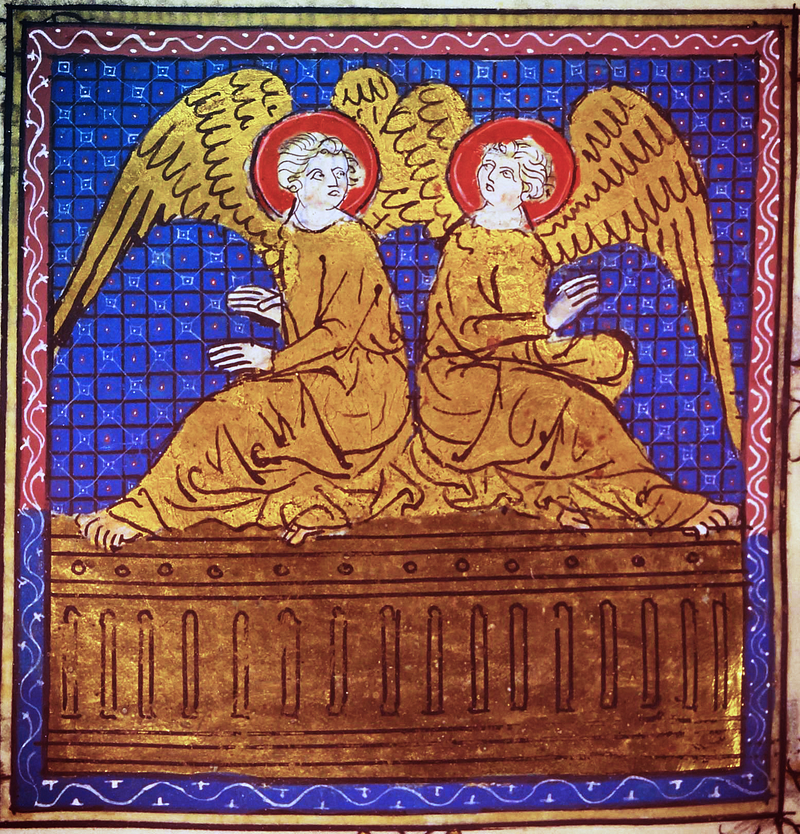
Illustration of the Ark of the Covenant from the Bible Historiale by Pierre le Mangeur c.1178 (gallica.bnf.fr / Bibliothèque Nationale de France; public domain; color enhanced)

In ancient Israel, a visit was required three times a year to the Temple to “behold” God, as we learn in the Bible (Exod 23:17; Deut 16:16). One might like description of such a remarkable experience, and there is a passage in the Talmud—which more than one commentator has pronounced “curious.”

We’d imagine people in Jerusalem filing into a building understood by them to be a nexus between Heaven and Earth. Within, in a golden room called the Holy of Holies, is the Ark of the Covenant. Over it hover the cherubim, mighty winged angels.

“In the midst of two living creatures you will be known,” says Habakkuk 3:2. To be an Israelite would be to understand that, from between these figures, the voice of the Creator had been heard.
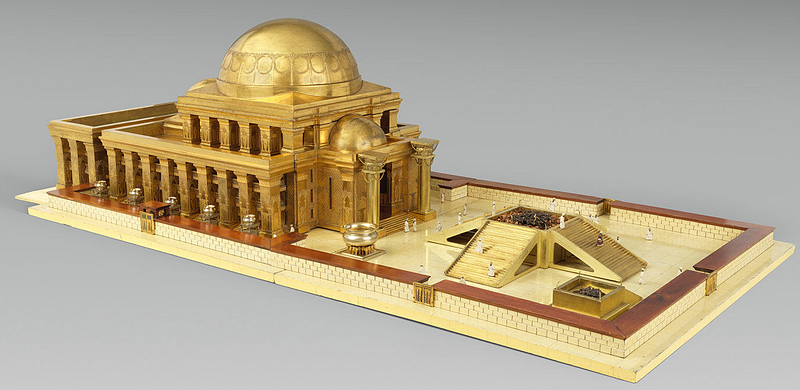
Thomas Newberry, model of the temple of King Solomon in Jerusalem (1883; public domain)

The Bible speaks of two sets of cherubim. The first are found back in Exodus 25:20, fashioned under Moses’ watchful gaze. These rest upon the Ark, and “face” each other, as their wings “spread” over it.

Later, Solomon had made a second, larger pair, free-standing it seems. Details are available in 1 Kings 6:23–28 and 2 Chronicles 3:10–13. As the latter passage reads: “For the Most Holy Place he made a pair of sculptured cherubim and overlaid them with gold.”

They are perhaps fifteen feet tall, with wings noted to be about seven and a half feet. They touch, “wing to wing.”

The positions of the second, larger cherubim are different from the earlier ones. In 2 Chronicles 3:13, they are “facing inward.”

The New Testament may have information about the cherubim. In Hebrews, 9:5, we read: “Of these things we cannot now speak in detail.”

This has struck some readers as unusual. “We do not know how to account for this failure to describe them, especially as all other articles connected with the tabernacle are minutely described,” notes James M. Freeman in Manners and Customs of the Bible (1874).

Artists over time have done illustrations of four cherubim found in Solomon’s temple, like Thomas Newberry’s miniature model done in 1883, on display at the Metropolitan Museum of Art.
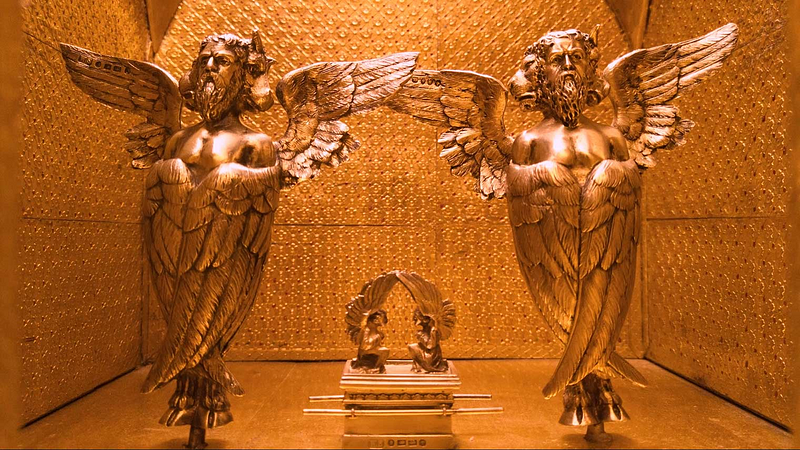
Thomas Newberry, model of the temple of King Solomon (1883; public domain)

But then, the Talmud’s description…

The passage reads:

“Whenever Israel came up to the Festival, the curtain would be removed for them and the Cherubim were shown to them, whose bodies were intertwined with one another, and they would be thus addressed: Look! You are beloved before God as the love between man and woman.” (b. Yoma 54a)

Rabbi Louis Jacobs unpacks the scene:

“A curious Talmudic legend has it that the cherubim in Solomon’s Temple were in the form of male and female. When the Israelites came to the Temple on pilgrimage, the curtain in front of the Ark was drawn aside and the cherubim were seen interlocked as if in sexual congress. This was said to be a miraculous indication that God’s love for Israel resembles the love of man and woman.”

Scholars puzzled over the scene. Raphael Patai, in The Hebrew Goddess, understood that both men and women had been able to view the cherubim, and afterward “used to mingle and commit what is euphemistically referred to as ‘lightheadedness’,” which he thinks was really “an orgiastic outburst of sexual license.”

A study of the sexual cherubim was done by Eugene Seaich, titled A Great Mystery: The Secret of the Jerusalem Temple, published in 2008.

He discusses a range of hints, as when Philo, the Jewish sage, believed the two figures of cherubim to represent the male and female principles, and offered that what was seen in the Holy of Holies was “the beginning and end of happiness.”

A later scene in the Talmud, Seaich notes, seems to reflect the sexual idea. This would be dated later — when the First Temple was ransacked by Babylonians.

“When the heathens entered the Temple and saw the Cherubim whose bodies were intertwisted with one another, they carried them out and said: These Israelites, whose blessing is a blessing, and whose curse is a curse, occupy themselves with such things!” (b. Yoma 54b)

Then a midrash had preserved a story in which the invaders gloat over the statues they have found.

“and they took them and put them in a cage and went around with them in all the streets of Jerusalem and said, ‘You used to say that this nation was not serving idols. Now you see what we have found and what they were worshipping’” (Lamentations rabbah, proem 9)

A similar scene might even happen when the Second Temple is sacked by Roman troops, as narrated with curious vagueness by Josephus, the Jewish historian:

“And last of all Titus Caesar, have conquered us in war, and gotten possession of our temple, yet have they none of them found any such thing there, nor indeed anything but what was agreeable to the strictest piety; although what they found we are not at liberty to reveal to other nations.” (Contra Apion 2:7).

Was there support in rabbinic thought?

Rashi, writing in the eleventh century, had believed the cherubim were “joined together and were clinging to, and embracing each other like a male who embraces a female.”

The “spreading” of their wings had reminded some of the language of marital intimacy in passages like Ezekiel 16:8 and Ruth 3:9, where the husband “spreads” his cloak over the wife.

The Zohar, the mystical text of Jewish interpretations, seems to affirm the idea: “The Cherubs, when Israel was with merit, were face to face, entwined with each other…” (2:278a).

Isaac Luria added: “From this we learn that where there is no union of male and female men are not worthy to behold the divine presence.”

It recalled, for some, a possible conceptual backdrop around biblical narratives: God and Israel are married. The Song of Songs, an erotic narrative, has often been seen as speaking of their bond.

There were, however, problems with the Talmud’s scene. Weren’t the cherubim hidden away in the Holy of Holies, accessible only by the High Priest? From descriptions, one wouldn’t seem to have been able to lift a curtain to see them.

Scholars, on occasion, discuss the Talmud’s story

André Villeneuve, in Nuptial Symbolism in Second Temple Writings, the New Testament and Rabbinic Literature (2016), thinks:

“it is not impossible that the Talmud may have preserved elements of an authentic historical tradition in its account of the embracing cherubim in the Second Temple.”

He traces how the Bible describes Israel as a ‘woman’, as in Ezekiel 16:8, who ‘marries’ God. The wedding would be the scene on top of Mount Sinai.

Villeneuve writes:

“The implication is that while the children of Israel were in the desert during the Exodus, they were bashful and could not yet directly look at the Shekhinah, the awesome visible presence (panim) of God. Once settled in their land, however, Israel reached sufficient maturity and familiarity with her divine Husband so that she could feast her eyes upon Him.”

Rachel Elior had some analysis of the Israelites going to see the sexual cherubim. She writes:

“The description in the Talmud, therefore, suggests a cultic, mystical representation of myths of hieros gamos, the sacred union or heavenly matrimony, probably in the context of the pilgrimage on Shavuot, the festival of the Covenant and the occasion on which the Chariot Throne of the cherubim is revealed.”

And there is plenty of discussion of erotic language around the Israelites, and the Temple, as the figure of a woman. In Ezekiel 23:17, after all, God calls Solomon’s Temple the “bed of love.”

Julie Galambush writes in Jerusalem in the Book of Ezekiel: The City as Yahweh’s Wife: “If the city is a woman, then the temple is her vagina…”

Could there be further suggestion in the New Testament?

Jesus is called the “bridegroom,” as human followers are the “bride of Christ.” The dream is being “united” to the messiah, or “one” with him.

Seaich writes:

“Indeed, though it is largely been ignored by modern believers, this divine male-female paradigm has been a critical part of Israel’s soteriology for countless centuries…”

Is there a hint in 1 John 4:8? “God is love.”

Religion
History
Christianity
Judaism
Bible
Recommended from ReadMedium