
And Then the Wind Blew: Living & The City that Care Forgot
Notes on the environmental diaspora from NOLA
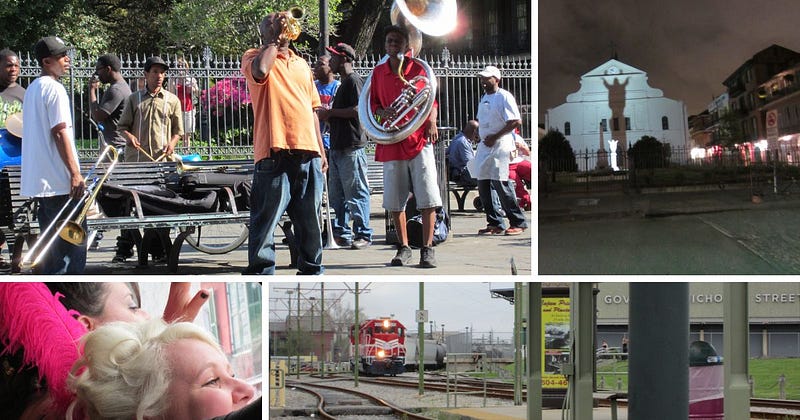
I became interested in “guesting” in Hurricane Katrina’s aftermath in late August 2005.
Let’s define guesting as staying in a domicile that isn’t your lease or mortgage for at least one day. And while vacations and family gatherings play a part, adventures as guests often happen because shift happens.
Separation, divorce, birth. A romance. Vocational opportunity. A job loss, fire, a foundation cracks. A time of transition and deep emotion. Personal growth wrapped up in a learning experience. Again!
At the time, I lived in a repurposed voodoo temple above the 9th Circle bar, across from Armstrong Park. A garret space that dreamed of being a studio apartment. Such are the wages of the writing life: the apartment held palmetto bugs so big that the worn floors trembled when the roaches rambled. For the Kafka-obsessed amongst us — palmettos aren’t your typical roaches. No. They’re much, much bigger — and they can fly.
Have you ever looked back at your life story and wondered what if? It wasn’t foresight or prescience to be out of town the week this incredibly vibrant, lovely, corrupt slice of Valhalla lay moldering in the fuggy heat — it was flashy, extravagant, dumb luck.
“Jerry, you think people live up there?” Tourists cricked their necks up at our balconies ornamented with beads and life-size voodoo dolls with massively swollen appendages (which my enterprising, hard-thinking/drinking neighbors displayed in barter for beers with the bar in the lower level. Absolutely.
I was a week away from moving into a room opening up in a grander, more glorious apartment. So I took a brief trip and was lurking in Berkeley, California, awaiting the keys to the new digs. One disaster away from discovering what roots are made of and how far they go.
My once and future roommate rode out Hurricane Katrina and the FUBAR aftermath in the apartment, living on crackers, potato chips, cookies, dry granola, cola, and warm beer as he looked out his duct-taped windows. It’s the stuff he usually lived on — but he became too sad and left without a po-boy or fresh Hubig pie to round out his diet.
So, the back end of a NOLA round trip was exchanged for an Austin one-way. Why Austin? Reasons to spend time in this relaxed college town include music, brewing, the scenery, and the college libraries/indy bookstores. There’s wild and wet lake/river/arroyo action. People shout out, “Hook ’em horns!” and throw hand signs all day and twice on Sunday. The sun filters green-gold through the canopy of trees. The tacos. The sun tea. Homemade peach cobbler served warm with ice cream. This is where Richard L. came up with Slacker. Austin is a personal default zone.
Webpages, phone trees, and emails went up, linking people offering temp housing to New Orleanians who’d escaped NOLA and were now high and dry. The world opened its hearts and homes. Wrap your mind around that! The generosity, stamina, kindness, organization, and slight insanity of people who took in bedraggled strangers boggles the mind, and I’m eternally humbled, surprised, and delighted by it.
Individuals who saw a problem and worked to improve the world, one person at a time — which translated to me, on their futon. (Hey there, fantastic Austinites!) That couch tour was booked with people who lived their activism — literally taking people into their lives and homes — and was life-altering in that it was one where Team Human won big in our shared response and our humanity.
Images of tired, bedraggled, scared/angry/sad/mad people beamed worldwide. Many viewers had an emotional connection/personal experience with a town that gets shout-outs as The City That Care Forgot. Hurricane Katrina was, some might argue, the first harbinger of “extreme weather events.” Or, at least, the first that was shown in real time.
People who’d broken bread and kegged beer together — who’d had crawfish boils, held hurricane parties, sat in one another’s audiences, and danced at weddings and second lines were dispersed like the fog in the bayou, slipping into cracks big enough to take a person, a couple, 3 out of 8 family members.
Trauma stories, getaway songs, black mold-stained heirloom recipe books — wade in the water. A lifetime’s possessions and memories. And that tree? That big one, the oak that sheltered a family under its lengthening branches. That tree survived, and some —
Shell-shocked and under-packed, we were taken in by strangers. I still feel such gratitude for their kindness, a generosity that can never be repaid but can only be carried forward.
Tossing and turning in strange sheets is an invitation to contemplation. That experience is remembered with an intensity of the senses. Part of it was the adrenaline rush, but every moment is etched precisely in memory
What happened to the Katrina refugees in the long term? We ended up all over the map. And you don’t need to be a weathercaster to understand which way the wind blows — or why one Katrina refugee (self-bestowed title) maintains an emergency bag stashed at the back of his closet. Another has border-hoarder proclivities, while another is a committed and house-proud minimalist.
And those New Orleanians who were often the most underprivileged in a poverty-stricken urban area — without access to laptops and cars and cash — died on rooftops and attics while waving to choppers that flew past their hand-made signs painted to share their desperate knowledge: We are here.
The experience of physical dislocation yet using technology as a grounding tool — I mean, beyond the usual quotidian shopping, dating, and porn — shows how people can (and do) use techno for good.
You might think sleeping on a stranger’s sofa as the city that birthed the art form of jazz went underwater would put one off travel, but the effect was the opposite.
The desire to move about has grown, and the experience has built a feeling of kinship with people on the move. Seeing a bag filled with all the accouterment of the “digital nomad” — the capsule wardrobe, the emergency novel or three, odds and ends, and unique talismans — fills me with hope.
Do you have a story of when you were a guest and someone showed you generosity, kindness, or care? Or have you aided others?