
And The World Has Come Together at Last: The Will and The Way Meeting
Or at least for this Russian roulette-gamble we’re all in!
Never before has the world be so interested in working together as a whole. Never before in the field of science, at least. I can remember the ‘We are the world’ movement, when the — mostly western — world became aware of how little we knew about the tragedies happening in remote places; how oblivious many of us were.
Maybe it was that I was very young back then to have been paying close attention; maybe it was that sometimes the news was not so widely spread, much less in real-time as today. If you’re so young you don’t know what I’m talking about, check the link … You may at least recall your parents singing the song.
There have been other instances where we DID know about things happening… but chose to overlook because those things did NOT touch us — and by no means am I saying that I believe it was morally or ethically correct to choose to ignore those things simply because they were so foreign to me. Foreign metaphorically speaking and geographically, indeed. No, I now know it was not the right choice. Sorry.
- What am I referring to? Ebola, for one. There was plenty of coverage on the news, but it was way too far away, and unless you were living in an African country, you felt SAFE. Not only did you feel safe, you truly were. Really, what were the odds of catching ebola living on a different continent and hemisphere, right? None, so it was not that we (the rest of us outside those ebola-stricken countries) didn’t care, it simply was lightyears away, completely abstract.
- Something similar was the case with HIV/AIDS. I happened to be living in San Francisco in 1980, and I remember the uncertainty felt everywhere. Then and there, the feeling of dealing with the unknown was similar to today’s, but at the beginning, it was clearly restricted to certain groups, even considered minorities: Mainly gay men and/or injected-drug users. Then it spread because of other parallel behaviors and circumstances, but — let me say that again, however ugly and embarrassing typing it is — if you were not in such groups, you were SAFE. We shouldn’t have been unconcerned about our fellowmen… but safe we were.
Doctors and scientists have had their challenges dealing with these illnesses and others, sometimes in a state of emergency to stop other pandemics from growing, as well as preventing them from ever breaking out. That’s the will.
Let’s not leave out the other part of the equation: The people with the power — political, economic — to make that research possible and to make vaccines and medication available. Because science by itself cannot do the trick of saving mankind, you know. Whether we like it or not, the pharmaceutical industry is a business… and that is the way.
With other illnesses, stakeholders have needed a great deal of lobbying and negotiation to get the will meet the way. But the novel coronavirus and Covid-19 has made everyone interested in fast-tracking it all. The way for the search, the discovery, the findings, the production, and the availability to all has proven to be less selfish than ever before, and the will more ardent; more urgent. The will and the way equally desperate.
So, individuals, institutions, pharmaceutical companies, governments, all have opted to go for it at full speed, hoping to find both vaccines and treatments ASAP.
And this reaction is only proportional to the action of the virus: It CAN be lethal, or not; it CAN be detectable, or not; one CAN catch it on a plane while vacationing, or on the bus to work. An elderly CAN become infected and survive, and yet a young marathon runner CAN die within hours. Why is this? What is this?!
The ugliest part: It’s still too novel for scientists to know enough, to figure it out. Potentially lethal to ALL, yet likely harmless to MOST. There’s just a limited number of measures we can ALL follow… but maybe — who knows — not enough. That’s why it feels like Russian roulette, you see? Whether you are, indeed, a responsible individual does not guarantee full immunity.
I have read posts where the comment is that we are all on the same boat. It is true in that everybody is at risk, regardless of our income, where we live, where we go, what our faith is (if at all), our race, gender, current health, age — the age and health exceptions have been too many to ignore the fact that even if you’re young and healthy, you are not necessarily safe… I disagree in that it’s not quite accurate that we all are on the same boat: A few are on yachts, some on boats; most on shaky rafts.
We are all in the same sea, though. The same sea.
Nobody is safe until everybody is safe.
Dr. Hans Kluge, WHO
Tragedies — natural or provoked by man — happen all the time: Hurricanes, monsoons, earthquakes, fires, flooding, oil spills, terrorist attacks, famine, war… Most people do feel something in their guts when these things occur. We light up candles, we pray, we donate money, we volunteer for others.
Sometimes we cry for ourselves because the tragedy involves us and our loved ones. We then learn to survive and make do and stand up — once more — and we feel thankful for the help received from afar. It’s our turn to be prayed for and cried for.
This time we are all in the same sea and the survival of one is the survival of all. We have been forced to come together, so we must do our part — however small it is, like staying home, washing our hands, wearing a mask — and look forward to the medical solution that can block the shooting trigger, hopefully for good.
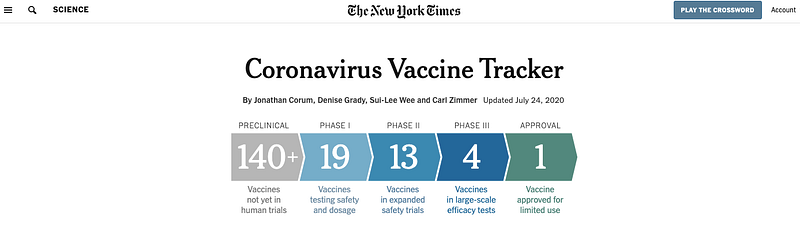
New York Times full article, updated July 24, 2020: