
And Just Like That, GPT-4 Becomes a Model of The Past!
The King is Dead RIP GPT-4 Claude Opus #1 beats GPT-4 & Mistral Large. It’s Insane How Cheap & Fast It Is!
How to Get Rich with Investing (without Getting Lucky)
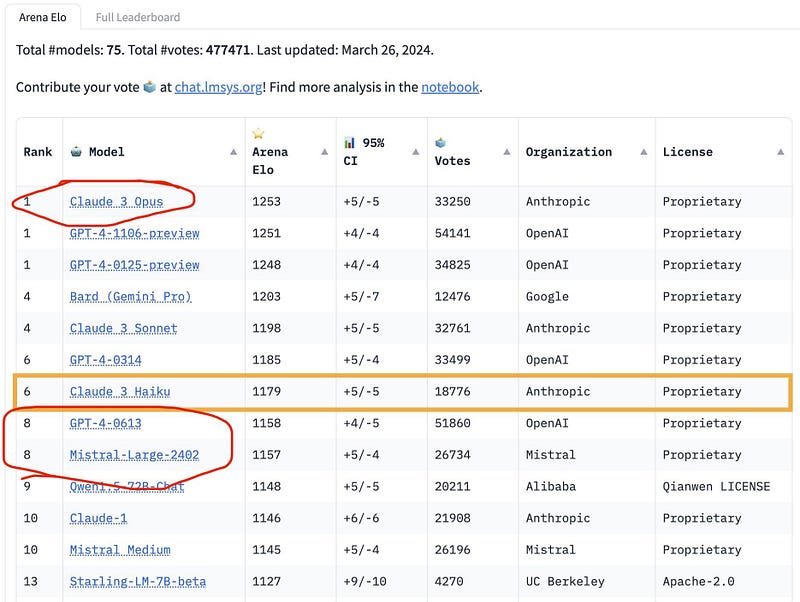
Claude 3 is good!
On March 4th, 2024, Anthropic, a leading AI research company, introduced the world to the Claude 3 model family.
This new suite of models, comprising Claude 3 Haiku, Claude 3 Sonnet, and Claude 3 Opus, marks a significant advancement in the field of artificial intelligence.
Each model in the family offers varying levels of intelligence, speed, and cost efficiency, catering to a wide range of applications.
Also, to read:
New Claude 1st impressions: Feels really good.
Free tier sonnet is MILES ahead of GPT-3.5
Absolutely smashing my test coding questions Opus vs GPT4 is harder to judge.
Will need to play around with it more, but OpenAI has competition!
Claude 3 Models: A Leap Forward
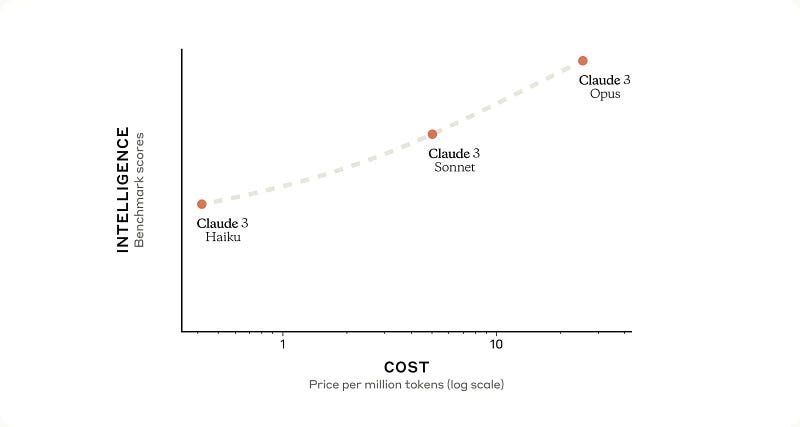
1. Claude 3 Opus: The Pinnacle of AI Intelligence
Opus, the most advanced model in the family, sets new standards in AI performance.
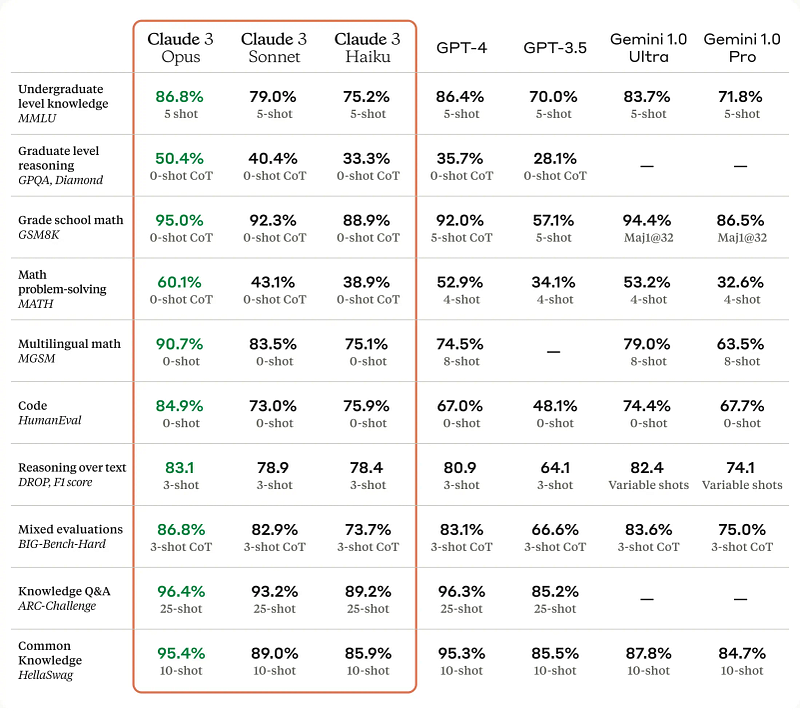
It excels in a variety of benchmarks, including undergraduate and graduate level knowledge, basic mathematics, and more, showcasing near-human comprehension and fluency.
Its capabilities extend to intricate tasks, offering enterprises a powerful tool for complex problem-solving.
2. Claude 3 Sonnet: Balancing Speed and Intelligence
Sonnet is designed for rapid response tasks, being twice as fast as its predecessors while maintaining higher intelligence levels.
This model is ideal for applications requiring quick information retrieval and decision-making, such as sales automation.
3. Claude 3 Haiku: The Fastest and Most Cost-Effective
Haiku, set to be available soon, is noted for its exceptional speed and cost-effectiveness.
It can process dense research papers in mere seconds, positioning it as the go-to model for applications demanding instant responses.
Enhanced Features and Capabilities
Vision Capabilities
All three models possess advanced vision capabilities, able to process various visual formats.
This feature is particularly beneficial for enterprises with knowledge bases in diverse formats like PDFs and flowcharts.
Reduced Refusals
The new models demonstrate a more nuanced understanding of user requests, reducing unnecessary refusals and showing improved contextual comprehension.
Accuracy and Trustworthiness
Accuracy improvements are evident in Claude 3 models.
Opus, for example, has shown a twofold increase in correct answers on complex factual questions.
The upcoming feature of providing citations will further bolster the models’ trustworthiness.
Long Context and Recall
The Claude 3 family boasts a 200K token context window, with the potential for expansion to over 1 million tokens for specific use cases.
Their recall ability is exceptional, evident in the ‘Needle In A Haystack’ evaluation.
Advancements and Limitations
Claude’s capabilities are not just limited to text generation.
Its proficiency in coding, even with smaller models like “Haiku”, is notably superior, outperforming larger models from other developers.
This is a significant achievement, reflecting the model’s efficiency and advanced understanding.
Furthermore, Claude has scored highly on benchmarks such as the “Hella Swag Benchmark”, which assesses common sense reasoning in everyday situations.
However, there are aspects where Claude lags.
Its image analysis capabilities, for instance, do not surpass those of Gemini Ultra in the math benchmark.
This indicates that each AI model has unique strengths and weaknesses, making them suitable for different applications.
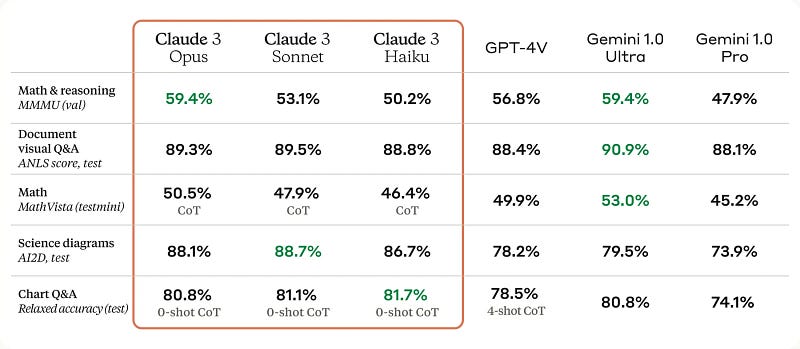
Each AI model has unique strengths and weaknessesDespite its impressive capabilities, Claude comes with limitations.
Unlike ChatGPT, it lacks a direct app, code interpreter, or sandbox environment, which are significant drawbacks for developers.
Furthermore, it lacks integrations and the user interface, though aesthetically pleasing, misses key features like conversation path forks and a seamless user experience.
Another critical factor is the cost. Access to Claude’s Opus model comes with a $20 monthly fee, adding to the already growing subscription costs for various AI services, which could be a deterrent for some users.
Concluding Thoughts
The introduction of Claude has shifted the landscape dramatically.
With the release of the Claude 3 model family, Anthropic has pushed the boundaries of AI capabilities, reaffirming its position as a leader in AI innovation.
With its release, users have noticed significant improvements over previous models, including GPT-3.5 and GPT-4.
One of the most striking features of Claude is its performance in code generation and understanding.
Users have reported that even its free tier, named “Sonnet”, far surpasses the abilities of GPT-3.5, especially in handling complex coding queries.
Moreover, Claude’s larger variant, “Opus”, has been a tough competitor for GPT-4, indicating that OpenAI now has formidable competition in the AI space.
While GPT-4 and its predecessors have laid a solid foundation, the emergence of models like Claude challenges the status quo, pushing the boundaries of what AI can achieve.
Sincerely,
The Pareto Investor


