
And Darkness Was Upon the Face of the Deep
Day zero: A reexamination of the prologue to the seven days of creation

1 In the beginning God created the heaven and the earth. 2 And the earth was without form, and void; and darkness was upon the face of the deep. And the Spirit of God moved upon the face of the waters. (Gen 1:1–2 KJV)
When I read this, I see an encrypted text.
Matter and Space
There isn’t much to this section, which gives us the opportunity to examine it in detail. We begin with the creation of heaven and earth. The heavens are black, given that light hasn’t been created yet. This being the case, the earth is suspended in an area of black nothingness. God creates something and also creates the area of nothing that surrounds it.
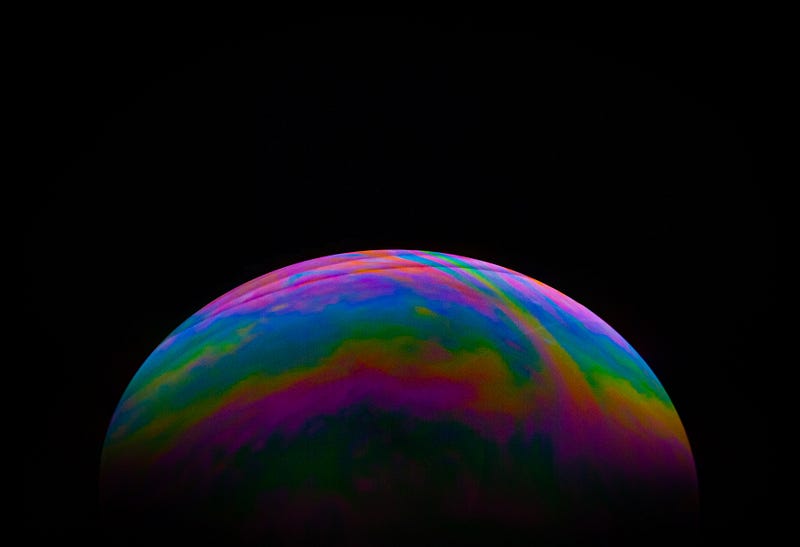
The earth is described as formless and empty, but if the earth is covered in water as the text implies, then it would seem that the description of the earth might actually be a reflection of the heavens above; formless and empty.
The text reads as though the earth is covered in water, but there is only darkness on the waters. So let us assume that the world is covered in ice.
While we are assuming, let’s call this a Snowball Earth event, but one even earlier than the Huronian glaciation which occurred between 2.4 billion to 2.1 billion years ago. I am suggesting that the text is describing a scene closer to 4.5 billion years ago.

The Sun was just beginning its lifecycle, while the earth was nearly recovered from its latest swarm of meteorite impacts …
… which likely vaporized much of Earth’s crust and upper mantle and created a rock-vapor atmosphere around the young planet. The rock vapor would have condensed within two thousand years, leaving behind hot volatiles which probably resulted in a majority carbon dioxide atmosphere with hydrogen and water vapor. Afterwards, liquid water oceans may have existed despite the surface temperature of 230 °C (446 °F) due to the increased atmospheric pressure of the CO² atmosphere. As cooling continued, most CO² was removed from the atmosphere by subduction and dissolution in ocean water, but levels oscillated wildly as new surface and mantle cycles appeared.¹
Please note that the text above taken from Wikipedia is in reference to a later, much larger impact with an object named Theia. Still, I believe that the general facts hold true given a meteor swarm of sufficient size. I will return to the Theia Impact hypothesis in a later article.
This early earth had sustained many impacts which, in time, resulted in an ocean of water covering the planet’s rocky core. As the sun had yet to really get going, the earth simply continued orbiting while it remained a frozen snowball of stone.
Wind over Earth
Then the text tells us that the spirit of God moved over the face of the waters. How does that fit into this whole idea that the text is describing some Snowball Earth situation?
Spirit is breath, so it reads like God is blowing on the waters.

I’m rather familiar with the I-Ching and this may seem like a stretch, but that looks like the description of a hexagram to me.
A hexagram is formed by placing one trigram on top of another. There are eight trigrams and they are a combination of elements and natural features. Each trigram is formed by three lines which are either whole or broken.
Earth ☷, Heaven ☰, Fire ☲, Water ☵, Mountain ☶, Lake ☱, Thunder ☳, and Wind/Wood ☴.
In this description of the spirit of God moving over the face of the waters, I see a hexagram formed by the trigram of Wind/Wood over a trigram of Water.
To those who consider applying the I-Ching to the text of Genesis to be ridiculous, consider a few points. The I-Ching dates from the late 9th century BC, while Genesis was written in the 5th and 6th century BC in Babylon during the Achaemenid Empire. The trade route that would in time become known as the Silk Road ran near Babylon and there is evidence of Egyptian trade in Chinese silk dating from 1070 BC.
Given the above, there was ample time and opportunity for knowledge of the I-Ching to move from China to Babylon in the four centuries between the publication of the I-Ching and the composition of the Genesis account.
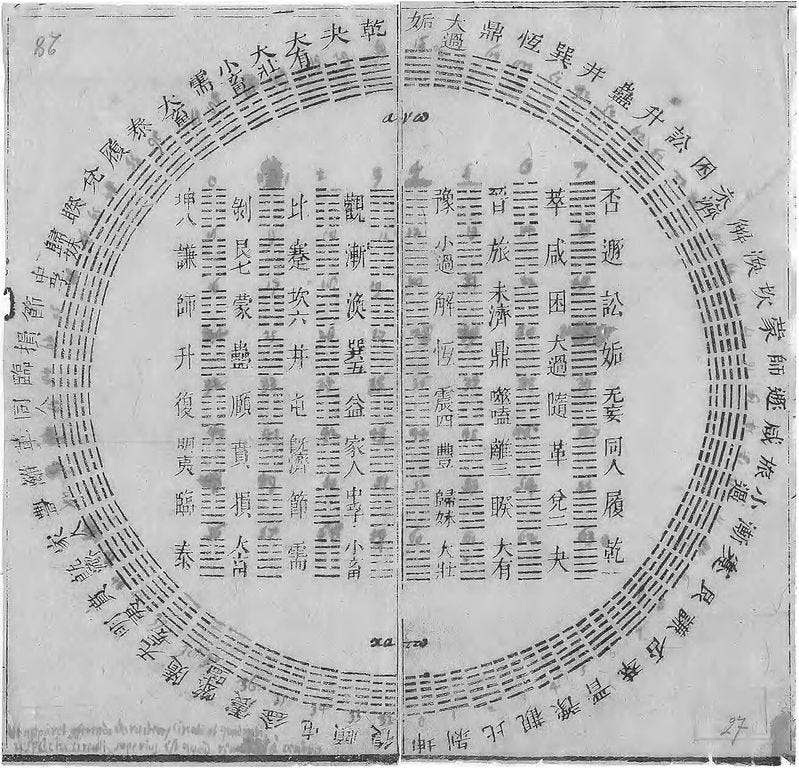
Back to Hexagram 59. The name of this hexagram is Dispersal. I am going to quote directly from Wilhelm-Baynes' 1950 translation of the I-Ching, which has finally entered the public domain.
THE IMAGE
The wind drives over the water: The image of DISPERSION. Thus the kings of old sacrificed to the Lord And built temples.
In the autumn and winter, water begins to freeze into ice. When the warm breezes of spring come, the rigidity is dissolved, and the elements that have been dispersed in ice floes are reunited. It is the same with the minds of the people.
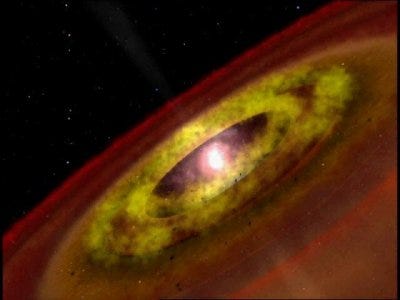
Wind over water describes the coming of warm wind that breaks up the winter ice. This matches quite closely with my reading of this section of the text as referring to conditions on earth in the period leading up to the initial ignition of the sun.
Our sun began its life as a typical T Tauri star, which means that it erupted into an extremely active early phase with an intense solar wind before settling down after a few million years into a regular G-type main-sequence star.
Perhaps it was that intense solar wind that was being referenced by the spirit of God moving over the face of the waters.


_-_WGA2772.jpg)

