
Ancient Tombs, Occult Rituals, and the Mysterious Magic of the Written Word
To write is to remember.
What kind of world would it be if we knew everything?
There are lots of ways to have a peak experience. Anything sufficiently massive can pull you out of yourself, out of the petty concerns of a single organism in a buzzing universe.
Mountains and oceans and endless prairie skies can all give you a taste of the feeling astronauts get when they look down on the precious blue bauble of the earth from the blackness of space. Awe is underrated. Without it, we wither and wilt like ragged flowers that no bee visits.
But it’s not just the astonishing beauty of the natural world that can expand our consciousness. The long span of human history does the job just as well. In the moody hush of Notre Dame or on the sunbaked sand of the Colosseum, you feel the passage of centuries not as an oppressive weight that pushes you down to earth, but as a vast river that carries you along with it, sweeping you away from the everyday and into the realm of the sublime.
Really, the more time that has passed, the better. The oldest buildings in the world baffle us. The lives lived by the people who built them are largely alien to us. But not completely.
They still looked like us. They loved like us. They felt hunger and thirst the same way we do, and worried about their children and their parents and their pets. The wonder lies somewhere in there, in the contrast between how much the world has changed and how little people have.
And the more mystery, the better. The less we know about the lives of those who lived before us, the more free our imaginations are to roam.
That’s why I find myself in these places. Dank underground caves. Starry-skied temples. Dusty palaces fallen into ruin, where bored ticket sellers and the occasional feral cat watch disinterestedly as I wander through the wreckage.
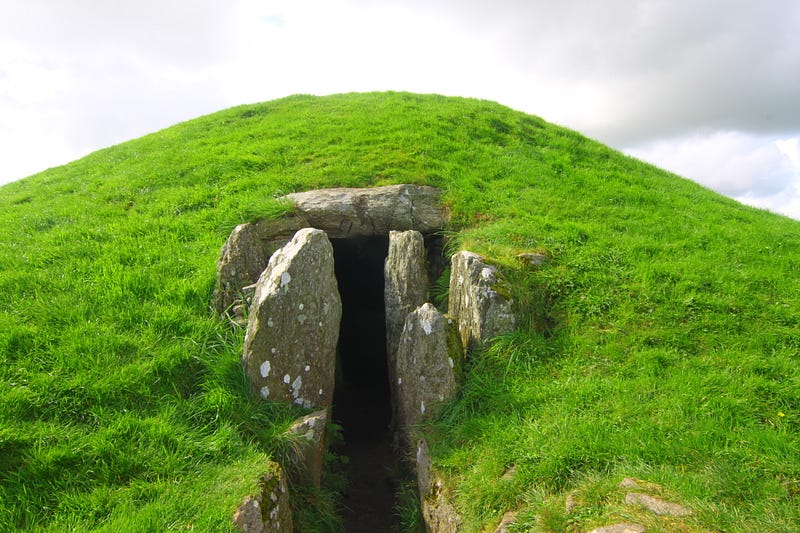
That’s how we found ourselves at Bryn Celli Ddu.
On the island of Anglesey just off the north coast of Wales, this tomb goes back 6000 years. We assume whoever was buried here must have been important to justify the labor involved in quarrying and carving the massive stones and setting them up in alignment with the sun and the stars.
But we don’t know anything about them. Their lives come to us through the medium of bones and stones, the calcified fragments that can survive the corrosive passage of millennia. These people wrote nothing down.
We do. The most literate culture that has ever existed, we tend to believe that nothing happened unless it was recorded. We live our lives that way, projecting the present moment into the wild crossfire of the future, living in reverse as we watch ourselves in a technological magic mirror.
Writing changed the world forever, allowing a person to communicate knowledge across time and distance. Every form of communication that has followed is simply a variation on that theme.
I’ve never been to Jerusalem.
Hopefully one day I will. But until I do, research will have to fill the gap.
At the Western Wall, people write notes to God and slip them into cracks between the ancient foundations. If you can’t make it to Jerusalem yourself, there are even companies that will let you fill out a note online and stick it between the stones for you. Rabbi Shmuel Rabinovitch personally places hundreds of letters addressed to ‘God, Jerusalem’, in the Wall every year.
This practice has been going on since perhaps the 18th century. It doesn’t take a genius to see that if it continued unhindered, the wall would soon be bristling with notes, multicolored scraps of paper bursting out of the rocks and blowing like a tornado through the sacred city.
No.
It’s somebody’s job to come along once in a while and pull all the prayers out of the holy Wall, sweep them up, and burn or bury them. It probably doesn’t matter. God — sorry, G-d — ought to be able to read even a note that has been destroyed.
But still, we write down what’s in our hearts so that the universe doesn’t forget.
I saw it on a TV show.
A ritual of repentance. Of forgetting. A way to balance lopsided energies. And though I generally despise superstition, I have a healthy respect for ritual.
Besides, I had a heavy heart at the time. I’d taken a path that didn’t suit me, and I didn’t know where to go next. I’d have tried anything.
It works like this.
You take three scraps of paper and write down your biggest mistake. The sin you struggle to forgive yourself for.
One scrap gets burned. One goes into the sea. And one gets left at the top of a mountain.
For all I know, it’s still there. Tucked away in the raftered roof of an abandoned fire tower, safe from wind and rain until the tower itself collapses. Or maybe someone has found it already. A tiny scrap of paper in the handwriting of a stranger, tattooed with some mundane sin of interest to no one but me.
It worked though. Magic or not. The surest way to remember something is to write it down, and that vanished scrap of paper torn from a long-since discarded notebook has pursued me ever since.
Making sure I not only redeemed my mistake. Making sure I never make the same one again. I don’t want to have to climb that mountain a second time.
There is nothing more enticing than mystery.
We have no idea what kind of beliefs the people who built the megalithic tombs held. The modern-day witches and neopagans who pretend to their heritage are as clueless as the professors.
But when you visit Bryn Celli Ddu, you’ll find small offerings tucked into the rocks of the dim and mossy burial chamber. Coins. Sprigs of holly. Feathers. Ridged shells from the nearby sea. Tiny traces of the world outside, to remind the vanished dead of the life they left behind.
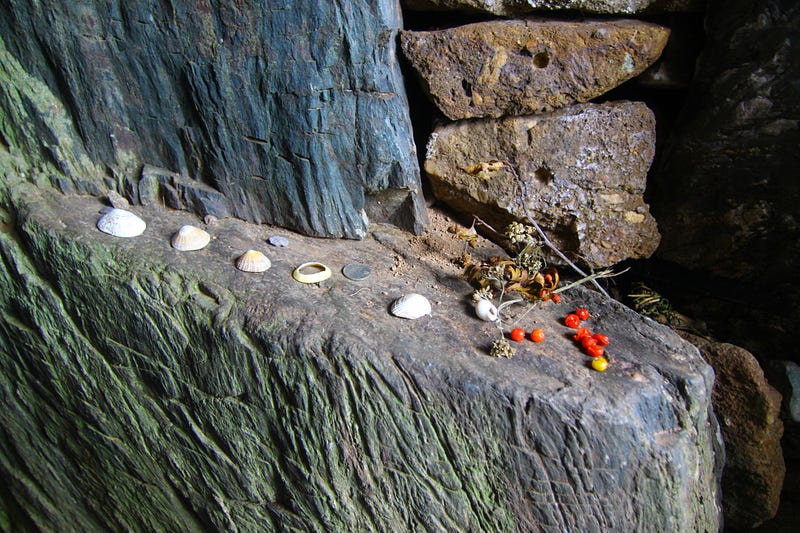
Even the vandals have some respect. They scratch their names into the modern concrete beams that hold up the dangerous ceiling. But they leave the original stone walls their ancestors built untouched.
And among the cold stones, pieces of paper slowly disintegrate in the damp air. Messages and prayers to forgotten gods. Words of thanks and of desperation. Petitions and praise.
A folded piece of paper, its edge ruffled by cycles of damp and dryness, crackled like a fallen leaf in my hands. Hello, unicorns, it read in the careful hand of a child. Thank you for letting us visit your beautiful place. Please help Auntie Deb get better.
The language changes, but the words stay the same.
The nameless dead who built this tomb and every other tomb in the world wanted what we do. Peace. Prosperity. Good health. A little more time with the people that they loved.
And when their prayers were granted, they expended enormous amounts of labor to build stone tombs with primitive tools so that the dead would have a place to rest.
They didn’t write anything down. But we do. Because the written word, the arbitrary symbols we’ve mutually decided mean something, carries a weight out of all proportion with its physical mass.
Because we have a superstitious belief that words endure, and that even once destroyed, they still matter. Because for all our scientific knowledge and technological advancement, we still believe there is magic in writing things down.
There is. Because now, like G-d in Jerusalem or the horned and starry-eyed deities of Bryn Celli Ddu, you’ve heard the prayers of a stranger. You don’t know Auntie Deb, but if you have any heart at all, you’re now hoping that she did get better.
You’ve become part of the long slow story of this deathless tomb and the human lives that buzz in and out of it like bees in search of pollen.
If I’ve done my job right, you’ve come away with a scrap of that pollen sticking to your coat.