
Ancient India: The Citadel of Disaffection
How Jainism, Hinduism, and Buddhism trump Western religions
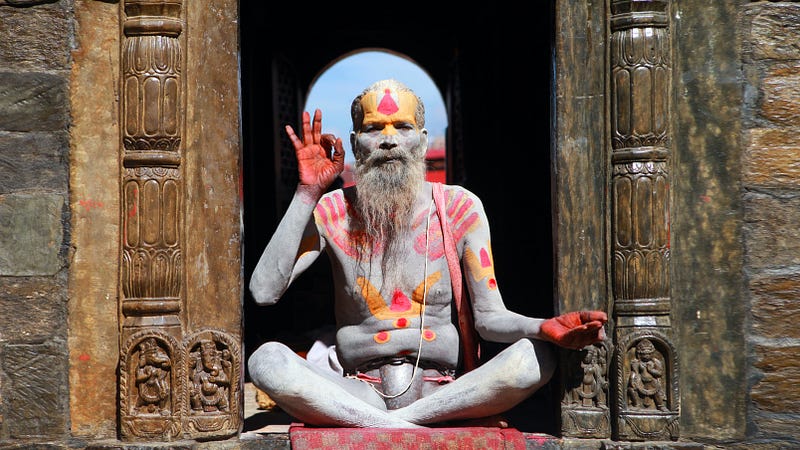
In the history of religion, the transitions from animism, through polytheism and henotheism to monotheism amount to a gradual ensconcing of God in a sacred domain which is supposed to be impervious to our profane machinations.
In the Jewish case, which informed Christianity and Islam, this theological move was motivated by the peculiarities of Jewish history: Jews were perennially on the bottom in contests of realpolitik, but they discovered a way to salvage their pride in their culture, by using the literary character of a transcendent God as a symbol of their tragic righteousness. Just as the ancient Jews were aloof and alienated from dominant societies, such as Assyria, Babylon, and Macedonia, their myths and legends promoted an image of God as being divorced from the natural order.
For Jews the oneness of God didn’t entail mystical monism or pantheism; instead, the sacred had to be kept separate from the profane, the pure from the impure, and goodness from evil. That duality was forced on Jews initially not so much by prophetic revelations, but by the inescapable political reality that throughout Jewish history, the strong had dominated the weak.
The source of religious alienation in India
Yet Indian alienation dwarfed the Jewish variety. Hinduism, Jainism, and Buddhism feature a more thoroughgoing sense of righteous estrangement, the cause of which wasn’t India’s religious history, but the depth of its sages’ religious experiences, known as “enlightenments” or “awakenings.”
Curiously, though, Indian religion began in a rather Jewish state, in the form of the Brahmanic, Vedic religion, which originated “in the Indus Valley Civilization after the Indo-Aryan Migration c. 2000–1500 BCE.” Just as the priestly class of Jews, led by Ezra and Nehemiah absorbed Zoroastrian ideals during the end of the Babylonian captivity, rewrote their scriptures, and imposed monotheism on pre-exilic Israel, the Brahmanic class, or Aryans, imposed Vedic religion on the rest of India, creating a caste system.
“Belief in the authority of the Vedas was encouraged by the priestly upper class — Brahmins — who could read Sanskrit, the language of the Vedas, whereas the lower classes could not. The Brahmins’ unique position further enhanced their reputation but, eventually, brought about calls for reformation as people objected to this one class dictating religious precepts for all.”
According to Britannica, Jainism and Buddhism developed during the Axial Age, in the mid first millennium BCE, along with
other belief systems that renounced the world and opposed the ritualistic Brahmanic schools whose prestige derived from their claim of purity and their ability to perform the traditional rituals and sacrifices and to interpret their meaning. These new religious perspectives promoted asceticism, the abandonment of ritual, domestic and social action, and the attainment of spiritual illumination in an attempt to win, through one’s own efforts, freedom from repeated rebirth (samsara).
In any case, while Jews projected their alienation into the messianic future, when the Day of the Lord would taunt the profane order with an apocalyptic display of the sacred one, there being only hints of the latter in ritualistic obedience to God’s commandments, Indian religious alienation derived from more available theophanies.
The Jewish prophets could supposedly hear God’s voice, but Indian religions developed therapeutic systems for overcoming our inherent mental limitations and for acquiring peak states of awareness. The Vedas were supposed to have codified the divine Word that all sages hear for themselves because the universe is simply talking to itself via those inner illuminations. That is, the world’s driving force, Brahman, informs its wayward manifestations — such as confused persons who deem themselves distinct — of their divine essence.
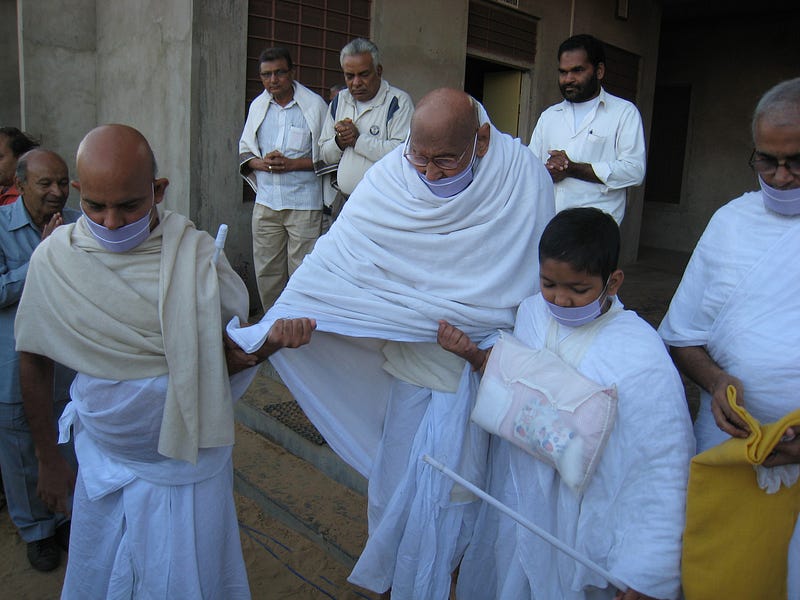
Jainism
Indian religions begin, then, with Jewish-like distinctions between ritualistic purity and impurity, and between high and low castes (comparable to Jews as the chosen ones versus the goyim, the effectively unchosen). But the reformed Vedic religion would incorporate a deeper duality, one between confused, mundane experience and clarity about the world’s nature. In short, India was more philosophical than ancient Israel.
Contemplations of how Brahman’s oneness ends up with the apparent plurality of the natural order led not just to Jainism’s theodicy (which was comparable to Orphism and to later, Western Gnosticism), but to ascetic practices. According to the theodicy, or the explanation of apparent “evil” or metaphysical lowness, we each have a divine spark of consciousness which is obscured by karmic debts of materiality that cling to our mind, clouding it with distractions.
Our spiritual, enlightened task is to resist natural inclinations, to free ourselves from the karmic prison. Essentially, we should stop behaving like animals — following our genetic code and our egoistic compulsions to harm or to seduce others out of ignorance, aggression, or lust — and recognize our transhuman potential.
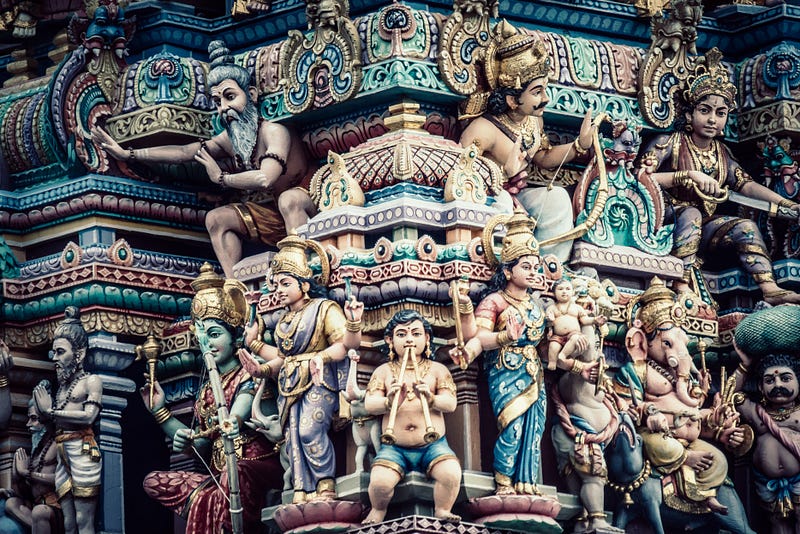
Hinduism
Hinduism itself is a sprawling edifice of compromises that was designed to harmonize the Vedic religion and the caste system with the later mystical and philosophical innovations. The Hindu modus operandi is to reconcile the seemingly irreconcilable by drawing a thousand and one distinctions and hierarchies.
Thus, in Hinduism there are:
- four stages of life (asramas: student, householder, hermit, and wandering ascetic stages)
- four life goals (purasharthas: economic values, pleasure, righteousness, liberation)
- five main castes (priests, warriors, landowners, servants, untouchables)
- four components of yoga (postures, regulation of breathing, relaxation, and meditation)
- four cyclic ages or yugas
And so on, and so forth. Moreover, ancient Indian philosophies are as multifaceted and deep as ancient Greek philosophy, and Hinduism encompasses all these schools.
Rather than holding up some simplified creed or series of dogmas as the final truth, Hindus regarded all symbolic expressions as misleading compared to epiphanies, the latter being direct, immediate grasps of profound truths.
Notice, though, how strained some of the Hindu hierarchies are since they include secularism and asceticism in a rank ordering of priorities, stages, and the like, as though everything has its proper place and is unfolding according to Brahman’s will.
This Hindu inclusiveness is unstable since once you imply, at least, that one stage is better than another, you allow for the urgency of moving upward in the hierarchy of options, in which case the hierarchy can look like a less compromising system.
Just as in Christianity you have the unsaved and the saved, with no middle ground, in Hinduism you have the implicit distinction between the misled slave and the liberated sage. Still, the Hindu impulse is to resist alienation, to bury the Jain/Orphic/Gnostic imperative of escaping natural slavery and ignorance and of returning to our inherent godlike state of knowing reality, beneath a labyrinth of convenient, often self-serving half-measures.
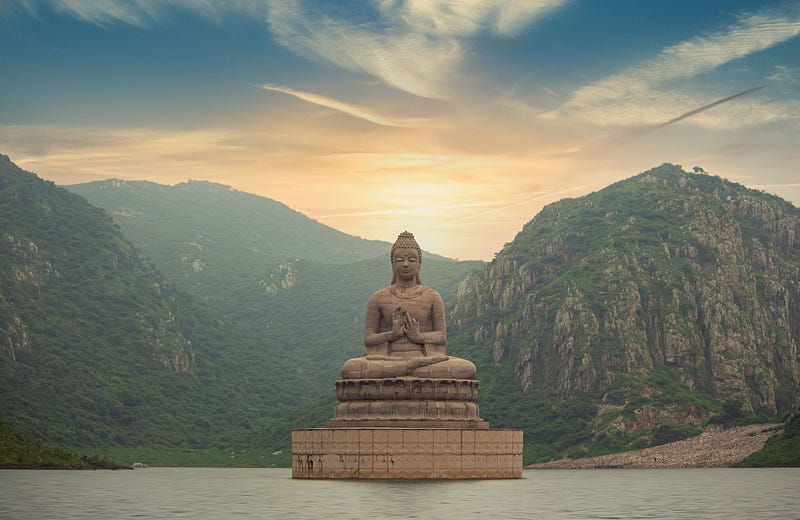
Buddhism
Buddhism was meant to reform not just Jain asceticism but Hindu complexity. The Buddha saw a simple middle path, one that set aside the mortifications of the body and the ontotheological speculations.
For the early Buddhists, religion should be a simple therapy for minimizing suffering, and the therapy begins with the insight that the personal self is an illusion. Rather than just accepting that as a declaration, you’re supposed to discover the superficiality of your mental independence by noticing firsthand that nothing contains your flow of thoughts. We suffer in life because we attempt to satisfy our automated cravings, which attempt is a fool’s errand.
The Buddhist ideal of nirvana, though, has an ambiguous relation to estrangement. Nirvana is a state of inner death within life, the quieting of the mind so that the awakened sage no longer mentally associates with personal or social matters as such.
The buddha doesn’t feel alienated, of course, but that’s only because in no longer identifying with her spontaneous thoughts and feelings, she just lets everything happen, like the Stoic, so that her heart, as it were, is no longer in the game. A buddha’s involvement in society should compare to that of a zombie or of a lobotomized person, except that while the buddha still undergoes mental states, she no longer cares about them. She just lets them come and go without personally attaching to them.
Still, Buddhism is meant to overcome another form of alienation, namely the kind that holds between deluded minds that view themselves as entirely independent, as opposed to being interdependent. For Buddhists, everything is causally related to everything else, so egoism and the pursuit of mastery are based on the lack of that ecological or cosmic perspective. We can suffer alienation, as well as loneliness, anxiety, hatred, and numerous other negative emotions when we cling to the image of our personal (metaphysically autonomous) identity. And the enlightened Buddhist who means to help free others is known as a bodhisattva.
In any case, in Indian religions there’s a yearning for moksha, for release from natural or mental imprisonment, and that yearning entails some state of profound alienation. There are three pillars of Indian religious alienation:
- one level of reality is supposed to be estranged from another, as when nature’s plurality misleads us and distracts us from our superhuman potential
- the sage is implicitly divorced from duped commoners
- or the bodhisattva wants to free slaves to craving from their implicit alienation from each other.


