
Anatomy of an Edgelord
The trolls of the Internet serve an important function in our society
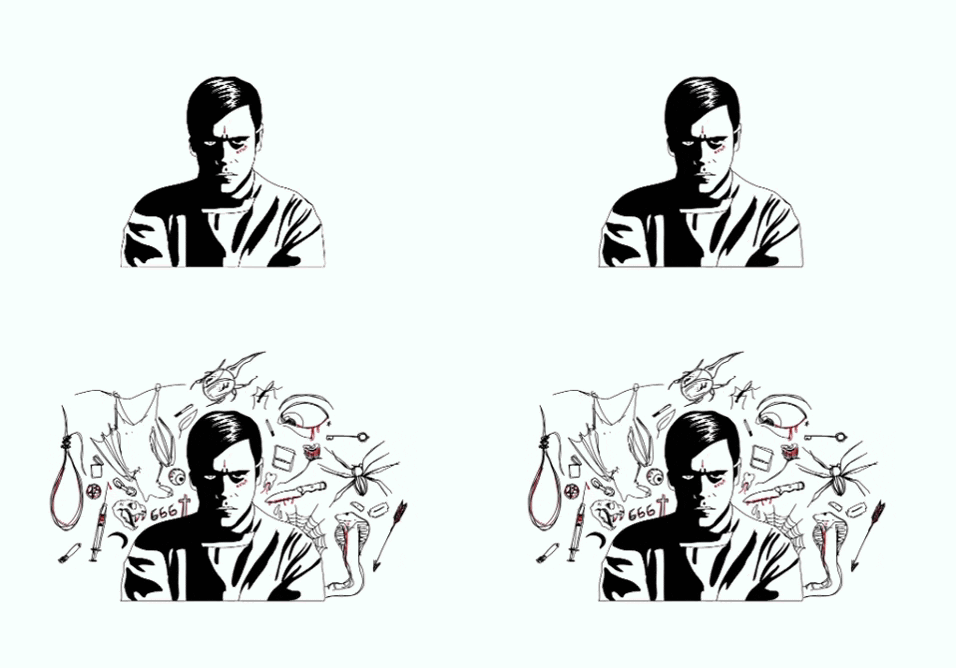
“One must still have chaos in oneself to be able to give birth to a dancing star.” — Friedrich Nietzsche
The word edgelord was first added to Urban Dictionary in 2015. An edgelord is “someone on an internet forum who deliberately talks about controversial, offensive, taboo, or nihilistic subjects in order to shock other users in an effort to appear cool, or edgy.”
But edgelords have been around a lot longer than 2015. Most of us probably remember the kids in high school that wore all black, used racial slurs, and wrote poems about Hitler. The men at parties that tried to play “devil’s advocate” and bait people into arguments about women’s voting rights or eugenics. The women that worshiped Charles Manson and sent letters to serial killers in prison. That one guy who’d always ask, “Has anyone here not seen Meat Grinder?” The creators of Something Awful. Young men who tried to scare women on dates by putting in a DVD of Antichrist or Salò before snuggling close.
Everywhere you go it seems like there’s a veritable choir of people who sneer, jeer, cough, mock, and jab at genuine emotion. If you get upset around the edgelord, you’ve lost. You’re feeding the vampire. The stereotypical Internet-era edgelord has a desperate desire to upset other people, while also demeaning anyone who does.
Many famous artists, philosophers, and writers could also be considered edgelords. The Marquis De Sade wrote most of his works of sexual sadism and torture as sort of anti-enlightenment screeds. He didn’t believe in the so-called goodness of humanity and wanted to show our worst impulses. Nietzsche railed against Christianity and German Nationalism, both considered sacred tenets of his time. Andres Serrano was the artist who created “Piss Christ,” which was a photograph of a plastic crucifix submerged in a jar of his urine. Then there are writers like Dennis Cooper, Edward Lee, Bret Easton Ellis, Ferdinand Celine, and Jack Ketchum. But whether or not these are “edgelords” is really a matter of perspective.
I’d also posit that a straight up criminal is NOT an edgelord. The Columbine murderers Eric Harris and Dylan Klebold appeared to be stereotypical edgelords right up until the point they committed mass murder. Lars Von Trier could be considered an edgelord, but John Wayne Gacy is not. To be an edgelord requires playing by the most important rules of society, or you become something else entirely. Edgelords may flirt with the law — like Banksy does — but they are not murderers, rapists, straight up sociopaths, or war criminals.
If one is a “successful” edgelord they’re usually called transgression, a contrarian, or a provocateur. “Edgelord” is often used as an insult for someone who is trying to be cool and edgy but misses the mark, blundering into straight up courageousness.
To try to get up to the edge of provocation means that you’re risking showing your ass at any moment. In order to do something honest and blunt, you have to risk offending people. If you do something “edgy” some people will think you’re refreshing and honest, while others just think you’re beating your chest and hollering for attention.
The work of a true edgelord can carry a statement, but there’s also a sort of ugly undercurrent. A stinging, filthy, dirty desire to upset and offend. The spectrum of the edgelord runs from “Says something offensive to a woman on the street” to “Gets a Ph.D. in philosophy just so they can write an entire book railing against philosophy Ph.D.s.”
I could also probably be considered an edgelord. I’ve certainly been called it more than once. The Crooked God Machine is probably my most edgelord piece of fiction. I get a sick sense of satisfaction out of offending people’s sensibilities, and although I try to write things that are meaningful, sometimes I just want to provoke people to feel something, to get pushed to their limits. If you want people to sit up and pay attention sometimes you have to shock them.
But sometimes in my desire to be provocative, I’ve just fallen off the cliff right into asshole territory. That happens to a lot of people who are trying to push boundaries, especially ones as impolite and assertive as I am. When that happens I just try to make a note that I took it too far and move on.
If we take apart the edgelord we often find someone who’s dissatisfied with life. Someone who’s a little ugly (either internally or externally). A little strange. The edgelord is rarely a well-adjusted member of society. They’ve often had abuse or a chronic unfairness in their life. They often have mental illness as a result of trauma, or have been in a horrific accident. They’re rarely the top 20% of society — men and women with good teeth and doe-eyed, symmetrical faces. Most people don’t become edgelords when things in life are working out for them.
And sometimes they’re just kids or young adults testing the waters of what it means to be human. They’re trying to get a reaction out of people because they don’t understand their place in the world, or others’. So they’ll act cringe. They’ll wear Matrix coats, say awful things, pick fights, read grotesque and profane texts. They’ll write “God is Dead” on the blackboard or get sent home from school for wearing a swastika. Eventually most of these people will become well-adjusted members of society, but at first they need to understand that the appeal of just offending everyone is short-lived, and any burst of dopamine you may get from the act is quickly overshadowed by the fact that nobody really likes someone who just wants to piss everyone off.
Our prefrontal cortexes don’t really fully develop until the ages of 25–28. If you look back at things you did in your youth with cringing embarrassment, you can probably be forgiven. Your brain wasn’t fully developed.
But the work of the edgelord is important. We need to understand the boundaries of our own disgust. We need to be brought right to the edge of darkness. We need to sometimes watch movies like “Cannibal Holocaust” or read Dennis Cooper’s “The Sluts” to understand that we really never want to see or read anything like that ever again.
We push right up to the edge of darkness so we understand how far we can go before we can’t see the light anymore.
To most people now there’s something really comical about “Piss Christ.” It’s a little too on the nose. A little too simple. But to a religious society it could be profoundly disturbing and disruptive. If you believe that the plastic Jesus is a representation of God on earth, then submerging Jesus in a bottle full of urine would be a profound and flagrant act of blasphemy.
Sometimes the edgelord just makes us roll our eyes. Sometimes they’re too inappropriate to be tolerated.
But sometimes they hit a nerve. They disturb the very existential ground we walk on. They make us question our existence. They deeply wound us in the places inside of us we tried so hard to protect.
There’s something really interesting about the human animal — our psychological soundness seems to be as important to our survival as food, water, shelter, energy. We need to have a theory of life and our purpose in it. We need to believe in God, or the lack of God. We need to try to understand the overreaching blackness and mystery that seems to surround our existence. Even the dumbest or most lackadaisical people usually have some opinion on God and where we came from.
If our psychological structures aren’t tested by the outside darkness then we become weak and brittle. If we’re not certain of who we are and our place in the world, then we may become recruited for any cause or scam that comes our way. We may try to chase God inside of cults, MLM schemes, drugs, and bad relationships — only for God to always disappear right when we think we’ve found him.
The edgelord is an important part of the societal ecosystem. Even when the edgelord does his job badly, he teaches us where our societal boundaries lie. If someone makes an edgy joke about Hitler at the Holocaust museum then we feel justified in kicking them out onto the street. If someone wants to make a dead baby joke to a woman that just lost her infant son, we immediately know they’ve crossed a line. Those edgelords have basically thrown themselves on their own swords. They’ve gone over the edge completely. They serve as examples for the others on where not to step, and why.
And when the edgelord does his job well he can take us right to the edge of the darkness, and dance with it. Never quite going over and tumbling down into the abyss, never quite saying something so egregious and inappropriate that they’re outcast from the group. They’re like a star on the periphery of our vision, a brightness that causes black spots. They make us feel electric, teeth set, lively, both nihilistic and hopeful at the same time. A tesseract of conflicting emotion that folds and enfolds itself, over and over again.


